

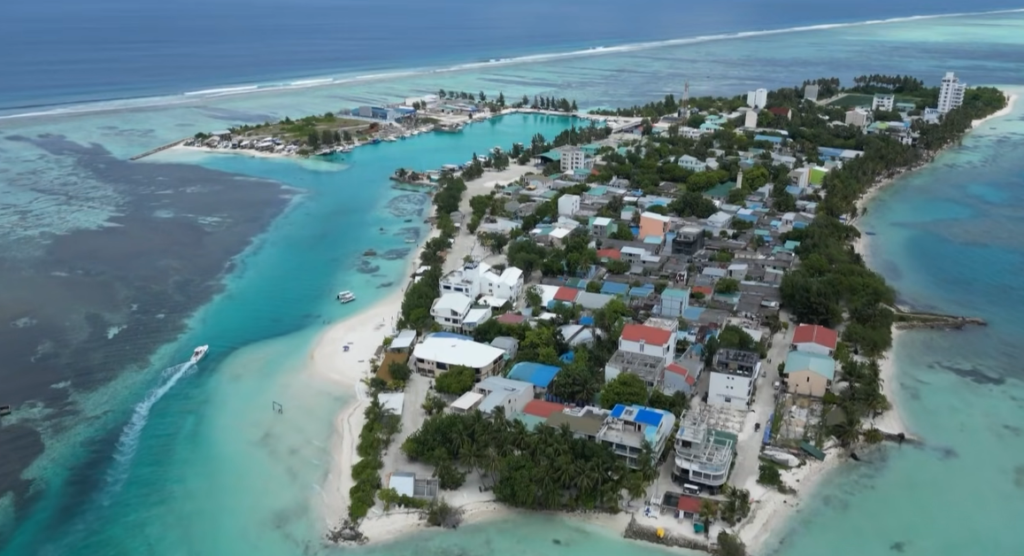
The Maldives’ capital, Malé, seems to be constantly under construction. Under a sun so bright it flattens shadows, workers in reflective vests and flip-flops carry rebar while concrete mixers churn next to turquoise water. Cranes continue to reach upward as though height alone might provide protection, despite the fact that the island is so small that it can be traversed in less than 30 minutes.
The sense of urgency is clear. Almost 80 percent of the Maldives is below one meter above sea level, and estimates indicate that by the middle of the century, a large portion of it may become uninhabitable. Observing the waves crashing against the seawall that encircles Malé like a belt, one gets the impression that this barrier serves as both a confession and a defense. Because the threat is no longer hypothetical, it exists.
In response, the government has built extensively. Northeast of Malé, the man-made island of Hulhumalé rises higher than the surrounding natural islands. As a “city of hope,” it was built with elevated roads and fortified coastlines to withstand rising sea levels. One could envision a future in which locations such as these are essential to survival as one strolls through its well-kept streets, past recently planted palm trees, and past vacant apartment buildings that are just waiting for occupants.
Hulhumalé, however, is merely a component of the scheme. Developers are building a floating city offshore, a $1 billion project that will house 20,000 people in dwellings that move with the ocean instead of against it. The buildings’ geometric arrangements, which draw inspiration from coral formations, subtly acknowledge nature while trying to outsmart it. It appears that investors think floating infrastructure may move from being an experiment to a necessity.
| Category | Details |
|---|---|
| Country | Maldives |
| Capital | Malé |
| Average Elevation | About 1 meter above sea level |
| Islands | 1,192 coral islands |
| Major Climate Threat | Sea-level rise, coastal erosion |
| Key Project | Maldives Floating City (5,000 homes) |
| Economic Dependency | Tourism contributes about 40% of GDP |
| Climate Risk Projection | Up to 80% of islands may be uninhabitable by 2050 |
| Official Reference | https://maldives.un.org |
An additional layer of urgency is added by the fact that tourism accounts for about 40% of the economy. In an attempt to maintain the appearance of permanence, upscale resorts are now using imported sand to reinforce their beaches. Seeing workers restore shorelines that visitors believe were always there has a slightly surreal feel to it.
The Maldives’ first line of defense, coral reefs, is deteriorating. Widespread bleaching brought on by warmer ocean temperatures has made reefs brittle and less able to absorb wave energy. Dead reefs provide little protection, but healthy reefs can significantly reduce wave force, according to scientists. Whether restoration efforts can keep up with the warming seas is still up in the air.
These days, engineering and nature coexist. They’re replanting mangroves. Artificial intelligence-powered early warning systems are being installed to notify locals of impending storms. These systems buy time, but they don’t prevent catastrophes. Here, time seems to be the most precious resource.
However, not everyone agrees with the approach. Controversy has been raised by land reclamation projects, which dredge sand from the ocean floor to create new islands. Some locals lament that the new land lacks the marine ecosystems that once flourished there, making it seem lifeless. Hotel owners in Addu Atoll saw their beachfronts turn into expanses of man-made sand, which, ironically, drove tourists away from the ocean.
In addition, there is the financial strain. A sizeable amount of the Maldives’ national budget, which could be used for economic development, hospitals, or schools, is spent on climate adaptation. Even though adaptation is vital, it may be changing the priorities of the country in ways that will affect future generations.
Construction is still ongoing in spite of this.
Disclaimer
Nothing published on Creative Learning Guild — including news articles, legal news, lawsuit summaries, settlement guides, legal analysis, financial commentary, expert opinion, educational content, or any other material — constitutes legal advice, financial advice, investment advice, or professional counsel of any kind. All content on this website is provided strictly for informational, educational, and news reporting purposes only. Consult your legal or financial advisor before taking any step.
