

The realization that something truly unique is taking place at the University of Southern California occurs somewhere between learning that Solange Knowles has been named USC’s first-ever scholar-in-residence and discovering that the school’s journalism department is introducing a course titled The Creative Enterprise: Learning from Cactus Jack. This isn’t a university that updates its curriculum covertly. This seems more like an institution making the conscious decision to rethink what constitutes appropriate education.
The Rossier School of Education at USC has long held a particular, esteemed position in academic life, producing educators, administrators, and policy thinkers. However, over the past few years, a much more restless vision has emerged from the larger university ecosystem. The campus, which is located in the University Park neighborhood of Los Angeles and is surrounded by the city’s peculiar mix of chaos and ambition, appears to have made the decision that creativity is not a supplement to serious academic work. It serves as the basis.
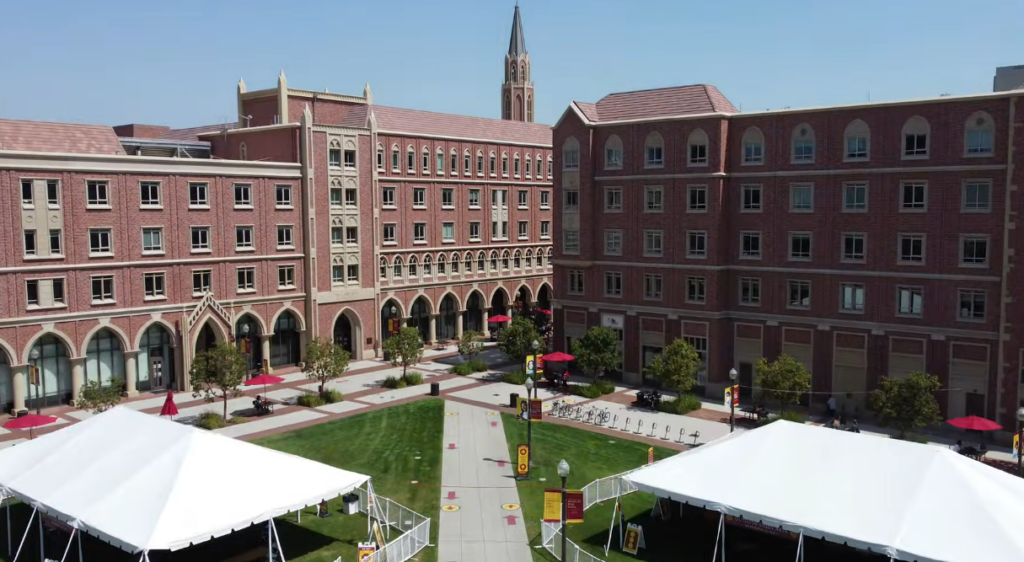
You can see how carefully this has been built by taking a stroll around the USC campus. Tucked away in the Leavey Library’s basement, the recently opened Digital Creative Lab was created with direct student input and isn’t the kind of institutional afterthought that colleges occasionally implement. It’s a signal. USC Arts is the same. The university’s broad interdisciplinary arts initiative now publicly states that its goal is to “inspire all students, no matter the field, to engage with the arts as a way of being and thinking.” It may not seem like much at first, but that final phrase—a way of being and thinking—is doing more work.
The unique combination of forces the university has been able to bring together is what makes USC’s strategy noteworthy. The Thornton School of Music, the Kaufman School of Dance, the School of Cinematic Arts, and the Roski School of Art and Design comprise the deep infrastructure. These are not ornamental additions to the resume of a research university. They create performers, directors, and composers who go on to influence real culture. According to most accounts, the faculty members are not scholars who speculate about creativity from a distance. They seem to genuinely incorporate their professional life experiences into their teaching.
Conversely, there is a willingness to try new things that don’t always feel comfortable but consistently yield intriguing outcomes. The then-radical notion that play and curiosity could be the catalyst for learning rather than an impediment to it served as the foundation for the PlayMaker School concept, which actually has some roots in USC’s own engineering department more than ten years ago. The questions posed by the educators who contributed to the development of that model are still urgent: shouldn’t schools be fostering deeper skills like real thinking, real creative problem-solving, and real resilience if a student can find any fact on a phone in twenty seconds? That question may be more pertinent now than it has ever been.
It’s simple to write off the celebrity appointments—like Solange and the Cactus Jack course—as marketing. And perhaps a portion of it is. A more intriguing interpretation, however, is that USC views creative professionals as legitimate intellectual partners rather than as objects to be showcased. It’s not a gimmick to think that a musician with Solange Knowles’s unique sensibility, whose work lies at the nexus of art, politics, and personal mythology, has something to teach upcoming educators about vision and expression. That is a philosophy of the curriculum.
Perhaps more than most universities, USC appears to recognize that students entering its doors in 2025 will be entering a world that demands true creative agility. Not only technical proficiency and knowledge, but also the ability to think in uncharted territory. There are no simple answers to the questions of whether this campus’s incredibly innovative curriculum can grow, withstand financial constraints, and continue to be truly experimental rather than merely labeled as such. However, the attempt itself is worth closely observing as it takes place against the expansive and complex backdrop of Los Angeles.
Disclaimer
Nothing published on Creative Learning Guild — including news articles, legal news, lawsuit summaries, settlement guides, legal analysis, financial commentary, expert opinion, educational content, or any other material — constitutes legal advice, financial advice, investment advice, or professional counsel of any kind. All content on this website is provided strictly for informational, educational, and news reporting purposes only. Consult your legal or financial advisor before taking any step.
