

They initially thought the microscope had malfunctioned. A platinum strip as thin as a human hair was being tugged rhythmically 200 times per second in a vacuum chamber at Sandia National Labs. As predicted, small cracks appeared along the stress lines over time. Surprisingly, though, the fissures did not deepen. They were gone.
As the fractured metal bonded itself back together, scientists stared in amazement. No obstruction, no glue, and no heat. Atoms simply realign, form a link across the opening, and seal a tear, just like a muscle fiber does after being strained. Despite being long-theorized, the phenomena had never been observed in real time. In astonishing fashion, Dr. Michael Demkowicz of Texas A&M’s prognosis from ten years ago has just been confirmed.
The consequences go well beyond a single laboratory. These weren’t superalloys with unique treatment, nor were they magical materials. The experiment was first conducted with pure platinum and then again with copper. Stress, nanoscale structure, and an ultra-clean vacuum—conditions that enabled spontaneous cold welding—were the exact combinations that set off the self-healing.
The behavior of metal surfaces varies at this small scale. Their atoms are free of impurities and may form a straight link when brought close enough; no heat from outside is needed. Cold welding is especially useful in space, where conventional repair techniques are ineffective, because of this atomic intimacy. For this reason, experts now think that this finding could be extremely helpful in creating spacecraft that can repair themselves while in orbit.
| Key Fact | Details |
|---|---|
| Discovery Location | Sandia National Laboratories and Texas A&M University |
| Metals Involved | Platinum and Copper |
| Process Observed | Nanoscale cold welding under repeated mechanical stress |
| Environment | Room temperature, vacuum chamber, no external intervention |
| First Observed | 2023 (published findings in Nature journal) |
| Key Mechanism | Cold welding and atomic reorganization at crack sites |
| Possible Applications | Self-repairing infrastructure, spacecraft components, fatigue prevention |
| Future Research Focus | Scaling to everyday alloys like steel, real-world conditions |
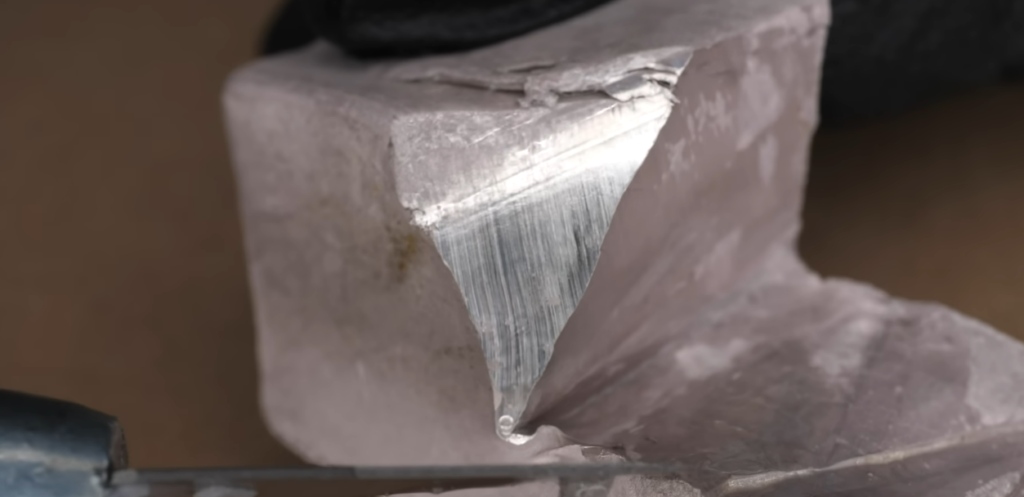
One can easily envision the potential applications of this on Earth. bridges with the ability to detect and close their own microfractures. engines that regenerate internal cracks prior to their expansion in order to prevent fatigue damage. surgical implants with a longer lifespan that recovers from stress. The idea of fixing metal the way we fix skin, which previously looked like science fiction, is now a plausible prospect.
The science relies on a deeper comprehension of disclinations, which are metal structural flaws that produce strong internal stress fields. Long written off as insignificant, these disclinations seem to be the cause of the reversal. When cracks meet at specific grain boundaries, they compress and merge rather than spread under tension.
Demkowicz’s simulations for years implied that this kind of behavior would occur. Many in the field, however, continued to be dubious, maintaining that metals need high temperatures in order to rearrange at the atomic level. This real-time observation completely alters that presumption.
I stopped reading the research notes in the middle and pictured a city bridge that, after thousands of daily tire impacts, gently healed itself overnight. I couldn’t shake the mental picture.
The discovery’s low energy requirements are what make it so novel. No external power source is present. no manual involvement. No additional chemicals. It’s a self-sufficient reaction to mechanical stress—a sophisticated, flexible system that has the potential to completely change the way we construct and maintain our infrastructure.
The research is early, of course. Only under vacuum, in certain metals, and at the nanoscale have the phenomenon been noted. However, the way forward is obvious: reproduce the effect in real-world settings, expand it to popular materials like steel or aluminum, and finally create alloys that give priority to this behavior.
Aerospace may be the most pressing frontier. Space provides an ideal environment for these materials to flourish because of its inherent vacuum. Consider satellites that can re-weld tiny stress areas or an exploratory rover that has parts that can silently fix themselves after a bumpy landing.
From the standpoint of manufacturing, this creates fascinating new discussions. Could metal microstructures be purposefully designed by engineers to promote this healing behavior? Is it possible to deliberately incorporate disclinations, such as tiny repair kits, into the material itself?
The answers to these questions will take years. However, the discipline of materials science is already moving away from the idea that metal is a static structure and toward the idea that it is dynamic, responsive, and possibly even resilient.
Self-healing polymers and plastics have been around for a while, it should be noted. However, adding that property to metals—which are typically thought of as hard and unyielding—marks a big advancement. In terms of science as well as our definition of durability.
For metal constructions, fatigue is one of the most frequent causes of failure. Bridges fall apart. The engines break. Over time, little cracks develop—often without being noticed—until the damage reaches catastrophic proportions. However, what if it were possible to prevent such fractures before they began? What if repair, rather than failure, could be triggered by stress?
That change from damage to response might be one of the most exciting developments in contemporary engineering. It’s not just about pieces that endure longer. Trust is the key. Have faith that materials may change. Have faith that fatigue need not equate to weakness.
The discovery’s broader implications—that materials, like life, may have hidden capacities we don’t completely understand—are perhaps the most intriguing aspect. Sometimes they mend when we anticipate them to break, and other times they react to their surroundings in unexpected ways.
Despite the pop culture allusions, it’s not quite a Terminator metal. However, it’s something equally remarkable. a fracture that recovers under stress. Reversing a failure. A fresh way of thinking.
And in a subtle way, that might change the way we construct, investigate, and persevere in the future.
Disclaimer
Nothing published on Creative Learning Guild — including news articles, legal news, lawsuit summaries, settlement guides, legal analysis, financial commentary, expert opinion, educational content, or any other material — constitutes legal advice, financial advice, investment advice, or professional counsel of any kind. All content on this website is provided strictly for informational, educational, and news reporting purposes only. Consult your legal or financial advisor before taking any step.
