

On the North Carolina Central University campus in Durham, North Carolina, construction is underway. Five thousand square feet. Construction is still ongoing. However, the discussions that are already taking place within the organization about it indicate that the structure is essentially irrelevant. What counts is what NCCU is attempting to accomplish and whether it can do so before the time runs out.
The university was established in 1910 as the first public liberal arts school in the country for African American students. Over the past few years, it has taken steps that would seem ambitious for any university, much less one that has historically received inadequate funding from state and federal systems. The Institute for Artificial Intelligence and Emerging Research was established by NCCU in January of this year. In a matter of months, it announced a collaboration with OpenAI, secured $1 million from Google.org, and partnered with IBM, FICO, and Cisco. Later this year, the 5,000-square-foot facility that will serve as the institute’s permanent home is anticipated to open.
This is not the type of lineup that usually favors HBCUs, so it’s worth taking a moment to consider that list of partners. Though it’s difficult to determine how much of this partnership energy is strategic positioning rather than deep commitment, there’s a sense that the larger tech industry has finally begun to acknowledge that it spent decades largely ignoring historically Black institutions. In any case, NCCU appears committed to making use of its leverage.
The goals of the institute go well beyond campus. The plan, which was created in collaboration with OpenAI, calls for providing workshops and developer training for HBCUs across the country. If it succeeds in scaling, this could change how dozens of institutions approach AI education. PhD candidate in integrated biosciences Shantel Riddick explained how an OpenAI Academy workshop expanded her knowledge of AI workflows and challenged her perspective on integrity-driven research methods. It’s simple to write off such an individual impact as anecdotal. However, when it is spread throughout a network of historically Black universities, it becomes worthwhile to observe.
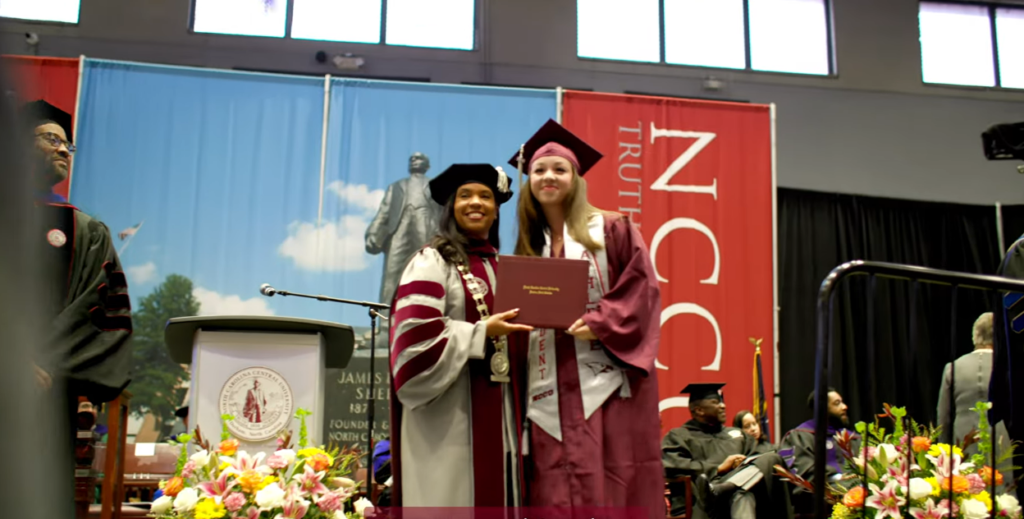
This was not an unexpected development. A little more than a year ago, NCCU opened a $38 million business school building that is outfitted with virtual reality technology, 3D printers, and AI tools. It looks like it belongs on the campus of a well-funded research university. The institute, which adds interdisciplinary courses and research tracks covering everything from cybersecurity, health sciences, assistive technologies, and AI and social equity, is the next level of that investment. The framing is intentional. These are not technical, abstract subjects. These are areas where the communities that NCCU has consistently served face actual, tangible difficulties.
In contrast, HBCUs are frequently discussed in the national media, typically in relation to funding shortages, enrollment pressure, or political threats to diversity initiatives. Presumably, NCCU is also handling all of that. However, Durham’s current situation appears to be less of an institution in a defensive crouch and more of one that has made the decision to move in the direction of something rather than just away from issues. At a recent event, Ronnie Chatterji, chief economist at OpenAI, told students that their freedom to experiment is their biggest advantage. That’s a message worth hearing anywhere, but at a university whose whole history has been an argument for being taken seriously, it resonates differently.
It’s not yet clear whether the institute will impact 200 students in its first two years, whether HBCU-wide programming will take off in the fall, or whether the partnerships will strengthen rather than wane after the press releases. It is evident that NCCU has determined that this is the ideal time to give it a shot. Getting this right is more important than the building because of the stakes for the students it serves and the institutions it hopes to bring along.
Disclaimer
Nothing published on Creative Learning Guild — including news articles, legal news, lawsuit summaries, settlement guides, legal analysis, financial commentary, expert opinion, educational content, or any other material — constitutes legal advice, financial advice, investment advice, or professional counsel of any kind. All content on this website is provided strictly for informational, educational, and news reporting purposes only. Consult your legal or financial advisor before taking any step.
