

The detection of snow falling on Mars happened silently through a laser pulse rather than with a camera click or a broad view of floating flakes. When the Phoenix lander pointed a beam into the sky close to Mars’ north pole in 2008, it was able to measure the unseen. Roughly four kilometers above the ground, tiny water-ice particles were falling from clouds and vanishing before they reached the earth.
The behavior of this type of snow differs from that of winter on Earth. To begin with, it hardly ever lands. The pressure on Mars is too low to allow water to freeze in conventional ways, and the air is too thin to support it for very long. Snowfall frequently ceases in midair, sublimating straight into vapor. Even so, it falls—covered by darkness and at temperatures as low as -190°F—covering a world that otherwise appears to be so uncompromising.
However, Mars also provides us with a very different kind of snow. During Martian winter, carbon dioxide snow, also known as dry ice, develops in the polar regions. These tiny flakes do reach the ground; they are smaller than a human hair. It falls enough, according to NASA scientists, that you could snowshoe across it, though skiing would probably need a crater’s slope.
The chemistry of this snowstorm is quite intriguing. The way water molecules connect on Earth causes snowflakes to form hexagonal patterns. Dry ice crystals, however, form fours on Mars. Cubic flakes, which are tiny, solid objects that float across a practically airless sky, are produced by that molecular structure. Under strange circumstances, a slow-motion geometry instruction is being presented.
| Fact | Detail |
|---|---|
| Snow Detected | Both water-ice and carbon dioxide snow recorded on Mars |
| Key Missions | Phoenix Lander (2008), Mars Reconnaissance Orbiter (MRO) |
| Unique Feature | Mars is the only planet where dry ice (CO₂) snow falls |
| Detection Method | Lidar (laser) and infrared sounders, not traditional imagery |
| Snowfall Zones | Poles, cold nights, under thick cloud cover |
| Snowflake Shape | Cube-shaped (dry ice), microscopic in size |
| Ground Impact | Water snow sublimates before landing; CO₂ snow reaches ground |
| Scientific Significance | Reveals Mars’ climate history and current atmospheric activity |
Through the use of extremely effective instruments, NASA’s orbiters and landers have progressively created a picture of Martian winter over the last 20 years. Snowfall hidden behind clouds can be detected by the Climate Sounder instrument on board the Mars Reconnaissance Orbiter. Up until then, scientists had only hypothesized what Phoenix’s laser—basically a Martian lidar—could confirm.
There is not a single picture of snow falling on Mars. The equipment doesn’t last long in areas where snow falls, and the sky are too dark when it occurs. Rather, scientists reconstruct the data as weather archaeologists would, deriving meaning from infrared scans, minute temperature changes, and ephemeral echoes of dispersed light.
After the snow has fallen and the frost has settled, some of the most striking pictures appear. Ridges and dunes with patchy frost, some in vivid blues and whites, can be seen in enhanced-color images taken from orbit. In one area, sunlight reflected off of translucent dry ice causes subterranean gas accumulations to erupt through the surface, sending forth fans of dark dust that resemble extraterrestrial fireworks.
When they explode at the end of winter, these geysers are more than just breathtaking sights. They indicate that sunlight, ice, and gas are actively interacting—a process that indicates a planet that is still thermally alive while appearing to be desolate.
A study about Martian soil creating polygons from water ice dividing the ground made me pause. The picture persisted. It was more than simply ice; it was a blueprint of time, a map of motion and freeze, inscribed on a frozen landscape.
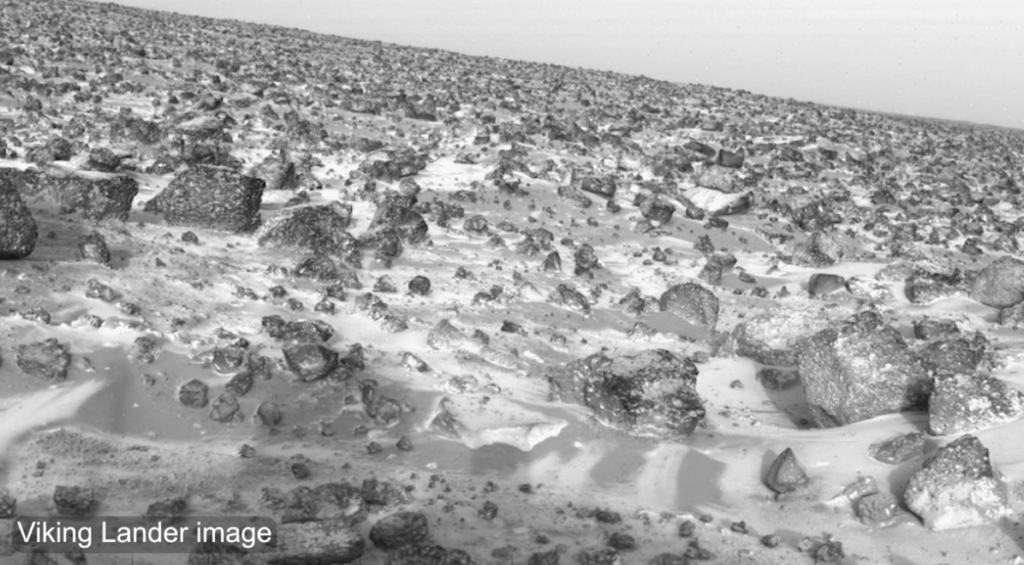
There is no denying Jack Frost’s influence on Mars, despite its subtlety. As NASA’s previous Viking flights demonstrated, frost can accumulate on rocks, ridges, and even rovers. Winter is not necessarily indicated by snow, but rather by the shifting shadows of frost melting with the morning sun or the crust of collected gas on shadowed ground. With the use of instruments that convert quiet into science, scientists have learnt to read these indications.
It’s interesting to note that not all areas of Mars experience snowfall. It only occurs on the deepest nights, at the poles, and behind dense cloud cover. Only the machines designed to wait and listen seem to be able to enjoy the planet’s protected winters.
However, the significance of Martian snow beyond its seasonal beauty. Scientists can better understand how water and carbon dioxide are transported between Mars’ surface and atmosphere thanks to these results. One day, knowledge of those cycles might influence how people settle there or how robotic missions extract minerals from the ice below.
Despite its beauty, the snowfall itself was never the focus of this study. It was about what we learned from it. Every falling flake, gas explosion, and surface-etched crystalline trace adds another piece to the planet’s atmospheric puzzle. NASA has documented a winter that few people ever thought was feasible by using orbiters and landers strategically.
Not only is the snow on Mars freezing, it’s also imaginative. It encourages interpretation, creates patterns, and elicits responses. It’s quiet, but not motionless.
Amazingly, we now know it’s real.
Disclaimer
Nothing published on Creative Learning Guild — including news articles, legal news, lawsuit summaries, settlement guides, legal analysis, financial commentary, expert opinion, educational content, or any other material — constitutes legal advice, financial advice, investment advice, or professional counsel of any kind. All content on this website is provided strictly for informational, educational, and news reporting purposes only. Consult your legal or financial advisor before taking any step.
