

Modern education is being shaped by a movement that is not being propelled by government reforms or new technology. It is being led by educators who are seeding curiosity, which is a deeply human quality. By establishing classrooms that are pulsing with exploration rather than repetition, educators such as Lisa Dant-Robinson are demonstrating how asking questions can be incredibly effective in rekindling the love of learning.
Oklahoma educator and TEDx speaker Dant-Robinson feels that awe rather than a solution is where learning starts. In her classroom, discussions flow naturally, students gather around experiments, and each discussion starts with a straightforward, heartfelt “why.” With an approach influenced by Reggio Emilia, she encourages kids to investigate subjects by asking their own questions. By walking alongside her students as a fellow student rather than as the ultimate source of knowledge, she creates an environment that is remarkably similar to the process of discovery itself.
Her and other educators’ willingness to accept uncertainty is what makes them so creative. When they don’t know everything, they don’t mind revealing it and take advantage of the chance to learn together. In an era of instant information, it feels like a particularly uncommon quality. These educators view ambiguity as a spark that propels students to greater engagement and critical thinking rather than as a threat.
The Inspiring Teachers Leading a New Age of Curiosity
| Name | Lisa Dant-Robinson |
|---|---|
| Profession | Educator and Speaker |
| School | Riverfield Country Day School, Tulsa, Oklahoma |
| Education | BA in Elementary Education, University of Central Oklahoma; MA in Teaching, Learning & Leadership, Oklahoma State University |
| Teaching Philosophy | Reggio Emilia-inspired, inquiry-led, curiosity-centered learning |
| Recognition | TEDx Speaker on Curiosity-Driven Education |
| Specialty | Literacy and hands-on interdisciplinary projects |
| Official Link | https://www.ted.com/tedx |
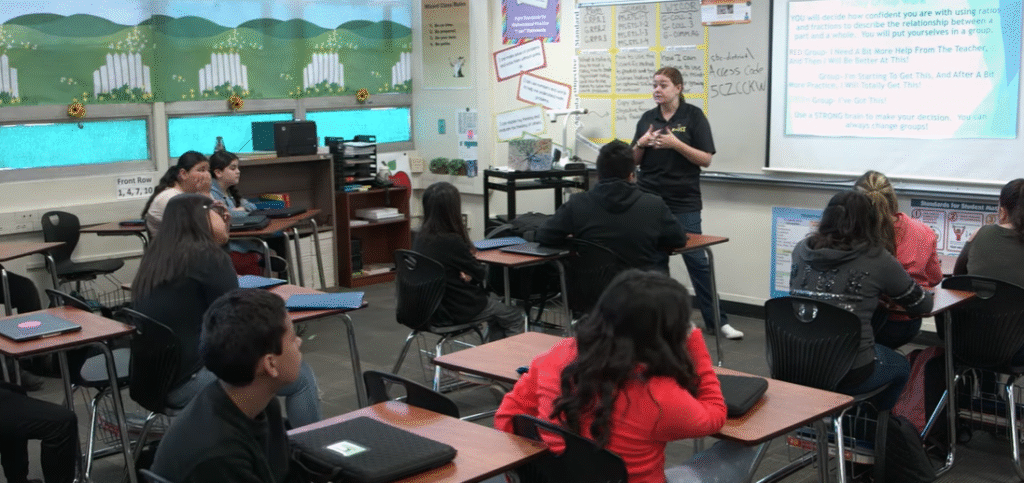
As the 2023 National Teacher of the Year, Rebecka Peterson remembers asking her Algebra 2 students if mathematics was discovered or invented. The query sparked days of intense discussion and careful consideration. Although it was only a simple curiosity experiment, her students’ perspectives on learning were significantly altered. Instead of memorization, they were thinking, pondering, and making connections between concepts. Her teaching changed dramatically as a result, demonstrating that when curiosity is allowed to flourish, intellectual energy flourishes.
Patience, according to educators like podcast host and Washington State Teacher of the Year Nate Bowling, is the key to teaching lessons that have an impact. He once remarked, “You have to give curiosity space to cook,” explaining how a single election rights question turned a single class into a twenty-minute discussion on democracy. His approach is so effective because it turns routine instruction into impromptu learning—evidence that comprehension naturally deepens when curiosity takes the lead.
Teaching with a curiosity-centered approach is not just for older pupils. The 2020 National Teacher of the Year, Tabatha Rosproy, and other early childhood educators view wonder as the lifeblood of their classrooms. She remembers a day when preschoolers saw worms wriggling on the sidewalk following a rainstorm. As a result of their fascination, spontaneous lessons about scientific observation, ecosystems, and compassion emerged. As she put it, “their questions became the curriculum.” The way that natural inquiry supports authentic learning was made abundantly evident by that particular instance.
This new generation of educators knows that curiosity is the driving force behind learning, not an add-on, something that data-driven reforms frequently ignore. According to research from organizations like the International Baccalaureate and Walden University, curiosity greatly enhances motivation, retention, and comprehension. Students retain information much better when they have an emotional connection to the subject matter. Curiosity actually rewires the brain to view learning as a reward rather than a chore.
A notable improvement in these classrooms is the emphasis on intellectual and emotional safety. In environments created by inspiring educators, no question is too minor or unusual. They create environments in which errors are not penalized but rather investigated—where admitting that one doesn’t know turns into an invitation rather than a humiliation. This compassionate and empowering method has been incredibly successful in motivating even the most reserved pupils to engage.
Being curious has become a counterbalance to distraction in a time when digital screens rule the attention. Editor and award-winning educator Tom Rademacher contends that educators need to take back the classroom as a place where people can think slowly. He bemoans the fact that displays frequently substitute cursory scrolling for in-depth inquiry, writing, “We’re teaching children to be curious again.” Students start to think critically, collaborate organically, and engage creatively when curiosity is reintroduced, though, and the effects are profound.
This same truth has been echoed by cultural icons for ages. Oprah Winfrey says her early teachers fostered her curiosity by teaching her to question the meaning of words in addition to reading them. Albert Einstein once said that he had “passionate curiosity, but no special talent.” These similarities serve as a reminder that the gift of curiosity transcends educational settings and serves as a bridge that unites creativity, empathy, and advancement across generations.
This change is especially advantageous to society. Even as automation changes the nature of work and information becomes more accessible, the one ability that machines cannot duplicate is curiosity. It fosters emotional intelligence, creative thinking, and adaptability—skills crucial for future leaders. Today’s educators are essentially molding the kind of thinkers that society will need in the future.
Disclaimer
Nothing published on Creative Learning Guild — including news articles, legal news, lawsuit summaries, settlement guides, legal analysis, financial commentary, expert opinion, educational content, or any other material — constitutes legal advice, financial advice, investment advice, or professional counsel of any kind. All content on this website is provided strictly for informational, educational, and news reporting purposes only. Consult your legal or financial advisor before taking any step.
