

Polar bear behavior in the icy stillness of Svalbard’s pale blue coastline has changed from what scientists had anticipated. A large male was observed moving slowly across a rocky beach one afternoon not long ago, its paws crunching over frozen pebbles rather than gliding across sea ice. It stopped next to what appeared to be a walrus’s remains, lowering its head and feeding resolutely and quietly. The bear wasn’t starving, which is why there was something almost unnerving about the scene.
Polar bears were thought to be declining for decades. The script was that. Their primary prey, seals, were disappearing along with their hunting grounds as the Arctic sea ice melted. That prediction has come true with brutal clarity in places like Hudson Bay, Canada. Bears became thinner. The Cubs had trouble. Populations decreased.
However, something unexpected occurred here in the Arctic of Norway. The bears gained weight.
| Key Information | Details |
|---|---|
| Species | Polar Bear (Ursus maritimus) |
| Region | Svalbard Archipelago, Norway |
| Population Studied | 770 adult polar bears |
| Study Period | 1992–2019 |
| Lead Research Institution | Norwegian Polar Institute |
| Lead Scientist | Jon Aars |
| Key Finding | Bears became fatter despite losing ~100 ice days |
| Main Cause | Dietary adaptation (reindeer, bird eggs, walrus carcasses) |
| Reference | Norwegian Polar Institute |
| Scientific Publication | Scientific Reports Journal |
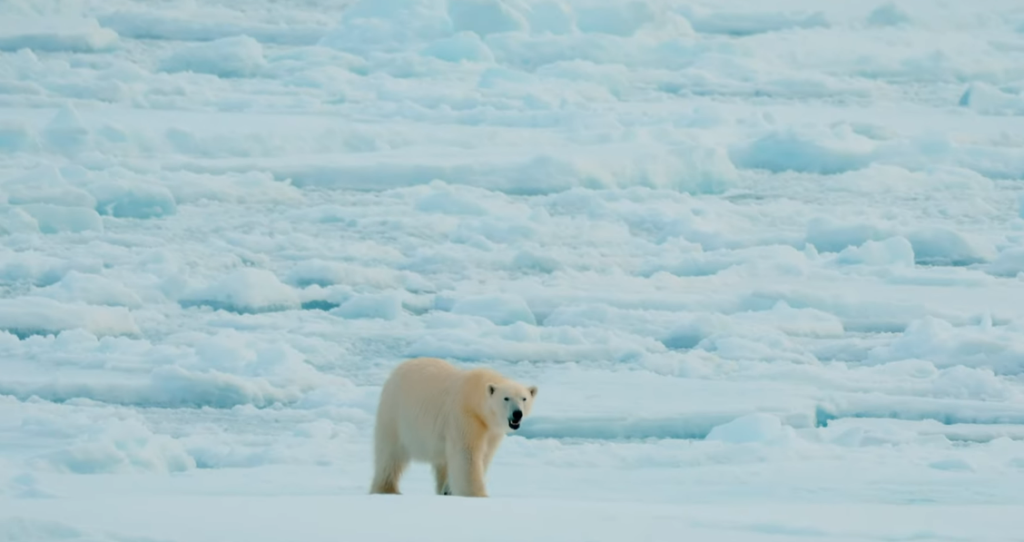
Despite losing about 100 more days of ice-free weather, scientists who measured polar bears throughout Svalbard discovered that the animals’ physical condition improved over almost three decades. Even the researchers who had spent their entire lives anticipating the opposite result might have been taken aback by this discovery. Imagine how unsettling it was when the data didn’t support what everyone believed to be true.
On the surface, the explanation appears to be simple. These bears adapted to less sea ice. They started to eat more on land, hunting reindeer, raiding bird nests, and scavenging walrus carcasses. As this change takes place, it seems as though the bears are rewriting behaviors that have been developed over thousands of years in a matter of decades.
Resilience can be disguised as adaptation. It may also appear desperate.
Previously an occasional supplement, female bears now spend extended periods of time close to bird colonies in parts of western Svalbard, where they feed on eggs. It almost seems like a biological contradiction to see a polar bear, which is designed to stalk seals across drifting ice, crouching awkwardly among nesting birds. But for the time being, the calories are sufficient. It seems as though nature is buying time.
Nearly nowhere else on Earth has warmed as quickly as the Barents Sea region, with some regions seeing increases of up to 2 degrees Celsius every ten years. Once lasting well into summer, ice now melts weeks sooner. Even so, these bears continue to gain weight as their new and strange routines support their thick fur-hiding bodies.
However, it’s still unclear if this seeming success is fleeting or genuine.
Seal fat, one of nature’s most abundant energy sources, is what polar bears have evolved to rely on. Although useful, walrus carcasses and bird eggs might not offer the same steady nutrition over many generations. Researchers are concerned about thresholds, which are imperceptible tipping points that might already be coming.
There is an unsettling resemblance to other ecological tales as you watch this develop. Species frequently seem stable until they abruptly change.
Cod populations appeared to be in good health in some areas of the Atlantic in the early 2000s—until they abruptly collapsed. Forests endure years of drought before dying virtually instantly. It turns out that stability can be deceptive.
For a long time, polar bears have been symbolic. Their image became a sort of emotional shorthand for environmental loss, appearing on magazine covers, being used in campaigns, and becoming synonymous with climate change. Perhaps by simplifying a reality that was always more complex, that symbolism influenced public opinion. These bears now add even more complexity to the tale.
They are not declining as would be expected, nor are they thriving in the conventional sense. Rather than relying on certainty to survive, they live in an uncomfortable middle ground. It’s difficult to ignore how unstable that equilibrium seems.
Scientists believe that the situation in Svalbard might be influenced by exceptionally advantageous local circumstances, such as expanding walrus numbers, reindeer populations, and geographic features that provide access to other food sources. Bears have no such choices elsewhere.
Furthermore, climate change is still happening.
Disclaimer
Nothing published on Creative Learning Guild — including news articles, legal news, lawsuit summaries, settlement guides, legal analysis, financial commentary, expert opinion, educational content, or any other material — constitutes legal advice, financial advice, investment advice, or professional counsel of any kind. All content on this website is provided strictly for informational, educational, and news reporting purposes only. Consult your legal or financial advisor before taking any step.
