

The pavement in some areas of Shanghai last July did more than simply crack. It arose. As though something beneath them were pushing upward, drivers slowed and gazed at areas of the road that had lifted unevenly. The air twisted light and warped distance as it shimmered over the asphalt. It’s possible that this was the first time the heat began to feel more like pressure than weather for many locals.
China has always constructed its cities to be large. Broad roads, tall apartment complexes, and expansive industrial areas. However, records of heat are challenging the notion that steel and concrete could silently withstand whatever nature threw at them. It seems as though contemporary urban life depends on circumstances that are no longer felt to be guaranteed when one observes the strain on these structures.
The numbers themselves have a somewhat abstract sound. Most recently, the average temperature in China hit its highest point since 1951. However, statistics don’t convey the experience of working at street level, where workers wrap towels around their necks and stop under the slender shadows of incomplete structures while they wait for strength to return.
Since millions of people depend on air conditioning to stay safe, demand for electricity has increased. Stretched to their breaking point, power grids hum continuously. In certain cities, officials discreetly requested that factories cut back on their use, giving priority to cooling homes. The sustainability of this balancing act in the face of further warming is still unknown.
Heat that persists through the night has an eerie quality. Concrete in crowded urban areas retains heat, which is gradually released after sunset. Refusing to cool, the air remains heavy. When residents open windows in search of relief, they are met with none. It gets hard to fall asleep. Weariness builds up.
Authorities in Nanjing have reopened underground air-raid shelters, which were initially created for wartime survival. Families sat inside in folding chairs, waiting out the worst of the heat while browsing through their phones. Children played in silence. Modern cities are using Cold War infrastructure to withstand climate conditions that no one foresaw when those shelters were constructed, so it’s difficult to overlook the symbolism.
Roads have started to break down in unexpected ways. During periods of intense heat, a section of concrete in Henan province reportedly exploded, necessitating abrupt closures. In addition to their efficiency, transportation networks now have to endure temperatures they were never built to handle.
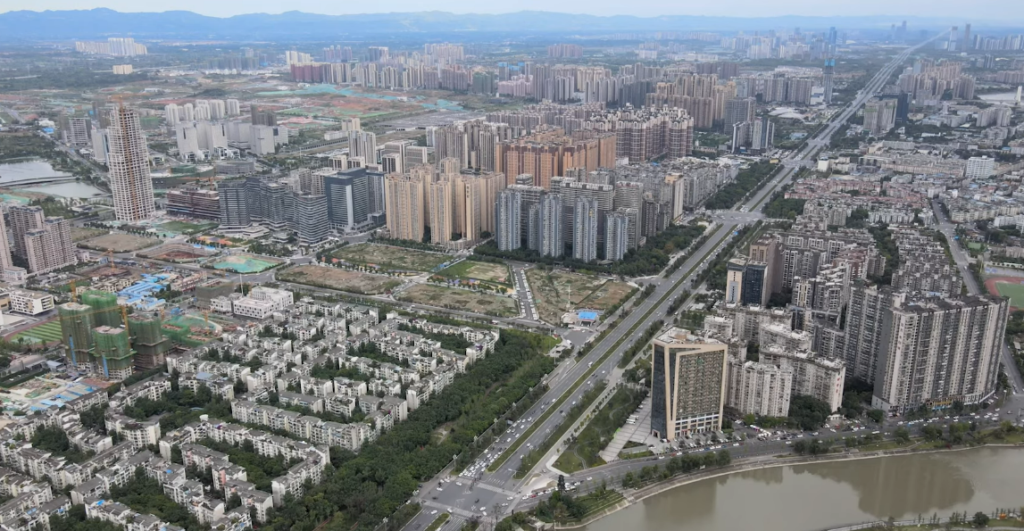
Part of the issue might be urbanization itself. Natural landscapes were replaced by heat-absorbing materials as a result of China’s rapid expansion. Sunshine is reflected by glass towers. It is trapped by asphalt. Although there are green areas, they are frequently in well-planned areas and are not enough to counteract the overall impact. There is a growing suspicion that the rapidity of urbanization made cities less resilient to environmental shocks.
The economic ramifications are gradually increasing. In times of tight power supplies, factories reduce output. Delivery networks experience delays. Investors appear to be becoming more conscious of the possibility that climate stress may affect industrial planning in the future. While some businesses are already changing their operations, few publicly attribute these choices to the heat.
For outdoor workers, the effects are felt right away. In order to allow their bodies to cool, delivery drivers rest in any available shade and cover their arms with water. On a busy afternoon, construction cranes remain still. Human endurance has its limits, not policy, which is why productivity slows down.
Although China’s heat is a part of a larger global trend, the effects are more obvious due to its size. In cities with hundreds of millions of residents, even the most modern infrastructure is subject to environmental stressors that engineers may not have fully foreseen decades ago.
How much worse it could get is also up in the air. Systems of climate change gradually and then abruptly. A few summers that break records could become a regular occurrence. Or there might be short-term respite. The uncertainty itself makes people uncomfortable.
There’s an odd silence when you’re standing on a city street during these heat waves, watching traffic pass under a white sky. It’s as though the heat absorbs both energy and sound, making even noise seem quieter.
Disclaimer
Nothing published on Creative Learning Guild — including news articles, legal news, lawsuit summaries, settlement guides, legal analysis, financial commentary, expert opinion, educational content, or any other material — constitutes legal advice, financial advice, investment advice, or professional counsel of any kind. All content on this website is provided strictly for informational, educational, and news reporting purposes only. Consult your legal or financial advisor before taking any step.
