

A silent revolution is taking place in classrooms strewn with finger paints and building blocks of various hues. Once written off as unstructured fun, play-based learning is now acknowledged as a highly successful educational strategy that develops emotional intelligence, creativity, and problem-solving skills. The change in the definition of early education is slow, intentional, and incredibly successful; it is neither loud nor coerced.
Professor Susan Edwards, whose work has reframed educators’ understanding of the delicate balance between intentional teaching and free play, is at the center of this change. The erroneous division between play and learning is contested by her research, which was published in the Australasian Journal of Early Childhood. She contends that both can coexist in an educational framework that places equal emphasis on curiosity and cognition.
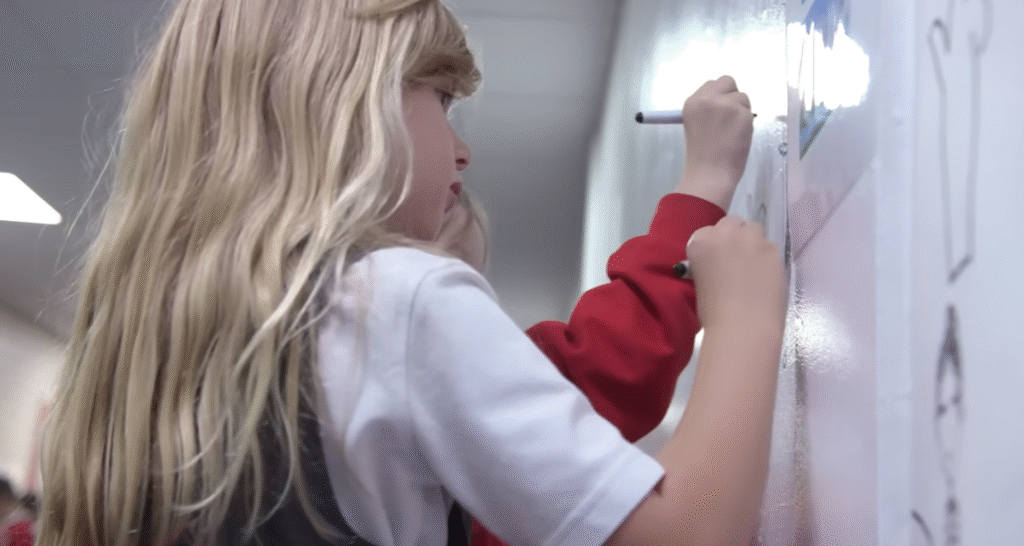
According to her, play-based learning is a deliberate process in which imagination serves as a medium for discovery rather than a random act of amusement. When a child stacks blocks, they are not only constructing a tower but also investigating cause-and-effect relationships, geometry, and balance. These seemingly insignificant moments serve as the basis for critical thinking, which is a skill that formal education frequently finds difficult to impart.
Teachers at Columbia University’s Teachers College, like Haeny Yoon, agree with Edwards. Yoon examines play as an intellectual pursuit that transcends early childhood and cultivates creativity and adaptability, traits that are prominently supported by innovative thinkers such as Elon Musk and John Lasseter of Pixar. Under these circumstances, play becomes less about recreation and more about developing adaptable, creative thinking.
This movement’s subtlety is what makes it so beautiful. The goal of play-based learning environments is to foster self-motivated students. Children follow instincts that generate internal motivation as they progress from painting to storytelling to role-playing. When adults watch rather than teach, kids take charge of their education and learn that mistakes are not failures but rather opportunities to try new things.
Preschoolers’ cooperation and emotional control have significantly improved as a result of this autonomy. Teachers report greater empathy and fewer behavioral problems, which is a result of the social scaffolding that play provides. Children gain negotiation, patience, and perspective-taking skills through role-playing, for instance—skills that are later needed in both corporate boardrooms and creative studios.
Nevertheless, not every interpretation of play-based learning is consistent with Edwards’ initial idea. Play has been taken over by adults who impose learning agendas under the pretense of enjoyment, according to critics like Sara from Happiness Is Here. Her statement, “Play is not something you do to a child,” strikes a deep chord. She maintains that genuine play needs to be self-selected and unaffected by outside forces. Teachers run the risk of undermining play’s fundamental qualities—its spontaneity and freedom—when they pass off instruction as play.
This criticism reflects a wider conflict in developed countries’ early education systems. Legislators want quantifiable results, but psychologists maintain that unstructured inquiry fosters genuine learning. This leads to a pedagogical struggle between meaning and metrics. A middle ground is provided by Edwards’ research: a framework for pedagogical play that combines freedom and purpose. Teachers take on the role of co-thinkers in this situation, directing rather than controlling the process.
Canada, Finland, and Australia—all renowned for their progressive early education policies—have adopted her teaching methodology as part of their educational models. These programs support teachers in using “purposefully framed play,” which combines unstructured inquiry with nuanced direction. Early language, numeracy, and cooperative problem-solving skills have all benefited greatly from the approach. Additionally, it has influenced STEAM-based play models, where constructing a paper rocket can simultaneously inspire lessons in storytelling, teamwork, and physics.
The cultural impact of play-based learning goes well beyond preschool. For example, the innovation culture of Silicon Valley is strongly influenced by children’s natural curiosity, the same creative drive that drives imaginative play. Connecting seemingly unrelated ideas is a cognitive process that Steve Jobs frequently discussed. It is remarkably similar to a child combining blocks, colors, and concepts without any boundaries. In both situations, unrestricted exploration fosters creativity.
More and more parents are realizing how transformative play can be. Social media groups like Bare Feet Farm School provide actual case studies of kids using creative outdoor play to learn responsibility. Children engage in activities that combine physical, cognitive, and emotional development, such as caring for animals, building forts, and planting vegetables. These settings teach resilience, adaptability, and an awareness of natural systems—lessons that no worksheet could ever replicate.
What many educators intuitively understand—that play is learning—is still supported by research. According to the Institute of Education Sciences (IES), it is a crucial part of developing 21st-century skills and is associated with critical thinking, creativity, and teamwork. It is a framework that reflects the demands of the modern workplace, where workers must be able to adapt, come up with ideas, and communicate clearly in changing settings.
However, in some places, especially those where academic rigor is valued more highly than developmental balance, play-based education is still underappreciated. For example, the cognitive advantages of play are frequently overshadowed in parts of Asia by the cultural emphasis on structured learning. However, schools that are experimenting with Edwards’ model are seeing unexpectedly positive outcomes—children show greater social adaptability in addition to later academic performance.
Disclaimer
Nothing published on Creative Learning Guild — including news articles, legal news, lawsuit summaries, settlement guides, legal analysis, financial commentary, expert opinion, educational content, or any other material — constitutes legal advice, financial advice, investment advice, or professional counsel of any kind. All content on this website is provided strictly for informational, educational, and news reporting purposes only. Consult your legal or financial advisor before taking any step.
