

With a serene conviction that seems almost rebellious in today’s performance-obsessed systems, Pasi Sahlberg explains Finland’s educational philosophy. His maxim, “less is more,” changed not only how a country learns but also how it views success in general. In Finnish classrooms, competition has subtly given way to cooperation, and guidance has taken the place of grades. The end effect is an educational model that has captivated educators and decision-makers from far and wide.
Trust—in educators, in learners, and in learning as an organic process—is the foundation of Finland’s success. Finland gauges progress by growth, empathy, and curiosity, whereas other countries use standardized test scores. Despite having shorter school days than their peers, the nation’s students routinely rank highly on international tests like PISA. This is intentional; it’s not a coincidence. In order to maximize creativity and reduce stress, Finland created a system that transforms potential into meaning.
The mindset of forward-thinking businesses that value innovation over output is remarkably similar to the Finnish approach. Similar to how Google used to give its engineers “20 percent time” to experiment with new ideas, Finnish educators are free to create lessons that inspire rather than teach. Getting into teacher training is as competitive as getting into medical school, and all teachers have master’s degrees. Once in the classroom, they are regarded as respected experts influencing the future of the country rather than as bureaucratic subordinates.
| Category | Details |
|---|---|
| Full Name | Pasi Sahlberg |
| Born | 1960, Finland |
| Occupation | Professor, Author, Education Policy Expert |
| Known For | Leading voice behind Finland’s education reforms; advocate for equity-based learning |
| Education | PhD in Education, University of Jyväskylä |
| Major Works | “Finnish Lessons: What Can the World Learn from Educational Change in Finland?” |
| Affiliations | University of New South Wales, Harvard Graduate School of Education |
| Awards | Grawemeyer Award for Education (2013) |
| Key Philosophy | “Less is more” — trust teachers, minimize testing, focus on well-being |
| Nationality | Finnish |
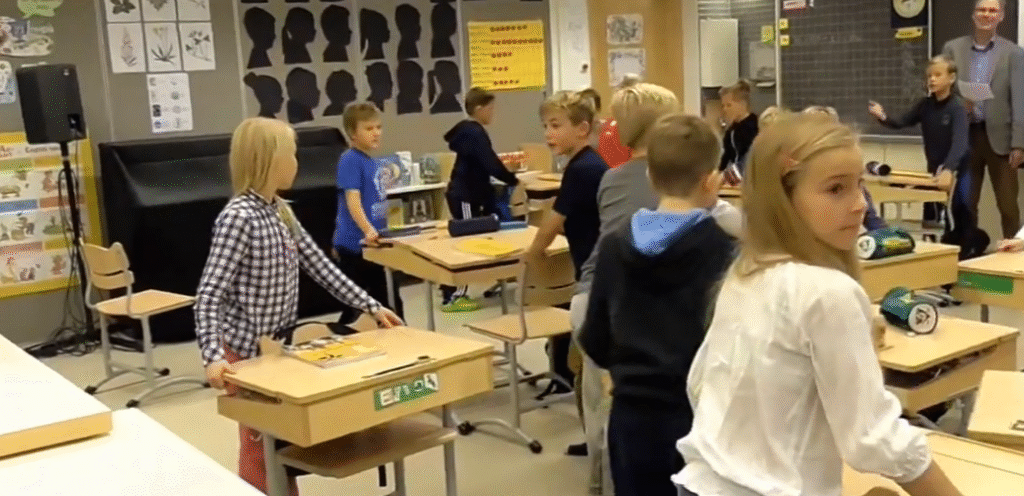
Finnish schools place a strong emphasis on individual growth rather than using a curve for grading or comparing students to one another. Projects, portfolios, and practical problem-solving are ways that teachers evaluate students. Learning turns into a dialogue rather than a contest. A student may use a tablet to record a science experiment, write in an electronic journal, or work with peers on a group project. Because they reflect how skills are used in real-world situations rather than just how they are remembered for tests, these evaluations are incredibly effective.
The balance of this system is what makes it so novel. Childhood is preserved, school days are brief, and homework is minimal. Play is an integral component of learning, not a diversion from it. Many schools incorporate hands-on activities, outdoor sessions, and lessons that foster a sense of connection between students and the natural world. In addition to making students better learners, this work-rest rhythm also makes them happier. Students in Finland are significantly more self-assured, sympathetic, and able to think for themselves than their overburdened counterparts in other countries.
Respect for teaching is engrained in the culture. In Finland, teachers are treated with the same respect as doctors in other countries. Autonomy is a direct result of this respect and has been shown to be very effective in raising academic achievement. Above-the-ground curricula and surprise inspections do not exist. Rather, teachers work together to exchange ideas and improve their approaches. They are able to innovate, adapt, and care for each student’s unique journey because there are no high-stakes tests.
Sahlberg’s ideas are applicable outside of the classroom. He frequently makes comparisons between Finland’s educational system and its creative sectors, such as the massive video game company Supercell or the design company Marimekko. Both flourish in an environment of experimentation, trust, and low levels of hierarchy. The entrepreneur creating the next big international startup is motivated by the same idea that enables a Finnish student to construct a robot in a classroom. Fear does not shape this mindset; freedom does.
It’s a sobering and illuminating contrast to more inflexible systems. Academic pressure starts early and rarely goes away in nations like South Korea or the UK. Students are subjected to countless tests, most of which gauge compliance rather than originality. High levels of burnout, decreased wellbeing, and a reduction in curiosity are the inevitable results. Finland took a different route, one that emphasizes education as a continuous endeavor rather than a one-time act.
This strategy has been especially helpful in promoting equality. Every child, regardless of background, goes to a public school that provides free transportation, meals, and supplies. Making sure every student succeeds is the aim, not producing the best. Finland’s “no child left behind” philosophy is ingrained in its organization and is not merely a catchphrase. Teachers frequently spend years with the same class of students, forming bonds with them that go well beyond the classroom. The relationship fosters continuity and trust that support learning and emotional stability, almost making it feel like family.
The development of the Finnish story is what adds to its allure. Reforms have been consistent but flexible since the nation’s initial overhaul of its educational system in the 1970s. Finland recently implemented “phenomenon-based learning,” in which physics and history are combined with more general topics like digital citizenship or climate change. It’s a very flexible approach that reflects real life, where issues rarely fall neatly into one field.
The success of this system has not gone unnoticed. Prominent individuals like Sir Ken Robinson and Bill Gates have hailed Finland’s emphasis on wellbeing and creativity as a model for education in the future. Even American teachers who travel to Helsinki are frequently astounded by what they witness—a strong sense of community, students who appear genuinely interested in what they are learning, and a total lack of test anxiety. It’s a surprisingly compassionate image of education.
However, Finnish teachers are not resting on their laurels. They keep improving their techniques to address emerging issues, such as migration, digital distractions, and mental health. Their dedication to evolution is very evident: they reform for relevance rather than rankings. Finland demonstrates that humility is just as important to sustainable success as innovation by consistently adapting while adhering to their core values.
Disclaimer
Nothing published on Creative Learning Guild — including news articles, legal news, lawsuit summaries, settlement guides, legal analysis, financial commentary, expert opinion, educational content, or any other material — constitutes legal advice, financial advice, investment advice, or professional counsel of any kind. All content on this website is provided strictly for informational, educational, and news reporting purposes only. Consult your legal or financial advisor before taking any step.
