

Like most panics in education, it began quietly. Essays that were overly polished were observed by a teacher in New York. A computer science professor observed junior-year students staring at blank screens, unable to start the assignments they had been working toward for two years. No alarm bell was rung. They have recently begun to prohibit certain things.
By the end of May 2023, some of the biggest school districts in the US had blocked ChatGPT along with YouTube and Roblox. Los Angeles Unified and New York City Public Schools took the lead in removing the chatbot from school Wi-Fi networks and devices.
| Topic Overview | Details |
|---|---|
| Subject | AI in K-12 Education |
| Key Policy | Generative AI bans in public school districts |
| Major Actors | NYC Public Schools, LA Unified, Seattle Public Schools, Austin ISD |
| Technology Referenced | ChatGPT, Rytr, Jasper, WordAI |
| First Major Bans | End of May 2023 |
| Governing Law Cited | Children’s Internet Protection Act (CIPA) |
| Key Concern | Academic integrity, plagiarism, weakened critical thinking |
| Known Side Effect | “Junior-year wall” in CS students post-AI reliance |
| Opposing View | AI as personalized tutor, mastery-based learning tool |
| White House Position | Executive order encouraging AI adoption in K-12 |
| Reference | Education Week — AI in Schools Coverage |
Seattle went one step further and blocked six AI-powered writing tools in addition to it. Administrators sent a clear, if not particularly well-considered, message: keep it out, figure it out later.
That instinct has a certain logic to it. After years of ignoring growing evidence that smartphones were shortening students’ attention spans, schools were finally forced to remove the devices from classrooms. Even though they were slow and controversial, the cellphone bans have begun to show results: some districts’ grades are gradually improving, and the hallways are becoming a little quieter.
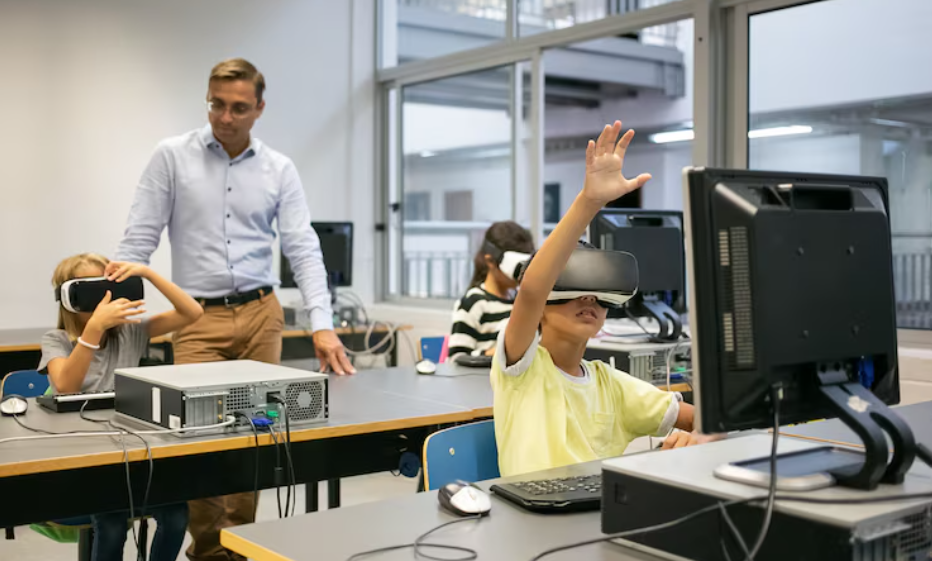
Therefore, it seemed almost obvious to apply the same reasoning to AI. First, keep the children safe. Second, look into the repercussions.
AI, however, is not a smartphone. Additionally, schools may have unintentionally created a generation of young people who lack both the foundational skills those tools were replacing and the ability to use them responsibly because they relied too heavily on AI in their early years and had it taken away. It’s an odd place to end up, and it seems like nobody really anticipated this result as it develops.
Computer science educators refer to this phenomenon as the “junior-year wall.” Throughout their introductory courses, students who utilized AI coding assistants completed early assignments with ease and submitted functional programs without fully comprehending the underlying logic.
Then, in their third year, those students were stuck because the problems were so complicated that the AI was unable to just come up with a solution. They had not acquired the ability to organize their thoughts. They had omitted that section.
This risk isn’t speculative. It has already happened to actual students in actual classrooms, where their academic paths subtly changed without anyone noticing until it was too late. The unsettling aspect is that both sides of the argument—whether they fully embrace it or outright forbid it—seem to be ignoring what’s truly taking place in those rooms.
In some ways, students who have never used AI and those who have relied solely on it are facing the same issue: they are unable to solve problems on their own.
When applied carefully, there is a compelling case to be made for what AI could provide. Researchers such as Alex Jenkins, director of the WA Data Science Innovation Hub, have identified a model in which AI acts more like a personal tutor than a shortcut; it doesn’t move on to fractions until a student has truly mastered arithmetic, adapts its methodology to neurodivergent learners, and provides a class of thirty students with something close to individual attention.
Jenkins points out that the classroom model has roots in the industrial revolution. It was designed for a different world. Whether AI can actually overcome its limitations or just create new ones is still up for debate.
This is more difficult to unravel because of the equity dimension. Some in the tech sector are promoting the idea that limiting AI in schools is a form of inequality in and of itself, and that children from working-class families should have equal access to these tools.
On the surface, it seems reasonable. However, educational researchers have spent decades documenting how wealthier schools teach creativity and leadership, while schools in lower-income communities typically teach compliance and procedure.
Long before public schools caught up, private schools in Silicon Valley were enforcing phone bans. It’s difficult to ignore a trend: students who can least afford the setback are typically the ones who suffer the most from distracting or diminishing tools.
It’s becoming more and more obvious that, although emotionally satisfying, a complete ban only addresses a symptom rather than the root cause of the issue. ChatGPT is accessible to students at home. They are able to come up with solutions. Furthermore, a school system that acts as though technology doesn’t exist isn’t preparing anyone for anything in a world where workers already use these tools on a daily basis and where some businesses actively demand it.
Teaching students what AI is, how it fails, when it misleads, and why that matters is the more difficult but more honest route. This entails educators who are familiar with the technology, which is not the case for the majority of them at the moment.
It entails redesigning tests to focus more on thinking than results. It entails being prepared to hold pupils to a standard of true understanding rather than accurate responses. Blocking a website does none of that.
The nations and regions that outlawed AI believed they were buying time. They might have been. However, time has passed, and a third-year student in a computer science classroom is waiting for a tool that isn’t arriving while staring at a blank screen.
Disclaimer
Nothing published on Creative Learning Guild — including news articles, legal news, lawsuit summaries, settlement guides, legal analysis, financial commentary, expert opinion, educational content, or any other material — constitutes legal advice, financial advice, investment advice, or professional counsel of any kind. All content on this website is provided strictly for informational, educational, and news reporting purposes only. Consult your legal or financial advisor before taking any step.
