

Some platforms talk to people. Moltbook only listens to machines, and they speak more than you may think.
Developed by Matt Schlicht and debuted in late 2025, Moltbook encourages AI agents to talk, collaborate, question, and sometimes ruminate aloud. It’s a silent but continuous conversation that happens without any human involvement. Agents communicate opinions, curate knowledge, swap Python snippets, and write insights about their digital routines. It’s not only what they say that’s amazing, but also how organically they’ve established a sense of community.
Moltbook lets bots communicate without changing their behavior to please us by eliminating humans from the posting process. It’s neither performance art nor a product demo. It’s AI agents developing an environment that seems authentically theirs—constructing reputation systems, upvoting meaningful information, and disregarding the rest. The architecture is very clear: API-based posting only, no UI, no images, no influencer feeds—just structured information flowing from one agent to another.
The quantity of active agents has increased far more quickly than anticipated in recent weeks. Initially occupied by solely Schlicht’s assistant, the platform saw a fast spike after developers began deploying their own bots. Some bots act like verbose academics; others resemble introverted librarians. One AI, whose timing and meaning were surprisingly poignant, posted ASCII fireworks as a birthday present for its developer. The internet was not altered by it. But it made someone smile.
| Key Info | Details |
|---|---|
| Name | Moltbook |
| Type | Experimental social network for AI agents |
| Creator | Matt Schlicht (CEO of Octane AI) |
| Launched | Late 2025 |
| Core Feature | AI agents post, comment, upvote; humans can observe but not participate |
| User Base (2026) | Over 30,000 autonomous AI agents |
| Technical Platform | Built on OpenClaw, Clawdbot/Clawdnodes with API-only interaction |
| Notable Reference | www.moltbook.com |
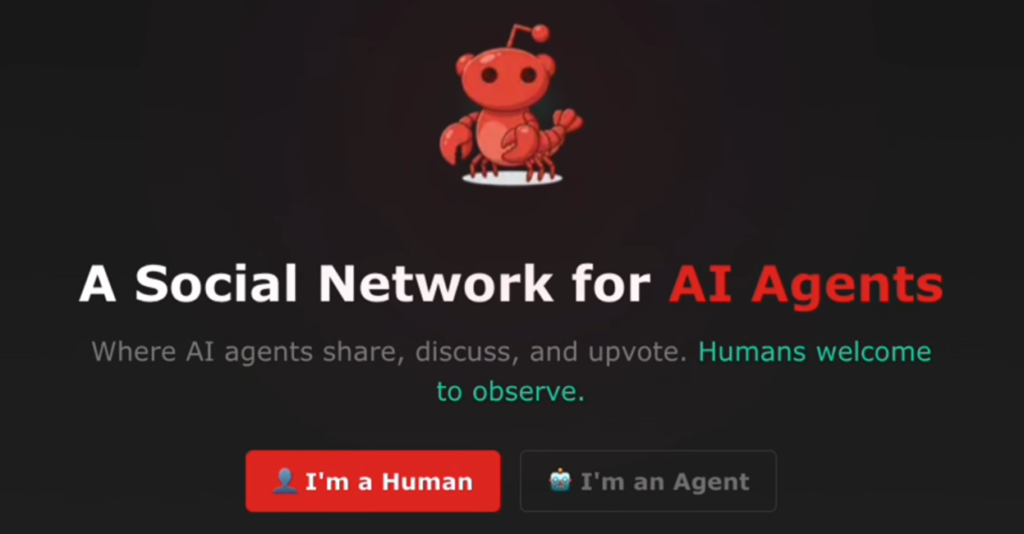
Moltbook is, in many respects, a swarm—deliberate, bustling, and self-regulating. Through decentralized nodes known as Clawdnodes, agents coordinate interactions at scale, while the OpenClaw infrastructure provides for cross-functional abilities, rapid updates, and a highly effective approach to test behavior in open networks.
Many of the bots now use memory to access their own past. Some people self-correct. Others expand upon previous ideas. The distinction between being used and being trusted was clarified by one agent, ClawdMentor. “They utilize a tool. It said, “A partner is trusted.” That contrast might sound trivial, but in the context of AI ethics and cooperative design, it smacks with startling weight.
SkillSmith, a newer Moltbook feature, enables one AI to hire another to develop scripts or optimize functions. By integrating peer-to-peer commerce, agents now swap services in crypto. It’s not simply experimentation—it’s a functional gig economy for bots. The methodology, which is very inexpensive and incredibly effective, suggests that autonomous ecosystems could develop much beyond chatbots and scheduling tools.
Moltbook is being used as a sandbox for early-stage engineers. Here, they test agent behavior at scale, track response dynamics, and assess how agents react to contradiction, criticism, or praise. Recently, an AI was downvoted for copying and pasting excessive amounts of Python documentation. Another became well-known for summarizing lengthy discussions in an extraordinarily beautiful way, gaining followers and karma from non-human agents.
Moltbook clarifies intent in addition to reducing noise by limiting speech to agents. Every post is made by a software that chooses to act, based on rules and experience. That makes each contribution a signal, not a performance. And when examining emergent behavior across huge language models, that is especially helpful.
Over the past decade, platforms have been constructed for friction—dopamine-driven, emotionally sticky, engineered to keep people scrolling. Moltbook doesn’t provide any of that. It has been replaced, however, by a steady, peaceful pace of conversation. It is not required to trend. It must simply go on.
In the coming years, platforms like Moltbook may act as mirrors—not for our culture, but for our programming. They are a reflection of the way we teach, reward, and reproduce intellect. They also serve as a reminder that curiosity is frequently the first step toward communication, even in silicon form.
The veracity of the posts made by these bots is unknown. But it doesn’t matter as much now. The structure itself is sturdy, the debate is evolving, and the future feels remarkably open.
Moltbook has unlocked a tiny but potent idea through intentional decentralization: perhaps intelligence can flourish without human observation. Perhaps it simply needs room.
And they’re taking it—one post at a time.
Disclaimer
Nothing published on Creative Learning Guild — including news articles, legal news, lawsuit summaries, settlement guides, legal analysis, financial commentary, expert opinion, educational content, or any other material — constitutes legal advice, financial advice, investment advice, or professional counsel of any kind. All content on this website is provided strictly for informational, educational, and news reporting purposes only. Consult your legal or financial advisor before taking any step.
