

It appeared to be a typical piece of fabric, similar to what you might find on a sports sleeve or exercise equipment. But when a hand lightly tapped it, a grid of LEDs came to life—light was powered by motion rather than cables or batteries. That test moment at Nanyang Technological University in Singapore signaled a subtly revolutionary development: cloth that produces electricity whenever you move.
Engineers have been pushing for wearables that are more than just monitors for the last ten years. The objective is clothing that functions autonomously—powering itself, adjusting to the body, and promoting health or communication without being dependent on large batteries. This fabric is a clear step toward that future because it was created with a hybrid energy-harvesting pattern.
Through the combination of the triboelectric effect, which depends on friction between surfaces, and the piezoelectric effect, which occurs when materials generate voltage when bent or squeezed, the textile is able to extract energy from routine motion. Walking, extending, or even just barely touching an object can all produce electrical signals that can charge small devices or light LEDs.
Here, the design’s subtlety is quite inventive. Instead, the developers incorporated nanostructured polymers straight into soft, flexible fabrics rather of creating a stiff tech layer and applying it to apparel. The completed product produces power in the background in a silent manner while breathing, bending, and even surviving a wash cycle.
| Key Concept | Description |
|---|---|
| Technology | Smart fabric using piezoelectric and triboelectric effects |
| Power Output | Up to 2.34 watts per square meter from motion |
| Materials Used | Conductive polymers, nanofibers, lead-free perovskites |
| Durability | Washable, stretchable, stable for up to 5 months |
| Use Cases | Wearables, health monitors, GPS, military gear |
| Fabric Properties | Breathable, flexible, and suitable for everyday clothing |
| Notable Developers | Nanyang Technological University, Singapore |
| Demonstration Example | A 3×4 cm patch lit up 100 LEDs through hand tapping |
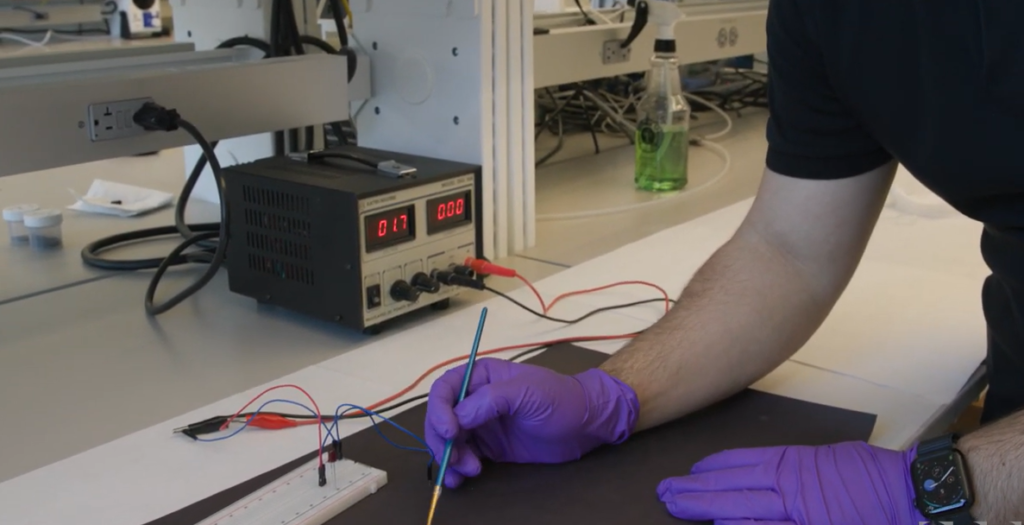
A 3-by-4-centimeter piece of the textile was tested, and with a few taps, it lighted up 100 LEDs, demonstrating its instant potential. Its incredibly adaptable design allowed it to be wrapped around arms, sewn into clothing, and inserted into shoe soles without sacrificing functionality. For a variety of real-world applications, such kind of adaptability makes it extremely effective.
In terms of wearable technology, this creates extremely productive prospects. Imagine medical gowns that use modest body movement to power sensors to monitor patient vital signs, or jackets that keep your phone charged while you walk. Self-powered beacons in rescue outfits have the potential to save lives in disaster areas.
Although the production of 2.34 watts per square meter may not seem revolutionary, it is a huge increase over previous attempts at textile-based generators. Through the optimization of material layers and electrical collection methods, the team has developed a system that is not only reliable but also efficient.
During one of the demonstrations, I saw the cloth wrinkle under pressure, yet the LEDs lit continuously instead of blinking crazily as it bent and changed. Years of improvement are reflected in that level of stability, as previous prototypes may have shorted or deteriorated under normal stress.
In terms of wearable innovation, this invention comes at a perfect moment. Despite their widespread use, fitness trackers, smart watches, and body-monitoring patches are still powered by conventional batteries. Including self-generating textiles could significantly increase these gadgets’ sustainability and independence.
In order to prioritize scalability and safety, the researchers strategically layered breathable polymers and sophisticated materials, avoiding poisonous or rare-earth components. When considering future manufacturing, this decision makes it not only incredibly clear in its function but also shockingly economical.
Developers may cut down on electronic waste, remove charging times, and provide more responsive gear by incorporating this fabric into apparel. For example, a set of gloves that replenish a haptic feedback device or a shirt that charges a hydration sensor are now more feasible.
I’ve kept up with a lot of wearable technology advancements over the last few years, but very few have seemed useful and instantly implementable. So did this one. Possibly due to its sophistication—an energy solution that blends in seamlessly with your daily routine without shouting tech.
Of course, more work needs to be done. The interface between fabric and storage devices, like as capacitors, is now being optimized by engineers to guarantee that energy can be reliably deployed and stored. Additionally, they’re investigating multi-modal versions that use motion, heat, and even humidity as energy sources. This is a rather creative twist that suggests garments that will last into the future.
This fabric’s washability and structural resilience aren’t the only factors that contribute to its remarkable durability. It’s the careful design that allows it to adjust to human movement, flourish under pressure, and seamlessly meet energy demands.
Wearable technology has been essential since the epidemic, particularly in safety and healthcare applications. These power-generating textiles may form the foundation of self-sustaining systems in the years to come as we expect more from our apparel—clothing that actively supports your everyday duties rather than merely providing cover or warmth.
This innovation doesn’t need us to alter our behavior because it makes use of what we currently do—move. It gives us incentives just for existing, breathing, moving, and reaching. The light turns on with a quick flick of the wrist and a tap of the foot.
Disclaimer
Nothing published on Creative Learning Guild — including news articles, legal news, lawsuit summaries, settlement guides, legal analysis, financial commentary, expert opinion, educational content, or any other material — constitutes legal advice, financial advice, investment advice, or professional counsel of any kind. All content on this website is provided strictly for informational, educational, and news reporting purposes only. Consult your legal or financial advisor before taking any step.
