

A drone drops to roughly ten feet above the ground, hovers for a short while, and starts firing somewhere over a stripped hillside in Myanmar. Seed pods, not bullets. At two per second, tiny, biodegradable capsules containing germinated seeds and a pocket of nutrients are launched into the ground. The entire process takes a few minutes. It would take months for a human crew using shovels to cover the same area.
This is how industrial reforestation currently appears, or at least how it is beginning to appear. The foundation of BioCarbon Engineering, which is currently known as Dendra Systems, was a straightforward but astounding idea: employ an army of drones to plant a billion trees annually. It sounds like the kind of moonshot pitch you’d hear at a conference in Silicon Valley, the kind that gets a round of applause before going unnoticed. However, Dendra has been improving the technology and conducting missions across several continents, and the results it is generating are truly difficult to ignore.
It is worthwhile to take a moment to consider the math underlying the ambition. Approximately 26 billion trees are currently destroyed annually by human activity due to fire, logging, urbanization, and agriculture. Despite recent increases, human replanting efforts only replace roughly 15 billion trees annually, leaving a deficit of more than 11 billion. Since the beginning of civilization, that gap has grown, costing the planet about 46% of its original tree cover, according to researchers. Hand-planting just cannot provide the scale needed to make a significant dent in that deficit. Perhaps 100,000 trees can be planted by two human planters working nonstop for two months. In a week, two operators managing a fleet of drones can accomplish the same.
| Topic | Drone-Based Reforestation and Robotic Tree Planting |
|---|---|
| Key Company | BioCarbon Engineering (now rebranded as Dendra Systems), UK |
| Founded By | Lauren Fletcher, former NASA engineer |
| HQ | Oxford, United Kingdom |
| Core Technology | Drones firing biodegradable seed pods containing germinated seeds and nutrients |
| Daily Planting Capacity | Up to 100,000 trees per drone per day; 36,000 trees/day with 2 operators |
| Annual Target | 1 billion trees per year; long-term goal of 500 billion trees by 2060 |
| Drone Speed | 2 seed pods per second; flying approximately 10 feet above ground |
| Cost Advantage | Approximately 15% the cost of traditional hand-planting methods |
| Notable Robot | BraSatt — autonomous planting robot by Swedish cooperative Södra; 70–75% 3-year survival rate |
| UN Partnership | Working toward restoring 300 billion trees by 2030 |
| Reference Links | World Economic Forum – BioCarbon Engineering/Dendra · Smithsonian Magazine – Drones to Plant 1 Billion Seeds |
Even though the execution is more difficult than it appears, the technical concept itself is elegant. A target area is first surveyed by drones, which map the terrain and pinpoint areas with ideal soil and light conditions. After that, they descend and start seeding, with AI directing placement to guarantee that pods land in the proper locations and at the proper depth. The germinating seed is shielded by the biodegradable pods until it takes root and dissolves. 500 billion trees by 2060 is Dendra’s declared long-term goal, which is so big it almost defies logic. However, the work’s direction is genuine.
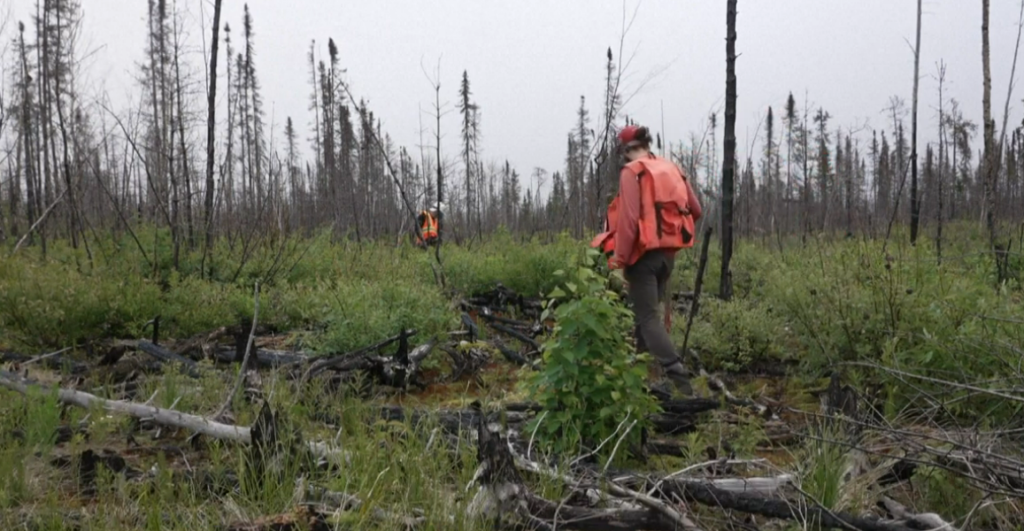
A Swedish robotics project that adopts a different but complementary strategy is worth mentioning here. The Södra forestry cooperative created BraSatt, a ground-based autonomous robot that plants trees in predetermined patterns while navigating through forest terrain. Although the dataset supporting those figures is still quite small, Södra reports a three-year survival rate of 70–75% for BraSatt-planted trees, which is a significant benchmark. Survival rates for drone-seeded trees—trees that weren’t meticulously hand-placed by someone who could assess soil moisture, rock density, and microclimate on the spot—remain genuinely uncertain at scale, according to researchers in this field. Planting a seed pod is not the same as planting a tree.
It’s difficult to ignore the fact that this distinction is frequently overlooked in discussions about drone reforestation. An attention-grabbing headline is “a billion seeds fired into the ground.” A billion trees that live to adulthood tell a different, more intricate tale. The biodiversity of the original forests is rarely replicated in replanted forests, new vegetation alone does not restore damaged soil, and more is needed for true ecological restoration, according to critics. All of that has some validity. However, it also seems a bit like allowing perfection to become the antithesis of necessity. It is obviously worse to do nothing while the deficit grows.
An additional level of complexity is introduced by the economic aspect. Drone planting is significantly more feasible at the scales under consideration because it costs about 15% less than traditional hand planting. However, it also brings up awkward issues in areas where thousands of people find seasonal work in planting trees, such as parts of Canada’s northern provinces where young laborers spend their summers planting in boreal forests. Reforestation is probably not an exception to the rule that technology can solve efficiency issues while creating new social ones.
This technology seems to be a few years away from its true testing ground. The test flights have shown promise. There appears to be a sincere institutional interest in the strategy based on the collaborations with the UN and local governments in Australia, Myanmar, and other places. Whether drone-planted forests can develop into something that truly serves as a forest—sheltering wildlife, cycling water, and creating soil—rather than merely appearing like one from above is still to be seen. The next ten years of data will have to provide an answer to that question.
Disclaimer
Nothing published on Creative Learning Guild — including news articles, legal news, lawsuit summaries, settlement guides, legal analysis, financial commentary, expert opinion, educational content, or any other material — constitutes legal advice, financial advice, investment advice, or professional counsel of any kind. All content on this website is provided strictly for informational, educational, and news reporting purposes only. Consult your legal or financial advisor before taking any step.
