

As of March 2025, there are 274 verified moons of Saturn.
This number has significantly increased our knowledge of the planet’s gravitational reach and was revised upon the confirmation of 128 more tiny satellites. Astronomers had been working with a figure closer to 146 just a year before. Instead of abrupt pandemonium in space, the jump was the result of meticulous observation, precise calculations, and perseverance.
Astronomers have employed incredibly effective tracking methods in recent months to confirm steady orbits around Saturn by spotting really faint objects and tracking them over time. It takes multiple measurements to prove that a speck of light is actually a moon and that its motion is centered on the planet rather than traveling on its own.
It’s a laborious but incredibly successful technique.
| Category | Details |
|---|---|
| Planet | Saturn |
| Confirmed Number of Moons (March 2025) | 274 |
| Newly Confirmed Moons in 2025 | 128 |
| Previous Confirmed Count (2024) | Approximately 146 |
| Largest Moon | Titan (larger than Mercury) |
| Ocean Moon | Enceladus (subsurface ocean with water plumes) |
| Smallest Moons | Irregular, tiny fragments — some comparable to the size of a sports arena |
| Governing Authority for Moon Recognition | International Astronomical Union (IAU) |
| Primary Scientific Source | NASA Science – Saturn Moons Overview |
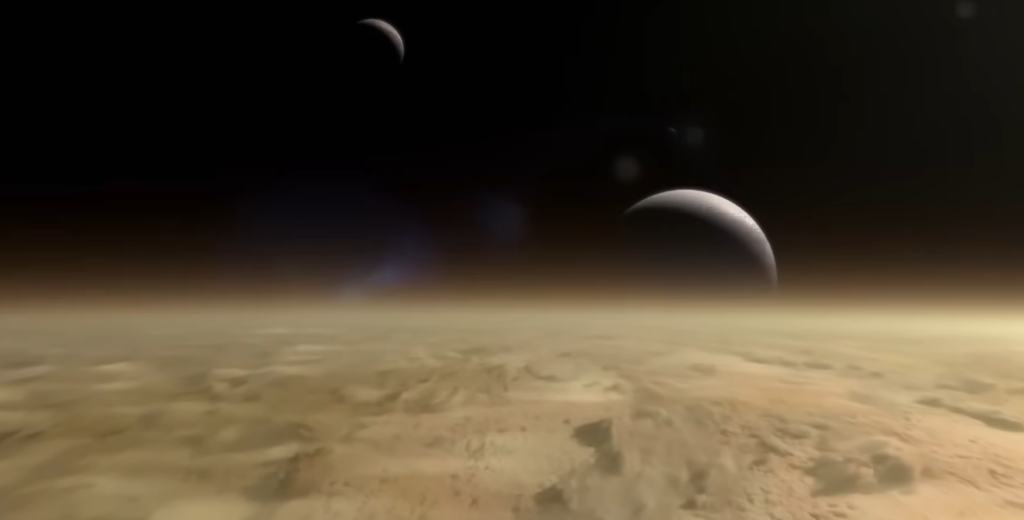
Due to a huge gain in telescope sensitivity over the last ten years, scientists are now able to discover smaller and fainter things than previously possible. Numerous irregular fragments of the 128 recently identified moons orbit far from Saturn’s brighter, more well-known satellites, most likely relics of previous collisions.
Saturn has an extremely powerful gravitational pull. Because it is roughly nine times as broad as Earth, it may easily trap passing debris with its force. If Earth were the size of a nickel, Saturn would resemble a volleyball more, retaining items that could otherwise slip away.
Size is important. The location also matters.
Saturn was situated further away from the Sun and originated in an area that was abundant in stony and ice debris. In the early solar system, collisions were frequent and resulted in debris that continued to orbit after being captured. Over millions of years, those pieces came together to form a system that now appears to be remarkably adaptable in terms of both size and structure.
Giant moons exist. Some are hardly more than debris.
Of Saturn’s family, Titan is still the biggest and most noticeable. It has lakes of methane on its surface and a dense nitrogen atmosphere, making it larger than Mercury. Because Titan shines brightly enough to be viewed with simple equipment, amateur astronomers can observe it through a telescope for remarkably little money.
A distinct tale is told by Enceladus.
There is a worldwide ocean beneath its frozen crust that spews water vapor plumes into space. These jets, which were found by the Cassini mission, were especially groundbreaking discoveries that changed the focus of science and made Enceladus an attractive target for further investigation.
After reading about the plume finding late one evening, I recall having a silent outburst of admiration for how a tiny, icy moon could so profoundly alter scientific thought.
Other big moons, including as Rhea, Dione, Tethys, Iapetus, and Mimas, have surfaces that have been formed by geological pressures and impacts; some of these surfaces are tidally locked, while others exhibit remarkable brightness differences. Iapetus’s hemispheres of light and dark seem to have been painted almost purposefully. Mimas is drastically beaten due to the scarring caused by a large crater.
The smallest objects, however, have caused the most significant shift in Saturn’s moon count.
Tracking them is a logistically challenging but very reliable science. Saturn’s distance from Earth is hundreds of millions of miles. In addition to strong telescopes, long-term observation and accurate orbital path charting are necessary for detecting dim objects at that distance.
Through thorough data analysis and enhanced imaging technologies, astronomers were able to demonstrate that these objects complete regular circles around Saturn. They are recognized as official moons by the International Astronomical Union after those orbital durations are recorded and confirmed.
It is now verified that the total is 274.
With that number, Saturn has more moons than any other planet, even surpassing Jupiter’s currently confirmed satellites. Tracking league standings in athletics is a remarkable analogy; while the figures change when new findings are verified, the fundamental procedure is still rigorous and controlled.
Why is Saturn so populated?
Debris is reliably captured by its gravitational field. The early solar system had plenty of material because of its location. And more fragments were probably created throughout time by collisions, orbiting in intricate patterns and interacting with Saturn’s rings and one another.
Some moons even contribute to the ring’s shaping by filling in spaces and directing particles along distinct edges—all part of an incredibly effective gravitational dance.
It is still a personal experience for skywatchers. Titan is visible as a tiny dot next to Saturn in bright sky. With improved tools, one may see the weak but steady glints of Rhea, Tethys, Dione, Enceladus, Iapetus, and Mimas.
It gives perspective to know that hundreds more orbit undetected.
Disclaimer
Nothing published on Creative Learning Guild — including news articles, legal news, lawsuit summaries, settlement guides, legal analysis, financial commentary, expert opinion, educational content, or any other material — constitutes legal advice, financial advice, investment advice, or professional counsel of any kind. All content on this website is provided strictly for informational, educational, and news reporting purposes only. Consult your legal or financial advisor before taking any step.
