

The space was clean, sterile, and clinically bright, and it seemed familiar. However, something remarkably strange was hovering just over the patient’s forehead: a semi-transparent image that shimmered in perfect harmony with the anatomy below. This was neither a robotic helper nor a mobile monitor. It was a hologram that was seen through a headgear that was fastened to the surgeon’s forehead and held in place only by light and data.
Modern surgery underwent a silent revolution at this time. For the first time, physicians at Beijing’s Xuanwu Hospital employed mixed reality to perform a procedure—live, in real time, with holograms directing the blade—instead of just preparing for it. The procedure is called external ventricular drain placement, and it involves inserting a catheter into the ventricles of the brain. Despite being often used in neurosurgery, there is a considerable chance of error because of the little margin for accuracy. The difference now is that, when projected, that pathway may be made remarkably apparent.
The surgical team saw holographic overlays created from the patient’s own CT images through the HoloLens headgear. These were more than just artistic animations. Safe areas, important structures, and the most correct insertion route were all highlighted in these spatially accurate 3D roadmaps. The way these images tracked the surgeon’s sight and could be adjusted with a slight hand gesture or head tilt was especially creative. It was instinctive, nearly instinctive.
This MR-assisted treatment was administered to fifteen patients over the course of the four-month clinical trial. An additional fifteen were placed using conventional freehand methods. The outcomes were strikingly successful. Surgeons in the control group required an average of 2.33 tries to position the catheter appropriately. It required somewhat more than one pass—1.07 to be precise—in the mixed reality group. Not only was accuracy increased, but it was significantly changed.
| Key Detail | Description |
|---|---|
| Technology Used | Mixed reality via Microsoft HoloLens headset |
| Procedure Type | External Ventricular Drain (EVD) insertion |
| Technique | 3D holographic CT-based surgical planning overlaid on live patient anatomy |
| Success Metrics | 1.07 passes vs. 2.33 in standard method; target deviation significantly reduced |
| Patients | 15 in hologram group; 15 controls |
| Key Advantage | Enhanced spatial accuracy, fewer passes, no complications |
| Future Implications | Could expand to tumor resections, heart procedures, orthopedic navigation |
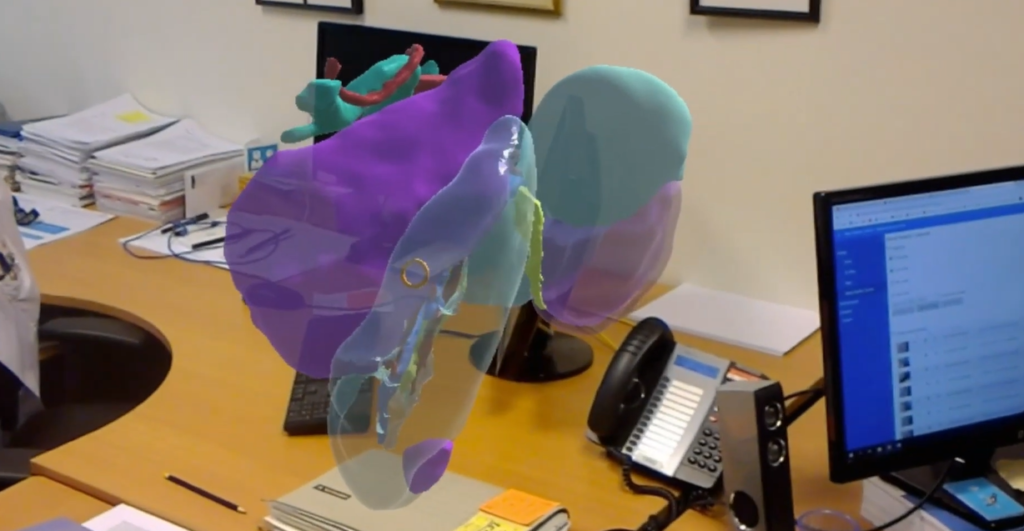
The hologram-guided group did not have any issues. None needed to be reinserted. Not only did the technology help, but it also provided a degree of spatial clarity that is hard to duplicate with only feel and experience. The headset enabled the surgeon to see past the skin, the skull, and the guessing by projecting the invisible into visible space.
As I read this, I can still picture the surgeon’s serene assurance, scales in hand, guided by projection rather than guesswork. Just that feels like a big step forward.
The hologram’s ability to change is especially helpful. The technology recalibrates itself in real time by applying sticky marks to the face and making adjustments for every angle of vision. The digital map is held in place even if the surgeon moves. This makes it possible to make extremely effective adjustments in the middle of the procedure, guaranteeing that every move matches the live anatomy.
Of course, there were hiccups. The model of one patient needed to be manually realigned after it strayed a little. Surprisingly, though, that moment made clear that the surgeon still had the last say. Technology never dictated; it just offered advice. And this tool’s remarkable durability in clinical practice may be due to that equilibrium.
The procedure proved sustainable even with the additional setup time of roughly 41 minutes per instance. It might become commonplace once it is simplified using internal software, which the team has already started creating. In comparison to previous surgical navigation systems, the equipment is remarkably inexpensive and wireless. Accessibility is important, particularly for organizations looking to improve treatment without raising costs.
There has been a surge of technologies in medicine during the last ten years that offered great promise but came with steep learning curves. This approach is unique in that it integrates seamlessly. The headset blends in with the flow and doesn’t interfere. The images support training rather than take its place. Most significantly, the approach does not require physicians to alter their practices. They can simply function with improved visibility thanks to it.
The consequences go well beyond brain surgery. Similar methods are already being studied for cancer resections, cardiac treatments, and orthopedic surgeries. Every application is based on the same idea: your ability to act more precisely increases with your level of vision.
This technology is developing through clinical trials and strategic partnerships—not as a futuristic trick, but as a useful instrument that improves human ability. This first hologram-guided procedure is therefore more than just a medical marvel; it serves as a model for future procedures.
The surgeon will not be replaced by mixed reality. It won’t automate the slowing of breathing and steadying of hands. However, it will provide a level of clarity never before seen in that instant. And in that clarity, lives will be saved—not just more precisely, but with greater assurance.
Disclaimer
Nothing published on Creative Learning Guild — including news articles, legal news, lawsuit summaries, settlement guides, legal analysis, financial commentary, expert opinion, educational content, or any other material — constitutes legal advice, financial advice, investment advice, or professional counsel of any kind. All content on this website is provided strictly for informational, educational, and news reporting purposes only. Consult your legal or financial advisor before taking any step.
