

A fifteen-year-old girl rode her bike to the Swedish parliament building in Stockholm early on August 20, 2018, took a seat on its steps, and displayed a hand-painted sign. Skolstrejkỹ Klimatet, or School Strike for Climate, was written on the sign. On her first day, no one joined her. A few people looked at her. The majority continued. She distributed flyers. She sat from 8:30 in the morning until school hours ended. After that, she left for home and returned the following day and the day after that.
| Full Name | Greta Tintin Eleonora Ernman Thunberg |
|---|---|
| Born | January 3, 2003, Stockholm, Sweden |
| Nationality | Swedish |
| Known For | Climate activism, Fridays for Future movement, UN speeches, global school strikes |
| Parents | Svante Thunberg (actor), Malena Ernman (opera singer) |
| Diagnoses | Asperger syndrome, OCD, selective mutism — described by Thunberg as a “superpower” |
| Movement Founded | Fridays for Future (School Strike for Climate), began August 2018 |
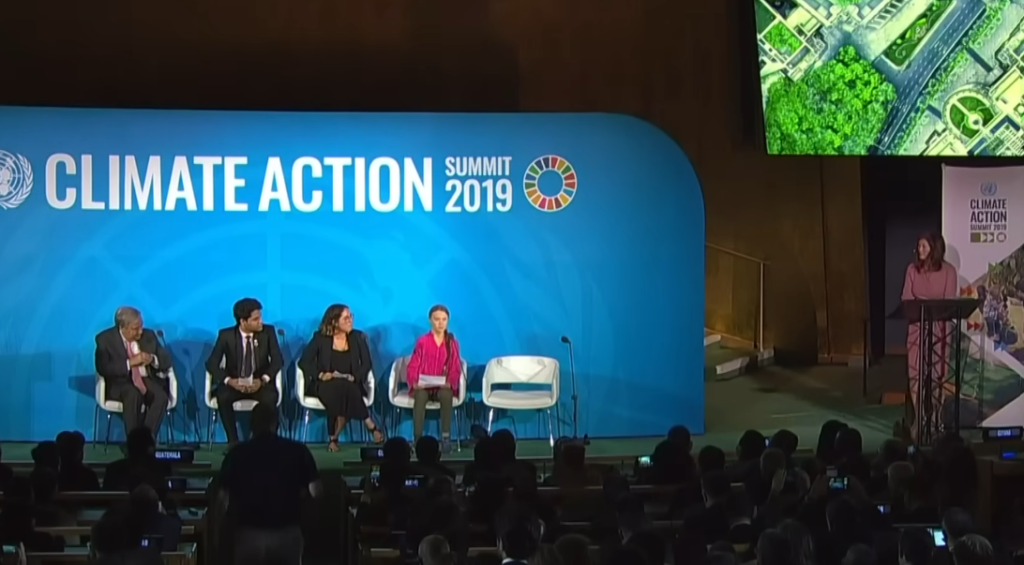
| Key UN Appearance | UN Climate Action Summit, September 23, 2019, New York City |
| Major Publications | No One Is Too Small to Make a Difference (2019); The Climate Book (2022) |
| Notable Awards | Time Person of the Year 2019; Amnesty International Ambassador of Conscience Award; Right Livelihood Award |
| Nobel Peace Prize | Nominated multiple times (2019, 2020, 2021, 2022, 2023) |
| Expanded Activism | Indigenous rights, Palestinian solidarity, Ukraine, Armenian rights, anti-fascism protests |
| Reference Links | UN DESA – Greta Thunberg at the Climate Action Summit · UN Media – Greta Thunberg at the General Assembly |
The image’s sheer, unyielding ordinariness is something worth pondering. No crowd, no microphone, no media equipment. Just a teenage girl who had determined that the adults in her immediate environment were lying about the scope of what was happening to the planet, with the unique clarity that occasionally accompanies Asperger syndrome and an unwavering relationship with data. She had spent years attempting to use graphs to explain it to her parents. She accused them of stealing her future when that failed. Eventually, instead of continuing to fly, her mother gave up an international opera career. Her father later stated that initially, it was more about keeping their daughter alive than it was about the weather. She had stopped going to school, eating, and speaking. She had a place to store everything thanks to the climate strike.
Greta Thunberg’s image as a lone figure on parliament steps had grown to something nearly unthinkable by the time she entered the UN General Assembly chamber on August 30, 2019, having just spent 15 days traveling across the Atlantic on a zero-emission racing yacht called Malizia II. She had unintentionally started the Fridays for Future movement, which has expanded into a global network of youth-led strikes in over 100 countries. On September 20 and 27, 2019, an estimated 4 million people participated in one of the biggest coordinated climate protests in history. She had previously addressed the parliaments of Britain, Europe, and France, as well as at COP24 in Poland and the World Economic Forum in Davos. She was personally thanked by Pope Francis. On Twitter, Donald Trump made fun of her. In response, she updated her bio to exactly match his description.
She spoke for three minutes and forty-five seconds on September 23 at the Climate Action Summit. It wasn’t a policy document. It wasn’t tactful. “This is all wrong,” she declared as she stood in front of the gathered heads of state. I’m not supposed to be up here. On the other side of the ocean, I should be back in school. However, you all come to us young people in search of hope. How dare you? Almost instantly, the phrase became widely known. It was quoted in parliaments, used in classrooms, projected onto the United Nations building, and set to death metal music. Later, while observing from the audience, UN Secretary-General António Guterres publicly acknowledged that his generation had not done enough to address the climate crisis. “No wonder they are angry,” he remarked.
It’s difficult to ignore how much of Thunberg’s response—from those in positions of real authority—focused on her tone, age, diagnosis, appearance, family, and anything else other than the content of her remarks. She was described as “kind and sincere” by Vladimir Putin, who also implied that she was being tricked. She was referred to as a brat by Jair Bolsonaro. Trump said she needed to learn how to control her anger. The pattern was obvious: the person making the argument is attacked when it cannot be refuted. It was amazing how unconcerned she appeared to be. She had said from the beginning that she only spoke when she thought it was necessary. It was obvious that she felt it was essential.
Thunberg’s presence at the UN was especially poignant because of the background she brought with her. She specifically traveled by sailboat because she had refused to fly, a decision that cost her mother a global career and that she steadfastly upheld despite the inconvenience. She identified the injustices committed against Indigenous peoples as being inextricably linked to the climate crisis itself, acknowledging at each stop on her North American tour that she was standing on Indigenous land. Along with Lakota youth activist Tokata Iron Eyes, she traveled to Standing Rock, the site of years of Indigenous-led protests against the Dakota Access Pipeline. She was subsequently given a traditional Lakota name, Maphiyata echiyatan hin win, which translates to “Woman Who Came from the Heavens.” It was one of the few accolades she accepted without hesitation.
What the Thunberg moment ultimately produced is still genuinely unclear. In the 2019 European Parliament elections, green parties achieved their best-ever results, partly due to the “Greta effect.” UK public concern about the environment soared to record levels. Young activists like Thunberg, according to German Chancellor Angela Merkel, have forced her government to act more quickly. However, Thunberg herself noted that greenhouse gas emissions had increased by 4% since 2015 during COP25 in Madrid later that year. At the podium, she declared that the strikes had “achieved nothing.” She was correct about the numbers, and her candor felt like a rebuke to the world’s leaders as well as to the cozy notion that widespread awareness inevitably leads to widespread change. She had said, “The eyes of all future generations are upon you.” The question of whether those eyes are sufficient is still unanswered.
