

There is a surprisingly close relationship between mathematics and music, one that is both remarkably analytical and exquisitely artistic. Despite their apparent differences, these two fields are based on the same principles: rhythm, structure, and patterns. The connection is very evident and backed by science, regardless of whether a child learns fractions through musical notes or imagines algebraic sequences as melodies.
Harvard Medical School’s Dr. Nadine Gaab has long researched the influence of music on developing brains. According to her research, listening to music improves the brain’s executive functions, which include the processes that underlie focus, adaptation, and planning. The brain does calculations that are strikingly similar to solving equations when a musician interprets tempo or modifies rhythm. Both hemispheres of the brain are improved by this dual creative and precision exercise, creating a very flexible learning foundation.
Music has a particularly positive effect on spatial-temporal reasoning. According to a Stanford University study, children who played the piano for just eight months outperformed their peers in terms of spatial-temporal skills by 34%. In fields like geometry and physics, where logic and imagination collide, this kind of thinking is crucial. Students develop their ability to mentally arrange sequences and visualize solutions by converting sheet music into coordinated movement. This ability is just as beneficial when solving challenging mathematical problems.
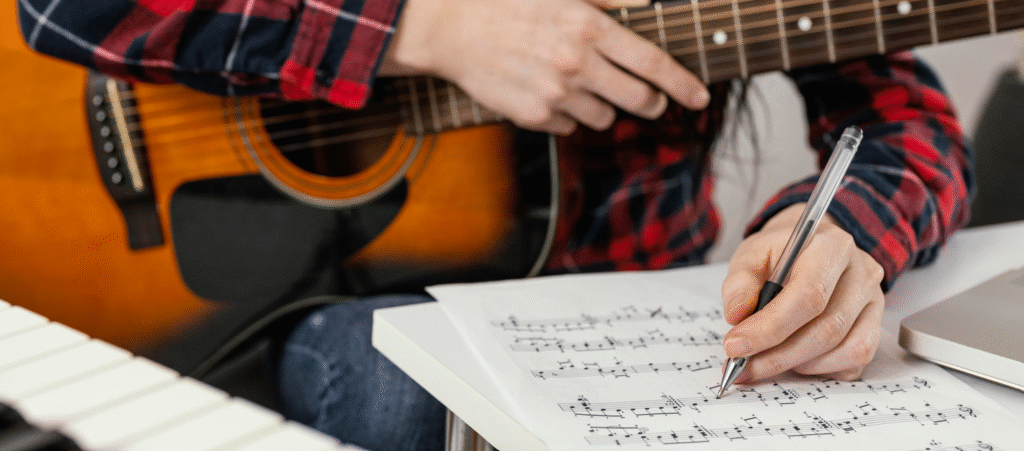
Math teachers’ explanations of division are remarkably similar to how rhythm teaches fractions to kids. Relationships in time between whole, half, and quarter notes reflect numerical patterns. Young students intuitively internalize ratios through repetition, understanding abstract concepts much earlier than anticipated. Numerous educators have noticed that students with musical training approach mathematical problems in a rhythmic manner, almost as if they are writing their solutions rather than calculating them.
The way that music encourages perseverance is what makes this connection so powerful. Every child who plays an instrument learns that patience and consistent discipline are the keys to progress. Mathematical thinking requires the same attitude. Compositional difficulties are similar to difficult problem sets in that they both call for concentration, repetition, and analytical adaptability. Every note practiced and every measure perfected enhances both musical ability and mental stamina.
This relationship extends beyond the classroom. Numerous bright minds serve as examples of how math and music can work in tandem. Albert Einstein claimed that his violin helped him “think musically” when he approached scientific theories, and Queen’s renowned guitarist Brian May earned a PhD in astrophysics. These examples are especially motivating because they show how analytical discovery is fueled by creativity. Both philosophers combined creativity and accuracy through rhythm as a means of accessing abstract thought.
Training in music improves emotional intelligence in addition to cognitive abilities. The ability to concentrate under pressure, which is a skill that is very effective in academic testing and problem-solving, is taught by performing on stage. Higher emotional control is developed by music students, which improves learning outcomes, according to studies published in Nature. Their capacity to control stress results in improved focus and flexibility, two traits essential for grasping complex mathematical ideas.
Measurable benefits are being experienced by nations that embrace this connection. Students in Singapore and Finland, where music is ingrained in the curriculum, routinely surpass global standards in STEM and creative subjects. Their educational systems show that combining logic and the arts produces flexible, inquisitive, and self-assured thinkers. Using melody and rhythm in the classroom is not just a creative endeavor; it is a calculated educational move.
Music exposure, even for brief periods, can have an impact. According to Dr. Gordon Shaw’s research from the University of California, children’s reasoning abilities were considerably enhanced by just four months of piano lessons. These studies demonstrate that learning to play is more than just a pastime; it’s a form of mental exercise for the growing brain. The neural pathways that music creates enable quicker information processing and improved memory retention, two abilities that are essential for precise math.
Dr. Gaab and her colleagues, of course, warn against oversimplification. Although not all children who receive musical training go on to excel in math, there is still a strong correlation between the two subjects. A large portion of this overlap can be explained by shared cognitive characteristics like executive control, motivation, and attention. Whatever the cause, the relationship itself continues to be very advantageous for the advancement of education, promoting a more all-encompassing method of instruction.
Mathematics is made more relatable by this interaction between structure and sound. Abstract numbers are transformed into audible and perceptible patterns through music. A pianist uses numerical logic on a sensory level when they break a bar up into rhythmic intervals. Because of this tactile connection, students can physically experience math, which makes comprehension both pleasurable and incredibly intuitive.
People who can think creatively and logically are valued by society more and more. Entrepreneurs such as Steve Wozniak and Elon Musk have frequently mentioned their musical upbringing as a component of their approach to problem-solving. Their capacity to “see patterns where others see noise” is a reflection of the way that rhythm fosters critical thinking. Once thought to be unrelated, the harmony between art and math is now influencing the next generation of designers, engineers, and inventors.
This synergy can be effectively harnessed by educators and parents. Playing an instrument helps kids develop more than just their musical abilities; it also helps them develop their critical thinking, memory, and self-confidence. Percussion and the piano are especially good at teaching timing and division to younger kids. For older students, creating digital music reinforces mathematical understanding through design and sound by fusing creativity and algorithmic logic.
Disclaimer
Nothing published on Creative Learning Guild — including news articles, legal news, lawsuit summaries, settlement guides, legal analysis, financial commentary, expert opinion, educational content, or any other material — constitutes legal advice, financial advice, investment advice, or professional counsel of any kind. All content on this website is provided strictly for informational, educational, and news reporting purposes only. Consult your legal or financial advisor before taking any step.
