

Usually, it begins with a neatly folded, straightforward letter from the Ministry. It notifies you that your child has been accepted into a nearby elementary school. It also subtly reminds you that, unless you have a pink NRIC, education is not totally free here. The monthly cost is a symbolic $25 for Singaporeans. For others, however, the numbers rise—sometimes sharply.
The range starts at S$580 and goes up to S$700 for permanent residents. That’s already a considerable leap. However, the number increases even more if you are an overseas parent—for example, if you have a dependant or employment pass: S$991.80 to S$1,688 per month, depending on your child’s nationality. It’s a pricing structure that’s been progressively escalating, almost rhythmically, over the previous five years.
By 2023, the Ministry of Education had already declared its plan to introduce annual price hikes for non-citizens, citing “cost sharing” and “equity.” Some considered this as very good policy calibration; others, notably expat parents, saw it as a soft push toward foreign schools. Families are undoubtedly influenced by the figures while making decisions.
| Student Type | Monthly Fee (Govt/Govt-Aided Schools) |
|---|---|
| Singapore Citizens | S$25 |
| Permanent Residents (PRs) | S$580–S$700 |
| International (ASEAN) | S$991.80–S$1,111.80 |
| International (Non-ASEAN) | S$1,695–S$1,905 |
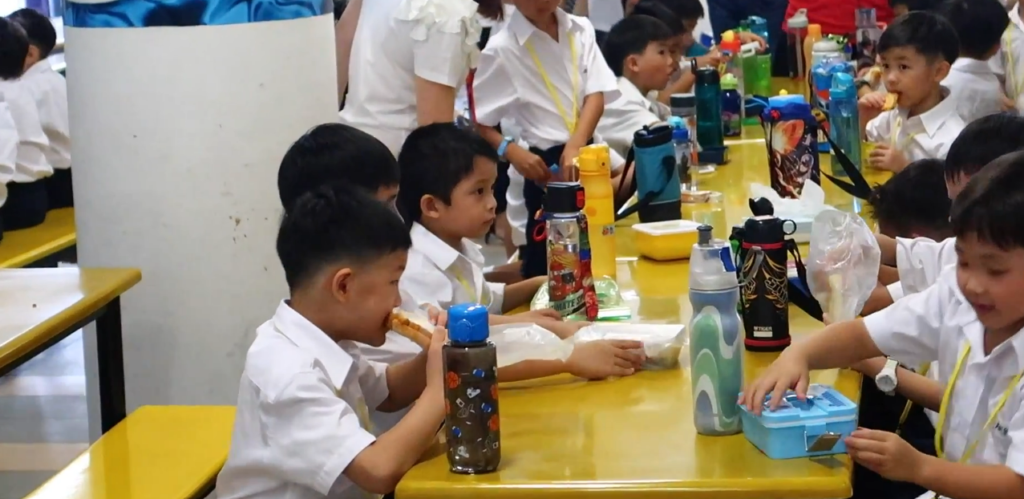
For locals, the fee remains set. Twenty-five dollars a month might not cover a reasonable supper for two, but it unlocks six years of disciplined study. Add a few dollars for typical miscellaneous costs, and the total still feels shockingly reasonable. This isn’t an accident—it’s policy by design. The government presents education as a shared investment by subsidizing a remarkably high percentage of the cost for residents.
However, the fee differential continues to be a silent signal in spite of this subsidization. It says: this is our system, and while we welcome others, there is a tiered price of access. The strategy is especially practical rather than punitive. It provides access while upholding a social compact by striking a balance between demographic openness and national resources.
In early 2025, I went on a school tour in Bedok, where the principal of a government-aided school casually revealed that 15% of their student body was international. She added—with a tone of admiration—that these students regularly ranked in the top decile. Their parents, she said, were “extremely committed,” a statement that carries more weight when tuition surpasses S$18,000 a year.
I was then impressed by how education here serves as a strategic filter in addition to being a service. Singapore screens out those who have made significant investments by charging foreigners higher charges. Those who stay, pay. Surprisingly, a lot still do.
Private schools—particularly the international ones—are priced on a different scale entirely. The annual cost of basic education at One World International School is around S$21,034. Tanglin Trust and GESS rise much farther. These schools provide families looking for flexible pedagogy, various cultural settings, and well-known curricula. They may feel mismatched with MOE schools because of their strict schedules and restricted spaces. But for others, the value offer remains enticing.
There’s also the question of quality. The quality of instruction is noticeably constant in the majority of MOE schools. Resources are equitably dispersed. The facilities are practical, if not opulent. Pedagogical standards are closely checked, and teachers are regularly upskilled. The end product is a very dependable system that generates one of the most robust reading and numeracy baselines in the area.
Still, beneath the surface, a slight inequity emerges—not in access, but in incidental assistance. Even for citizens, private tutors, enrichment programs, and tuition centers can easily cost more than the official school rates. The true arms race in education frequently takes place there.
In the framework of national cohesiveness, school fees do more than balance budgets. They shape social narratives. They have an impact on who and how enters the system. They highlight a greater message: education is a shared undertaking, but not an identical route for everybody.
The Ministry has developed a pricing system that does more than just pay for classrooms by incorporating various charge structures. It conveys identity, value, and strategic intent. And perhaps more gently, it begs a silent question of every parent: how much are you willing to invest—not only financially, but in belonging?
This tiered structure is likely to persist over the coming years as Singapore manages its changing demographics and educational priorities. It will probably be modified, possibly improved, but it will continue to serve as a gatekeeper and a guide.
The system continues to be a balancing act for lawmakers. It’s a choice point for parents. And for the students—blazers too big, sneakers scuffed from the morning sprint—it’s just the beginning of another school day, ignorant of the silent economy beneath their desks.
Disclaimer
Nothing published on Creative Learning Guild — including news articles, legal news, lawsuit summaries, settlement guides, legal analysis, financial commentary, expert opinion, educational content, or any other material — constitutes legal advice, financial advice, investment advice, or professional counsel of any kind. All content on this website is provided strictly for informational, educational, and news reporting purposes only. Consult your legal or financial advisor before taking any step.
