

At exactly 8:30 a.m., a robotic assistant wheels into the classroom, gives a perfectly timed bow, and begins reading aloud from the national curriculum. The students, most barely out of basic school, don’t flinch. For them, this is math time, not science fiction.
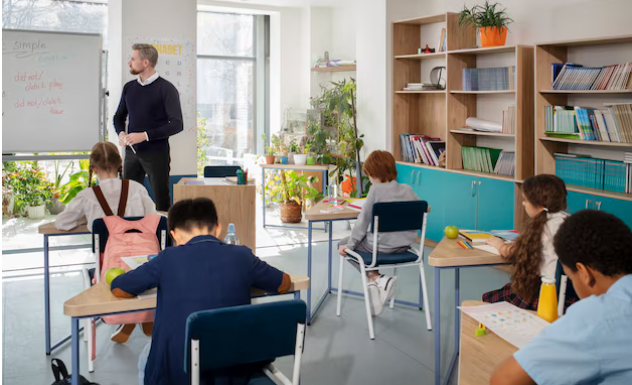
Humanoid robots and AI-powered teaching aids are being incorporated into regular classroom activities throughout Tokyo. These aren’t just novelty items brought out for particular occasions. They are now expected to provide explanations, tests, guidance, and even encouragement as regular employees.
AI Educators in Tokyo – Key Context
| Category | Details |
|---|---|
| Location | Tokyo, Japan |
| Implementation | AI-powered instructors, humanoid robots, voice-interactive teaching assistants |
| Age Group Targeted | Elementary and middle school students (typically 11–14 years old) |
| Primary Goals | Alleviate teacher shortages, personalize learning, enhance digital literacy |
| Ethical Focus | Empathy, fairness, accountability, emotional development, inclusivity |
| Supporting Program | Critical AI Literacy Workshops with children (ages 11–12) |
| Notable Challenges | Emotional nuance, data use, bias detection, monitoring overload |
| Credible Source | Ministry of Education Japan, OECD reports on digital pedagogy and AI integration |
It began with easy exercises like math flashcards, vocabulary drills, and pronunciation adjustments. Slowly, their role has grown. These bots are becoming an anchor for students who might otherwise fall behind because of their capacity to customize responses and adjust to varying learning speeds. Their presence has been particularly beneficial for those with attention or language issues.
By leveraging speech recognition and emotional AI, these bots can now recognize when a youngster is confused or disengaged and gently pivot the lesson in real time. That feedback loop—rapid, data-rich, and nonjudgmental—has become a type of silent support system in the classroom.
For many instructors, the transformation was as unexpected as it was rapid. Japan’s elderly population and teacher scarcity produced an especially severe need. In some places, human teachers were juggling 40 or more pupils per class. AI was created to relieve them, not to replace them.
Children were asked to create their “ideal future classroom” during workshops that took place all across Tokyo last year. Most drawings contained AI teachers—some floating, some glowing, some delightfully odd. Yet nestled amid the enthusiasm were modest concerns: empathy, justice, emotional safety.
One child illustrated a panic button “for when the robot doesn’t listen.” Another showed a little, bearded human teacher in the corner labeled, “backup brain.”
The kids weren’t wrong. These AI systems are incredibly good at seeing trends and tailoring lessons, but they are much less able to react to social subtleties. A muttered insult, a moment of obvious distress, a nervous laugh—these are often ignored. And when missed, they are not addressed.
That session, part of an expanding “critical AI literacy” program, was designed not merely to teach coding but to stimulate intelligent inquiries about how AI behaves, what data it sees, and what rules it follows. For a generation growing up fluent in computer interaction, this kind of introspection feels particularly vital.
Tokyo’s education government has responded by requiring moral components in digital curriculum. Some schools are even experimenting with student feedback systems where students can score their AI tutors, marking confused responses or exchanges that felt “cold.”
By bringing children into the feedback loop, the city is doing something especially progressive—treating kids not as passive digital consumers but as informed co-designers. How can we train a child to challenge a computer that’s always confident? When every AI response seems incredibly clear, how can we maintain uncertainty as a valid component of learning?
In classrooms where these tools are completely implemented, students now receive individualized feedback after every task, replete with progress graphs and voice-guided reviews. Compared to traditional grading, it is far quicker and more accurate. But it’s also less forgiving.
One student stated during a focus group, “The robot never forgets my mistakes.” The others nodded.
Yet for all the criticism, the benefits are tough to reject. Children who previously felt ignored now receive regular input. Those with learning difficulties encounter teaching modified to their rhythm. And teachers—human teachers—are finding new ways to work in tandem with robots, using them to streamline routines and free up energy for emotional direction.
Through strategic relationships with universities and tech corporations, Tokyo has constructed an immensely dynamic system that bends based on the school’s needs. In higher-income communities, AI tools augment already great classroom participation. In lower-income wards, they sometimes carry the instructional weight totally.
AI can explain a math formula, but it cannot see the spark of self-doubt in a student’s eyes or recognize when laughing covers humiliation. Instructors can.
Because of this, several educational institutions are experimenting with hybrid models, which allow AI to control the pace of the course while humans move around the classroom and concentrate only on making connections.
It’s an approach that’s gaining appeal, particularly in regions where social-emotional development is prioritized. In this case, robots serve as scaffolds rather than replacements. Additionally, “The best teachers don’t see AI as a threat,” according to one principal. They regard it as a second pair of hands and ears.”
That hope is echoed by many families, especially those who’ve seen children thrive under more individualized settings. The instant improvements in student confidence and classroom quiet are difficult to ignore, even though some people are still concerned about data privacy and long-term implications.
In the next years, Tokyo’s strategy may become a model. Not because it has solved every problem, but because it has ventured to pose every question. What should a teacher be? Who decides how youngsters learn? What if we educated kids to challenge even the most beneficial devices?
When one student recently asked whether the robot would ever retire, the teacher smiled and responded, “Only if you teach it how.” A new type of school is emerging somewhere between student drawings and steel circuits, between moral algorithms and well-lit hallways. One not characterized by robots or people alone—but by the discourse between them.
Disclaimer
Nothing published on Creative Learning Guild — including news articles, legal news, lawsuit summaries, settlement guides, legal analysis, financial commentary, expert opinion, educational content, or any other material — constitutes legal advice, financial advice, investment advice, or professional counsel of any kind. All content on this website is provided strictly for informational, educational, and news reporting purposes only. Consult your legal or financial advisor before taking any step.
