

It doesn’t quite seem serious when it first appears on a screen. A glossy, animated pineapple flirting with a strawberry, with slightly off voices and overly dramatic expressions. A beach can be seen in the distance; it is synthetic, looping, and strangely ideal. It appears to be a parody. The view count then shows up. Millions.
That is “Love Island AI Fruit’s” peculiar gravity. People are drawn to it despite the fact that it seems disposable and even ridiculous. It’s difficult to ignore how frequently these clips—brief bursts of drama between anthropomorphic fruits, complete with betrayal arcs, love triangles, and cliffhangers that seem both absurd and strangely captivating—appear when browsing TikTok late at night.
| Category | Details |
|---|---|
| Trend Name | Love Island AI Fruit |
| Platform Popularity | TikTok, YouTube, Instagram |
| Content Type | AI-generated animated parody series |
| Concept | Fruits as contestants in a Love Island-style reality show |
| Viral Reach | Millions of views per video |
| Notable Characters | “Watermelonina,” “Strawbania,” others |
| Audience Reaction | Mixed—addiction vs criticism |
| Cultural Category | Meme culture / AI-generated entertainment |
| Reference Links | TikTok (Fruit Love Island), YouTube Channel |
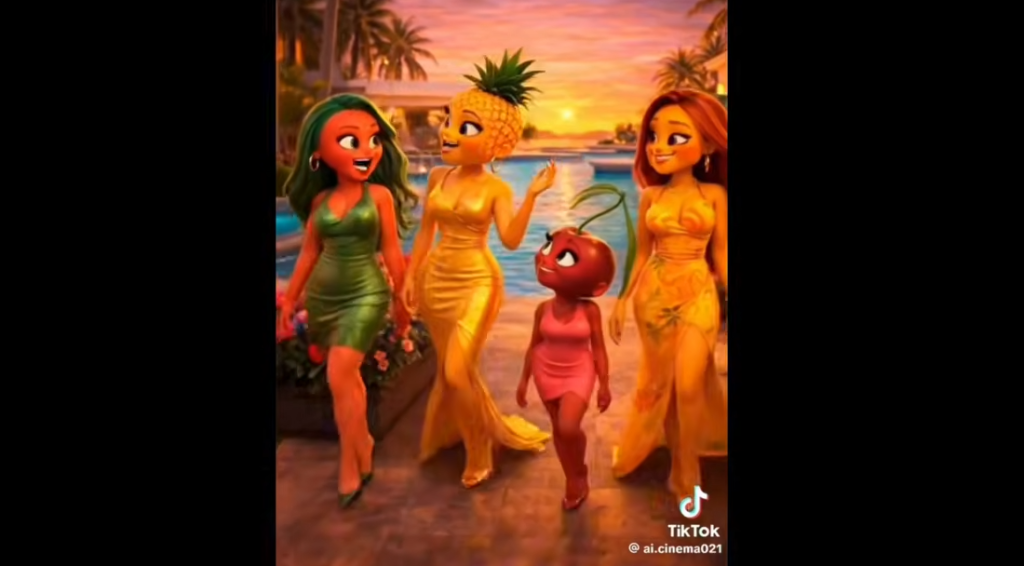
There’s a feeling that the content isn’t the only thing that makes it appealing. It’s possible that the familiarity—the structure of reality TV reduced to something nearly weightless—is what people are responding to. The bombshell arrival, the dramatic reunion, and the hushed confessions all have the same beats. Now, however, Watermelonina is arguing with Cocanike, a coconut, rather than people.
There is a pause as you watch these clips play out. The voices are not in perfect harmony. The eyes change shape in the middle of the scene, leaves appear and disappear, and the characters move subtly from frame to frame. It’s not perfect. However, it appears that this flaw contributes to the allure, or at the very least, to the curiosity that draws viewers in and keeps them watching for a few extra seconds.
Some viewers give it their all, treating these fruit characters like actual competitors. Oddly earnest arguments about who is toxic, who is loyal, and who should be removed from office abound in the comment sections. It’s difficult to ignore how quickly people give meaning to something that, at its most basic, seems to have been created at random.
Others give a sharp pushback. Some people on the internet are becoming increasingly frustrated because they think that this type of content indicates a problem with attention spans and creative standards. It’s surprising how frequently the term “AI slop” is used. Even those who criticize it, however, frequently acknowledge that they have seen multiple episodes.
That paradox seems significant. It’s still unclear if viewers actually like these videos or if they just can’t take their eyes off of them. After all, algorithms reward even the smallest amount of attention. Millions of views can be generated from a few seconds of curiosity, giving the impression of intense engagement when there may only be passing interest.
Another layer is added by the setting itself, those artificially rendered beaches that are perpetually sunny. There is no weather, no unpredictability, and no friction from the real world. Everything has a controlled, nearly frictionless feel to it. It’s entertainment reduced to its most fundamental elements, recurring themes that viewers are already familiar with.
However, there is something strangely illuminating about its popularity. Exaggeration has always been a key component of reality TV, transforming minor feelings into significant events. “Love Island AI Fruit” advances this concept by completely eliminating the human component while maintaining the emotional framework. It begs the silent question of how much reality TV was actually about reality in the first place.
The speed at which this trend has spread is difficult to ignore. The format is changing almost instantly, from short TikTok videos to longer YouTube compilations, from informal reposts to entire “episodes.” The algorithm amplifies what sticks while creators experiment and audiences respond.
Beneath the surface, there is also a slight change taking place. Once considered a novelty, AI-generated content is beginning to permeate daily entertainment. There are still some rough edges, but it’s smooth enough for people to interact with it without much hesitation. Even if this specific trend fades, that could have a longer-lasting effect.
However, there is still some uncertainty surrounding it. Such trends frequently have a short lifespan before being replaced by something even more bizarre. “Love Island AI Fruit” might be remembered as a fleeting internet oddity or perhaps as a preview of a new genre of storytelling that is both recognizable and a little unsettling.
As you watch it all happen, you get a sense that reveals more about the audience than the actual content. On a virtual beach, people aren’t merely observing fruit flirt and quarrel. They are contributing, responding, and influencing the story in shares and comment sections.
Disclaimer
Nothing published on Creative Learning Guild — including news articles, legal news, lawsuit summaries, settlement guides, legal analysis, financial commentary, expert opinion, educational content, or any other material — constitutes legal advice, financial advice, investment advice, or professional counsel of any kind. All content on this website is provided strictly for informational, educational, and news reporting purposes only. Consult your legal or financial advisor before taking any step.
