

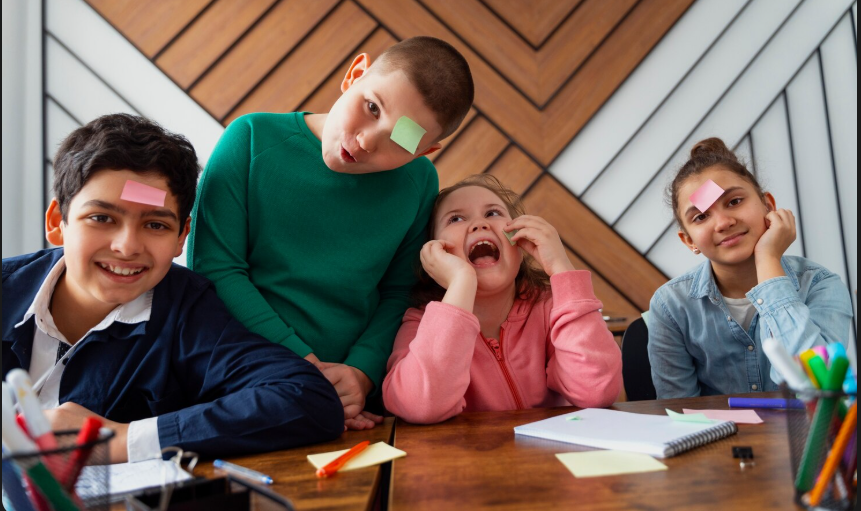
No bells are present. Not a single one. That metallic clang that marks the end of one thing and the start of another won’t be audible to you. Instead, when you walk into most Danish schools, you’ll hear a sort of hum: kids chatting, moving, fighting over a group project in the corner, and a teacher sitting close by with a coffee, present rather than lecturing. It takes a moment to realize that this is a school.
For someone who grew up with strict schedules, color-coded homework planners, and the low-grade dread of Monday morning, it’s difficult to ignore how disorienting that stillness is. Here, Denmark has created something truly unique. It probably says more about your own education than anything else whether you find it inspiring or a little unsettling.
| Category | Details |
|---|---|
| Country | Denmark |
| Education System | Folkeskolen (Danish Public School System) |
| Compulsory School Age | 6 to 17 years old |
| Homework Policy | None mandated until age 15 |
| Exam Policy | No formal exams until age 15 (FSA after Year 9) |
| School Funding | Fully tax-funded; university students receive government stipends |
| Teacher-Student Relationship | First-name basis; flat hierarchy |
| Governing Law | Folkeskoleloven (Danish Primary and Secondary Education Act) |
| Key Focus Areas | Academic, Social, and Emotional Wellbeing |
| Global Happiness Ranking | Consistently among top 3 happiest nations worldwide |
| Notable Feature | Student voices included in school decision-making |
| School Bell System | Not used in most Danish schools |
| Democracy in Education | Research confirms Danish students among the most democratically competent globally |
The Danish system is based on ideas that would be unsettling to most education ministries in the West. Until they are fifteen, children are not given any kind of homework. Before they have had the opportunity to just be curious about the world, there are no standardized tests pushing them in the direction of a ranking.
Free play is the lesson, not a reward at the conclusion of a challenging lesson, starting in nursery school. The philosophy is neither coincidental nor the result of some ambitious progressive experiment gone wrong. It is intentional, supported by decades of social consensus, and legally enshrined.
It’s important to consider what the law actually says. In Denmark, education is required starting at age six and is financed by taxes; however, a child is not required to sit in a classroom by the Folkeskoleloven, the governing legislation. It requires the child to receive an education.
Although subtle, the difference is significant. It is the duty of parents to make sure their children are eventually prepared to engage in a free and democratic society. Surprisingly little is known about how that occurs. This nation has faith in all of its people, even the little ones.
However, that trust is accompanied by a complex web of unwritten rules that are less apparent from the outside. The Danish classroom is typically misinterpreted by those who think it is chaotic. Students gradually, almost osmotically, absorb the mutual respect that underpins the movement, the noise, and the seeming looseness.
A person’s title or position at the front of the room does not grant them respect. It’s merited. Just because the schedule says so doesn’t mean that a teacher who doesn’t interact with students in a genuine way will automatically command their attention. In many respects, that standard is more difficult than the one imposed out of fear of receiving a poor grade.
In Denmark, there is no official, centralized system for evaluating teachers. No external inspector is checking any boxes. The caliber of their everyday interactions with students determines their professional value, if you will. This, according to some critics, makes room for what observers have bluntly referred to as the “coffee-drinking” model, in which a teacher assigns a group task to the class and then withdraws to talk with a colleague, satisfied that everyone is safe and occupied. It does occur. It’s a valid criticism, too. When freedom is granted without responsibility, it can lead to apathy.
Even so, it is challenging to ignore the outcomes. When it comes to independent task management, group problem-solving, and democratic participation, Danish students routinely rank among the best in the world. In almost every way, they are content. Something more stable, not the fake joy of kids instructed to smile for a picture. Growing up without constantly being judged by your peers seems to have a subtle but profound impact on a person’s relationship with education.
When they enroll in more structured universities overseas, students who have encountered both systems frequently describe something intriguing. Some people initially feel as though they have never received a map before. Even though they occasionally experience the shock of being formally evaluated on a curve, American university students characterize their Danish peers as creative, socially confident, and surprisingly self-directed. Danish graduates have a tendency to adjust. They are not broken by the structure. They seem to have spent fifteen years learning how to think instead of how to perform.
As a window into the entire philosophy, the school camps are also worth mentioning, not as a footnote. Every few years, staff and students at Odense International School vanish into Jutland together for four days. They abandon mobile phones. Students who are older sleep in tents. Without irony, they hike all 147 meters of Himmelbjerget, a hill known to the Danes as the Sky Mountain.
The altitude is not the point. The idea is that students from various year groups interact, support one another, and return to school with knowledge about their community that cannot be imparted in a classroom setting.
The Danish model might only be effective because Denmark is Denmark—small, affluent, and culturally homogeneous enough to maintain a level of social trust that would be difficult for other nations to match. That’s a legitimate worry. However, dismissal is also too simple.
The fundamental realization that children learn best when they feel safe rather than threatened, when they are trusted rather than watched, and when their emotional lives are acknowledged as genuine rather than inconvenient is not Danish. It’s simply human.
The bells are not returning. It’s really hard to see why anyone would want them to, given what Danish schools have accomplished without them.
Disclaimer
Nothing published on Creative Learning Guild — including news articles, legal news, lawsuit summaries, settlement guides, legal analysis, financial commentary, expert opinion, educational content, or any other material — constitutes legal advice, financial advice, investment advice, or professional counsel of any kind. All content on this website is provided strictly for informational, educational, and news reporting purposes only. Consult your legal or financial advisor before taking any step.

