

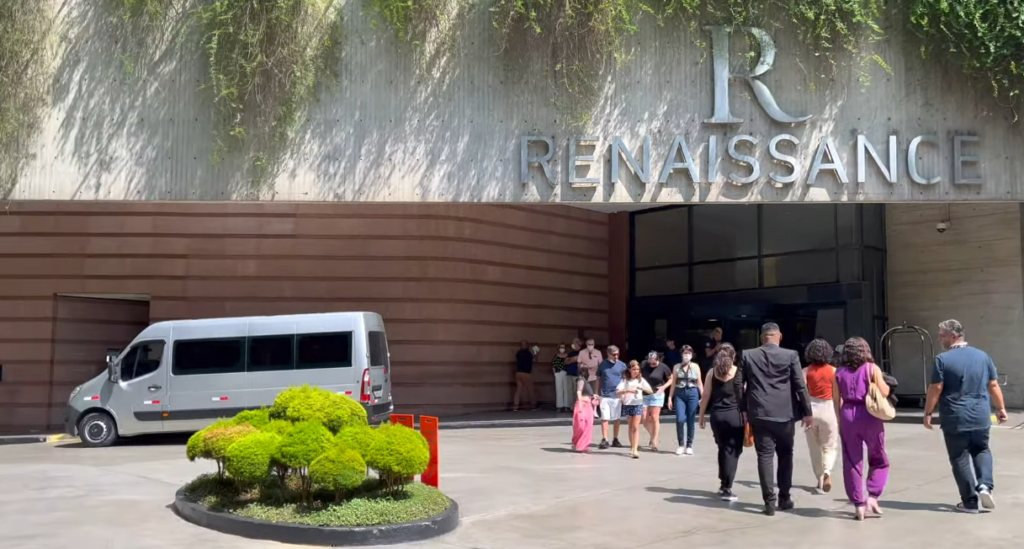
The Renaissance Hotel, located on 17th Street in Fort Lauderdale, is the type of establishment that frequently accommodates airline crews on layovers. It is a refined Marriott-brand hotel just a short distance from Fort Lauderdale-Hollywood International Airport and has the kind of quiet hallways and well-lit lobbies that pilots and flight attendants pass through dozens of times a year without any problems. A year after something went wrong in one of those hallways on February 1, 2025, Southwest Airlines was named in a $215,576 federal lawsuit alleging that a flight attendant had “negligently interfered” with a fire sprinkler system, according to court documents.
The hotel’s filing presents some pretty stark facts. During a crew layover, a flight attendant from Southwest allegedly set off the fire sprinkler in her room. The system turned on. Water dispersed. It didn’t stay in her room; it eventually flooded common areas like the front desk and office spaces after spreading to neighboring guest rooms and the building. Drying, sanitizing, and deodorizing were the tasks assigned to restoration crews. Reservations for guests were canceled. The hotel claims that its remediation expenses alone exceeded $50,000, and the total damages sought in the lawsuit, which was filed in Broward County on January 22, 2026, total $215,576.
The hotel’s legal justification for holding Southwest accountable is fairly straightforward: since the airline reserved and paid for the room, Southwest was the one who made the reservation. The hotel contends that Southwest is accountable for what transpired in the room because it was both the employee’s employer and the organization that put her there. Although the hotel is obviously targeting the deeper pocket, the flight attendant is also named in the lawsuit. It’s important to note that the hotel also hired a third-party fire sprinkler specialist who is ready to testify that the system was fully operational prior to the incident and that the room was clearly marked with warnings not to tamper with the equipment. That particular detail is important. It implies that the hotel’s legal team is preparing for a defense that attempts to blame equipment malfunction rather than human error.
| Renaissance Hotel vs. Southwest Airlines — Key Information | |
|---|---|
| Plaintiff | Renaissance Hotel Fort Lauderdale (Marriott brand), Fort Lauderdale, Florida |
| Defendant | Southwest Airlines Co. (and named flight attendant) |
| Incident Date | February 1, 2025 (crew layover) |
| Incident | Flight attendant allegedly “negligently interfered” with fire sprinkler, triggering flood across multiple rooms |
| Areas Affected | Multiple guest rooms, front desk, office spaces; guest reservations cancelled |
| Damages Sought | $215,576 (remediation, sanitization, deodorizing, lost bookings) |
| Lawsuit Filed | January 22, 2026 — Broward County, Florida |
| Court Movement | Southwest filed to move case to Florida federal district court (citing claim size) |
| Hotel’s Key Evidence | Signage warning against tampering; independent fire sprinkler expert retained |
| Southwest’s Recent Legal History | $140M DOT fine (2023); $600M+ in passenger refunds after Dec. 2022 meltdown |
| Southwest’s Response | No comment; did not respond to media requests |
Southwest has not made any public remarks. However, due to the size of the claim, the airline did file to transfer the case from Broward County to a federal district court in Florida. That procedural action doesn’t reveal much about the airline’s strategy for addressing the underlying accusations; it is standard procedure for more significant disputes. However, given how serious even relatively minor lawsuits can become when an airline is already dealing with reputational pressure from several sources at once, the silence on the matter is noteworthy.
It’s difficult to ignore the timing. Right now, Southwest is not in a comfortable position. The airline is still dealing with the fallout from its operational collapse in December 2022, which the U.S. Department of Transportation publicly referred to as a “meltdown.” In 2023, the airline was fined $140 million for violating consumer protection laws during a time when nearly 17,000 flights were canceled and over two million passengers were stranded during the holiday season. That fine, according to the DOT, was thirty times greater than any penalty it had ever imposed on an airline. Additionally, Southwest had to reimburse passengers for more than $600 million. Additionally, the airline has had to deal with criticism from customers regarding its decision to do away with free checked baggage, tighter enforcement of its two-seat policy for larger passengers, and a seating overhaul that has upset a devoted customer base that has been built over decades on a noticeably straightforward boarding procedure.
All of that is more expensive than this lawsuit. However, every new court document adds to the picture, and Southwest’s picture has been becoming increasingly complex on a regular basis. Another noteworthy precedent is that a different Southwest flight attendant was arrested in 2023 following what appeared to be a similar incident at a hotel, which involved sprinkler flooding and a physical altercation with other guests. After a brief period of attention, that case faded. Depending on what is discovered during the discovery process regarding the details of Southwest’s hotel contracts and the particulars of the February 2025 incident, the Fort Lauderdale case may or may not take the same course.
In reality, crew layover accommodations are a mostly undetectable aspect of commercial aviation operations. Across their network, airlines have long-term agreements with hotel establishments, especially in cities where crews frequently have to wait out schedule delays or turn around. These arrangements usually function without any problems because they are based on routine and trust. When something goes wrong in a crew room, such as damage, injuries, or actions that endanger the property or other visitors, the issue of who should pay is usually settled amicably through insurance claims and business negotiations, long before a courtroom becomes involved. The fact that this one went to court indicates that either the settlement talks failed, the damage was actually substantial, or both.
Depending on how a Florida federal court interprets the issue of employer liability for an employee’s actions during an officially scheduled layover and the language buried in whatever contract the airline signed with the Renaissance property, Southwest may ultimately pay the full $215,576 or something less. From the outside, neither response is predictable. It is predictable that Southwest would have preferred this specific story to remain in the hallways of a Fort Lauderdale hotel rather than appear in court documents and news articles—exactly when the airline is already attempting to persuade travelers that its operations and reputation are back under control.
Disclaimer
Nothing published on Creative Learning Guild — including news articles, legal news, lawsuit summaries, settlement guides, legal analysis, financial commentary, expert opinion, educational content, or any other material — constitutes legal advice, financial advice, investment advice, or professional counsel of any kind. All content on this website is provided strictly for informational, educational, and news reporting purposes only. Consult your legal or financial advisor before taking any step.
