

It’s hard not to feel the weight of what transpired here a millennium ago when you stand at the northern tip of Newfoundland on a clear morning and look out across Epaves Bay toward the Strait of Belle Isle. A peat bog stretches back from the water’s edge, and a small brook runs toward the shore in this open, windswept landscape that is now mostly grass. In other words, it appears to be nearly nothing. The only known Norse settlement in North America was located beneath those grassy mounds, which the locals had always referred to as “the old Indian camp.” Here, Vikings constructed iron forges, fixed ships, and stood at the very edge of the known world.
That location is L’Anse aux Meadows on Newfoundland’s Great Northern Peninsula. Its name, which is a French-English construction that roughly translates to “Grassland Bay,” has been under Parks Canada’s management as a national historic site since 1968 and has been recognized as a UNESCO World Heritage Site since 1978. However, the tale of how it was discovered and what it reveals about human migration around the world is more fascinating than any of its official titles would imply.
Helge Ingstad, a Norwegian explorer, brought a theory to the tiny fishing village of L’Anse aux Meadows in 1960. The Norse sagas, those remarkable oral histories passed down through generations of Icelandic and Norwegian storytellers, were thought by him and his wife, archaeologist Anne Stine Ingstad, to contain actual geographic information rather than merely legend. According to the sagas, Leif Erikson and other Norse explorers traveled west from Greenland and Iceland to a place known as Vinland. For a long time, historians believed that Vinland must be located near the northern edge of wild grapes, on the coast of New England. The Ingstads were not persuaded. They believed that the Norse would have looked for something more familiar and defendable. Helge Ingstad was guided to the mounds close to the village by a local fisherman named George Decker. Almost instantly, Ingstad recognized what he was seeing.
Eight buildings made of wood-framed turf were discovered during seven excavations conducted between 1961 and 1968. This architectural style is similar to that of Norse sites from the same era in Greenland and Iceland. There were three homes. One was an iron smithy that still had slag and a forge from a single iron smelting incident. Four were workshops, such as a specialized boat repair area with worn rivets and a carpentry facility with wood debris. The largest residence was almost 29 meters long and had several rooms, indicating that a leader and possibly his household lived there. Slaves or lower-status crew members might have been housed in smaller buildings. Women lived at the site, not just male explorers on a raid, as evidenced by the presence of a spindle whorl and a bone needle for délebinding, a textile technique.
Important Information: L’Anse aux Meadows — Canadian Viking Settlement
| Detail | Information |
|---|---|
| Site Name | L’Anse aux Meadows National Historic Site |
| Location | Northernmost tip of Newfoundland’s Great Northern Peninsula, near St. Anthony, Canada |
| Province | Newfoundland and Labrador, Canada |
| Coordinates | 51°35′47″N 55°32′00″W |
| Date of Norse Occupation | Approximately 1000 AD (carbon dating: 990–1050 CE; tree-ring dating: 1021 CE) |
| Discovery Date | 1960 |
| Discovered By | Helge Ingstad (Norwegian explorer) and Anne Stine Ingstad (archaeologist) |
| Excavation Period | 1961–1968 (Ingstads); additional excavations 1973–1976 (Parks Canada) |
| Structures Found | 8 buildings — 3 dwellings, 1 iron forge, 4 workshops |
| Largest Structure | Building F — 28.8m × 15.6m (leader’s hall) |
| Artifacts Found | 800+ Norse objects including iron, bronze, bone, stone items; spindle; boat repair materials |
| Notable Food Evidence | Butternuts (not native north of New Brunswick — indicating southern exploration) |
| UNESCO Status | World Heritage Site (designated 1978, 2nd session) |
| National Historic Site | Designated November 28, 1968 |
| Managed By | Parks Canada |
| Site Area | 7,991 hectares |
| Possible Connection | Vinland Sagas — voyages of Leif Erikson |
| Nature of Settlement | Base camp for further exploration — not a permanent colony |
| Possible Second Site | “Hóp” — Norse archaeologist Birgitta Wallace suggests Miramichi-Chaleur Bay area of New Brunswick |
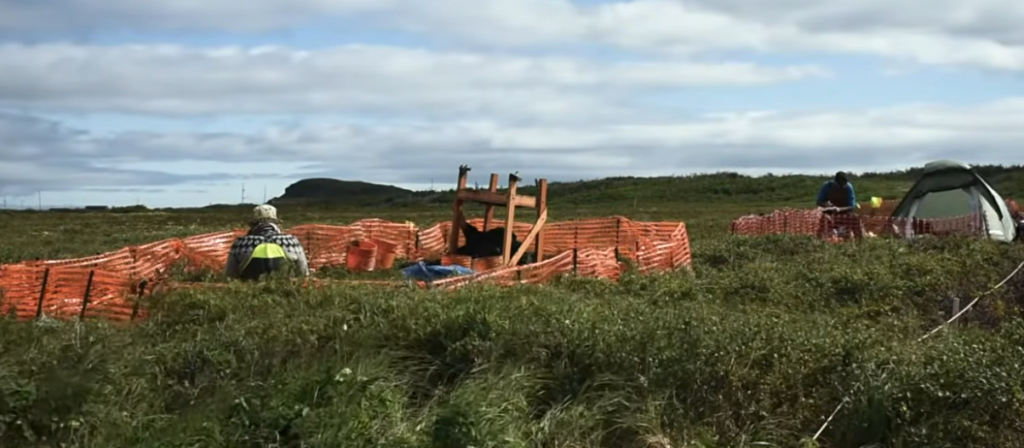
Radiocarbon analysis, which was used to date the site for decades after it was discovered, put Norse activity between 990 and 1050 CE, with a mean date of roughly 1014. Archaeologists wanted something more precise, but that was accurate enough to prove the settlement was pre-Columbian by almost five centuries. A group of researchers used a technique that completely altered the answer in a study they published in Nature in 2021. Three distinct tree-ring samples from wood cut at L’Anse aux Meadows were examined, and the results were compared to a known anomaly in atmospheric carbon-14 concentrations from 993 CE—a spike brought on by a solar storm. All three samples’ analyses came to the same conclusion: Norse activity at L’Anse aux Meadows in 1021 CE. That date’s accuracy is astounding, and it is hard to refute given the convergence of three separate samples.
The settlement was never substantial. Although there were only roughly 2,500 Norse people living in Greenland at the time, the homes could have accommodated between 30 and 160 people. According to archaeologist Eleanor Barraclough, the site was most likely a temporary boat repair facility rather than a colony because there are no animal pens, burials, or agricultural tools. It seems that the residents departed in a systematic manner, taking their tools with them. Because butternuts don’t grow naturally north of New Brunswick, the people who lived at L’Anse aux Meadows were also traveling much further south, passing through areas with wild grapes and warmer climates before returning to this windswept base camp. This is especially evident from the butternuts found in the Norse stratum of the bog.
It is still genuinely unclear whether there are any more Norse sites in North America. According to Norse archaeologist Birgitta Wallace, the Miramichi-Chaleur Bay region of New Brunswick may be the location of “Hüge”—a settlement mentioned in the Vinland sagas, a tidal lagoon with wild grapes, salmon, and residents who used animal-hide canoes. That is intriguing but still speculative. Tanfield Valley on Baffin Island and a number of other Arctic locations were suggested as potential Norse outposts in 2012, but none have been verified. There was absolutely no Norse evidence discovered during excavations at Point Rosee in southwest Newfoundland in 2015 and 2016.
L’Anse aux Meadows is unquestionably the only uncontested pre-Columbian European contact site outside of Greenland in the Americas. It’s difficult not to imagine what it would have been like to arrive here in 1021, having crossed the North Atlantic from Greenland in an open wooden vessel, and discover a continent that your maps had never depicted as you stroll among the rebuilt sod buildings north of the archaeological remains, which were constructed in the late 20th century so visitors could sense the scale and texture of Norse construction.
Disclaimer
Nothing published on Creative Learning Guild — including news articles, legal news, lawsuit summaries, settlement guides, legal analysis, financial commentary, expert opinion, educational content, or any other material — constitutes legal advice, financial advice, investment advice, or professional counsel of any kind. All content on this website is provided strictly for informational, educational, and news reporting purposes only. Consult your legal or financial advisor before taking any step.
