

To drive on water demands a special kind of trust. It is a confidence in physics, in the collected wisdom of elders who know the texture of a frozen lake by the sound it makes under a tire, and, increasingly, a faith in a climate that is betraying its promises. The winter road to Cat Lake First Nation in Northern Ontario winds through a seemingly endless, monochromatic landscape—a corridor of snow and spruce that only lasts as long as the temperature permits.
This temporary infrastructure has served as the Far North’s circulatory system for decades. It’s the way heavy objects move. Diesel for the generators, lumber for new dwellings, and non-perishable food that doesn’t cost a week’s pay all come on the back of semi-trucks driving over ice that is three, maybe four feet thick. But the season is fracturing.
What used to be a reliable window stretching from January to April has become an inconsistent, anxiety-inducing sprint. Jonathan Williams, a road builder who has spent years dragging heavy tires behind a truck to smooth the icy surface, remembers when minus 50 degrees Celsius was routine. It was definite, but it was cruel. These days, the spring thaw occurs with a sudden, slushy intensity that may leave entire communities stranded weeks ahead of schedule, while the severe freeze hits later.
Key Factual Context: Canada’s Vanishing Ice Roads
| Feature | Key Details |
| Network Scale | Approximately 3,700 miles (6,000 km) of seasonal winter roads. |
| Communities Affected | Over 50 First Nations communities (approx. 56,000 people). |
| Primary Function | Essential transport for fuel, housing materials, and food; social connectivity. |
| Climate Impact | Construction starts later and roads close earlier (approx. 2-week shift on both ends). |
| Economic Tension | High cost of air freight vs. political pressure to allow mining for permanent road funding. |
| Primary Reference | Pulitzer Center: Ice Roads Are a Lifeline |
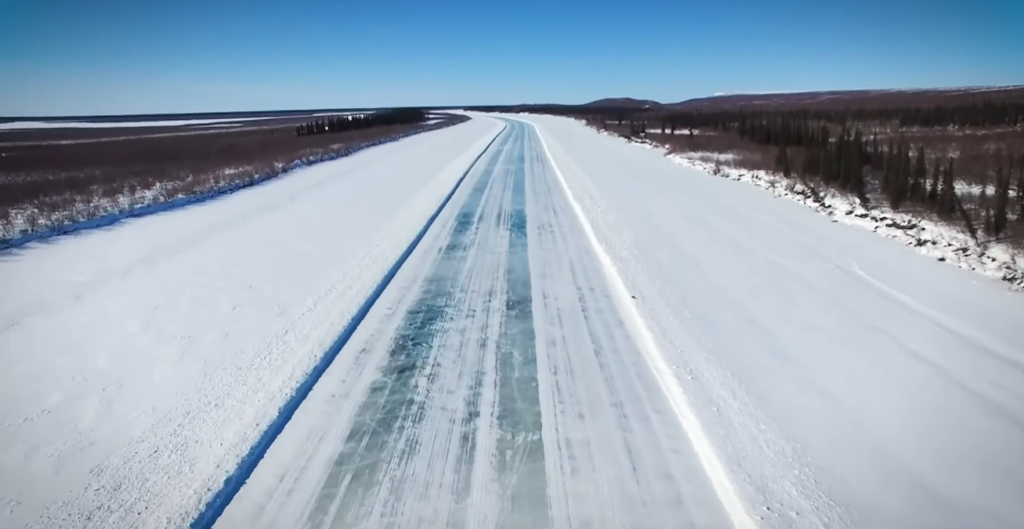
The mechanics of these highways are deceptively simple yet fragile. It isn’t only about clearing snow; it is about “farming” ice. Crews race to flood the lakes and compress the snow over creeks to make bridges. They are trying to manufacture winter in a world that is increasingly losing it.
Rachel Wesley, the economic development officer at Cat Lake, has found herself in the odd position of buying a snowmaker—the kind you’d see at a ski resort—to try and freeze a creek crossing that nature refuses to firm. It is a harsh image: a machine blasting manufactured winter into the face of a warming world, a desperate attempt to keep the supply lines running for just a few days longer.
The repercussions of this shorter season are cascading and brutal. When the highways close early, the fuel tanks might not be full. Construction projects stall since the lumber didn’t make it up the corridor. The alternative is air freight, which is too expensive for areas that are already experiencing chronic underfunding and housing issues. In Eabametoong, Chief Solomon Atlookan notes that dwellings sometimes shelter 14 people under one roof. They need materials to create, but the path to transport those materials is melting.
Standing on the edge of that fading white line, gazing at a slurry that should have been solid as concrete, I felt a silent, growing fear that had nothing to do with the weather.
A difficult and divisive discussion on long-term infrastructure has been made possible by this logistical failure. The obvious solution—building all-season gravel or paved roads—is loaded with a different kind of hazard. These potential roadways typically correlate with the interests of the mining industry, notably in the “Ring of Fire,” a mineral-rich crescent that the province government is eager to exploit for nickel, copper, and chromite.
For leaders like Chief Atlookan, the choice is presented as a conundrum that feels more like an ultimatum. To gain the road that assures their survival, they may have to accept the mines that could transform their land forever. It is a contradiction between the urgent requirement for a stable supply system and the long-term stewardship of a landscape that sequesters billions of tons of carbon in its peatlands.
The government’s stance is a mix of bureaucracy and lofty promises. While there are offers of support, the money is sometimes attached to economic development—code for resource extraction. The “Blue Road,” as the ice networks are frequently nicknamed, was once a symbol of perseverance and resourcefulness. Now, it is becoming a metaphor of a negotiation where the terms are being determined by a shifting context.
In the Northwest Territories, the historic road to Tuktoyaktuk has already been replaced with an all-season highway, removing the romance of driving on the Arctic Ocean but offering the security of year-round mobility. But for dozens of towns in Ontario and Manitoba, that security is still a line on a map, waiting for funds or a mining permit to make it real.
The ice road builders will continue to venture out into the dark until then. They will monitor the thickness of the ice, study the weather reports with intense intensity, and do the “happy dance” with their grooming equipment on the few days when the lake freezes hard and deep. They are fighting a rearguard action against the temperature, buying time one frozen mile at a time. But every year, the light feels a bit warmer, and the water waits a little closer to the surface.
Disclaimer
Nothing published on Creative Learning Guild — including news articles, legal news, lawsuit summaries, settlement guides, legal analysis, financial commentary, expert opinion, educational content, or any other material — constitutes legal advice, financial advice, investment advice, or professional counsel of any kind. All content on this website is provided strictly for informational, educational, and news reporting purposes only. Consult your legal or financial advisor before taking any step.
