

As Mike Fincke walked back on Earth for the first time, his legs trembled a little. Even gravity becomes unexpected after almost six months in space. It wasn’t a sign of weakness to lie on the gurney; astronauts knew this ritual well: reentry takes patience. Zena Cardman trailed behind, waving and grinning, then stealthily slipped into the hands of NASA’s rescue crew. There was something odd behind their eyes, even though their faces appeared serene. They had trained for a different conclusion.
There was no plan for Crew-11’s return. A few weeks ahead of their scheduled February handover to Crew-12, they returned home early. A medical problem was the straightforward but infrequently observed cause in orbit. NASA has not and most likely won’t reveal which crew member was impacted. All four astronauts are stable, they have confirmed, and the problem was not caused by any malfunction on the station.
The lessons learned in the past, when plans were subject to change and human safety was the top priority, are remarkably comparable to this time. The difference now is how incredibly effective the procedure turned out to be.
Located 250 miles above Earth, the International Space Station completes one orbit every 90 minutes. Timed meals, routine maintenance, and rotating experiments are all part of the structured life aboard. However, the sudden urgency of medical emergencies throws that rhythm off balance. It wasn’t a disaster. However, it was so bad that the first medical evacuation from the ISS since it started operating continuously in 2000 was carried out.
The crew consisted of multinational partners, including Oleg Platonov from Roscosmos, Kimiya Yui from JAXA, and Cardman and Fincke from the United States, as well as veterans of NASA. Living together in zero gravity had required intensive cross-cultural training for each of them. They conducted research, ran diagnostics, and got ready for spacewalks while orbiting at 17,500 miles per hour for 167 days. That final one never took place. Just before execution, it was suddenly canceled. NASA confirmed an onboard illness just hours later.
| Category | Details |
|---|---|
| Event | First-ever medical evacuation from the ISS |
| Mission | NASA Crew-11 |
| Crew Members | Zena Cardman, Mike Fincke (NASA); Kimiya Yui (JAXA); Oleg Platonov (Roscosmos) |
| Duration Before Return | 167 days in orbit |
| Reason for Evacuation | Unspecified medical issue affecting one crew member |
| Return Date | January 15, 2026 |
| Splashdown Location | Pacific Ocean, off the California coast |
| Replacement Crew | NASA Crew-12, launching mid-February 2026 |
| Current ISS Crew | Chris Williams (NASA), Sergey Kud-Sverchkov & Sergey Mikayev (Roscosmos) |
| Source | BBC, NASA, Florida Today, The Guardian |
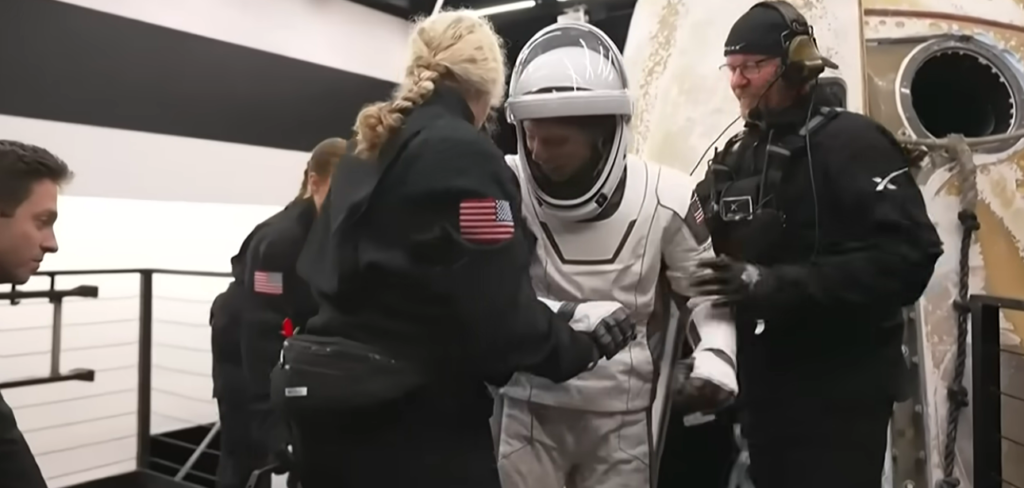
It was a swift turn of the mission. Splashdown zones were cleared and undocking processes were started. Crew-11 was returning to Earth a month ahead of schedule. They touched down off the coast of California. It was a smooth comeback, almost uncanny.
NASA’s partnership with SpaceX has significantly increased the emergency procedures’ dependability. The dragon’s return scene went perfectly. Following their arrival, the astronauts spent a peaceful night at a medical center while their condition was monitored and their privacy was protected. There was constant reassurance that they were in capable hands, but no haste to explain.
It is presently planned for Crew-12 to launch from Cape Canaveral in mid-February on a SpaceX Falcon 9. The ISS is now run by a skeleton crew consisting of cosmonauts Kud-Sverchkov and Mikayev and NASA representative Chris Williams. In preparation for the unexpectedly early handoff, they launched Soyuz on Thanksgiving.
Fincke described the transfer of ISS command to Kud-Sverchkov as bittersweet. Space has a way of condensing language, I thought. Seldom do astronauts use exaggerated language. They talk calmly and in a methodical manner. The word “bittersweet” conveyed the weight of a mission that was changed by circumstances rather than by failure.
NASA claims that despite the medical disruption, the crew completed almost all of the tasks that were scheduled. While some goals were rescheduled, others will be covered in the upcoming rotation. Adaptability is still the most important capability for long-duration spaceflight, not just for machines but also for people.
We were reminded of the brittleness of routine during the pandemic. It’s the same in space, only magnified. Calling for assistance is not enough. The emergency room is not nearby. There’s no way to avoid the atmosphere. Trust needs to transcend time zones and orbits, and decisions need to be made precisely.
It’s interesting to note that this was just the third early return in spaceflight history due to medical reasons. Soviet cosmonauts returned early from Salyut 7 in 1985. A cardiac arrhythmia sent another mission home two years later. Procedures have since advanced greatly in speed and sophistication, but the risk is still there.
There is medical equipment on board the ISS, and astronauts are given rudimentary emergency training. There’s still no doctor on board. The idea of space physicians no longer seems like science fiction as humanity looks to Mars and a permanent presence on the moon. It feels essential.
NASA performed the Crew-11 return with calm confidence by utilizing extensive planning and contingency models. The fact that it wasn’t theatrical was exactly what made it remarkable. Every action and choice was based on a process that had been refined over decades and tested in real time.
“It’s so good to be home,” Zena Cardman stated with a smile at the camera, perfectly capturing the essence of the moment. There was no need to elaborate on the situation. It was straightforward and human.
The ISS has been used as a symbol and a laboratory since the beginning of this international collaboration in 1998. Instead of upsetting that legacy, this incident strengthens it. The station demonstrated its tenacity not just by withstanding technical stress but also by skillfully handling unforeseen circumstances.
There is a certain comfort in knowing that kindness and care are still the go-to reaction, even when dangers increase and control becomes more limited.
We’ll keep that lesson in mind as we reach a wider audience in the years to come: empathy is crucial, but preparation is strength.
