

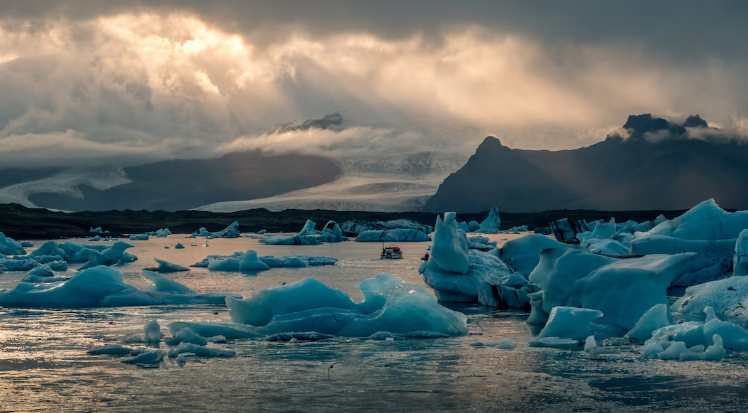
The scenery surrounding the Thwaites Glacier appears almost surreal on a calm Antarctic morning. Only faint ridges of wind-sculpted ice break the endless white expanse of the horizon. Not a city. No trees. Most days, not even the far-off hum of airplanes. The silence is overwhelming, according to scientists who visit this place. But something massive is changing beneath that silence.
One of the most watched ice formations on Earth is Thwaites Glacier, sometimes referred to as the “Doomsday Glacier.” It drains a vast amount of the West Antarctic Ice Sheet toward the ocean, and it is enormous—roughly the size of Great Britain. The glacier has been losing more ice than it is gaining due to snowfall for decades. The change was slight at first. However, it appears that the pace has accelerated recently.
| Category | Information |
|---|---|
| Glacier Name | Thwaites Glacier |
| Location | West Antarctica, along the Amundsen Sea |
| Nickname | “Doomsday Glacier” |
| Size | Roughly the size of Great Britain |
| Ice Loss | About 50–80 billion tons of ice lost per year |
| Contribution to Sea-Level Rise | Around 4% of global sea-level rise |
| Potential Sea-Level Rise if Fully Melted | Approximately 65 cm (2 feet) |
| Larger Risk | Could destabilize the West Antarctic Ice Sheet |
| Research Programs | International Thwaites Glacier Collaboration |
| Monitoring Tools | Satellites, radar mapping, ocean sensors |
| Reference | https://www.scientificamerican.com |
Satellites have been keeping a close eye on things. According to their measurements, the glacier currently loses tens of billions of tons of ice annually. Depending on the study, the figures vary, but most estimates range from 50 to 80 billion tons per year. That is an incredible amount of frozen water, even by Antarctic standards, moving slowly in the direction of the ocean.
Thwaites is situated on bedrock that forms a bowl-like depression below sea level as it slopes inland. The glacier is vulnerable because of that geometry. The floating ice shelf at the front may be melted from below by warm ocean water sliding beneath it. The shelf ceases to function as a brace once it becomes weak. Behind it, the glacier starts to flow more quickly. That process might have already started.
Long flights across featureless ice before landing close to the glacier’s edge are described by field researchers who arrive at Antarctic camps. Radar units, ocean probes, and seismic sensors are among the equipment that is transported out of cargo planes and put together in the cold. The task may take several months to complete.
The fragility of the entire operation is evident as scientists unpack delicate instruments while snow is being whipped across the camp by winds. However, the measurements they collect are extremely valuable.
Thwaites is already responsible for about 4% of the rise in sea level worldwide. Although that might not seem like much at first, sea levels are actually rising annually. The world’s oceans have risen about nine inches since the late nineteenth century. The curve may become steeper if a sizable glacier destabilizes.
Sea levels could rise by roughly 65 centimeters on their own if Thwaites collapsed entirely, which scientists estimate would take centuries. Coastlines would be drastically altered by that amount. Cities wouldn’t be completely submerged by it overnight. However, it would increase the frequency of flooding, intensify storm surges, and make infrastructure more susceptible.
Much of the West Antarctic Ice Sheet is held back by Thwaites, which functions as a barrier. Deeper ice basins inland may be reached by warmer ocean water if it retreats far enough. Eventually, enough ice could be released by that chain reaction to raise sea levels by several meters worldwide. Not right away. However, with time.
Engineers are already debating redesigning flood barriers and seawalls in New York. As rising sea levels and land subsidence combine to create a slow-moving crisis, city officials in Bangkok and Jakarta discuss relocation plans in private. As these conversations develop, it seems that coastal cities are starting to consider longer time horizons—perhaps 50 or even 100 years. However, there is still uncertainty in the science.
According to some recent research, the glacier may not disintegrate as quickly as previously projected. Some ice cliffs might turn out to be more stable than initially thought. That subtlety is important. It suggests that, contrary to what the most dramatic headlines suggest, humanity may still have time to react. However, “more time” does not always equate to “no problem.”
Already, Thwaites’ ice shelves are thinning and cracking. In ways that models did not fully predict, warm tidal currents are slipping underneath and speeding up melt. A researcher who was looking into these currents acknowledged that they had hoped the ice would hold for hundreds of years. Rather, the pace now makes people uncomfortable.
In the meantime, some scientists have begun putting forth strange concepts, such as massive underwater “curtains” or barriers intended to prevent warm ocean water from reaching the glacier. The ideas resemble science fiction in many ways. large-scale engineering initiatives under the Antarctic. Potential is seen by some researchers. Some shake their heads.
It’s still unclear if these concepts are realistic or just the result of desperate brainstorming. Many climate scientists contend that lowering global emissions should continue to be the main priority in order to slow the warming that initially causes ocean heat.
As the glacier itself continues to move, it stands apart from the discussion. Slowly, kilometer by kilometer, the ice moves toward the Amundsen Sea.
There’s a weird sense that Thwaites has evolved beyond a glacier as you watch the annual updates of the satellite photos. It functions similarly to a planetary warning system. Quiet, isolated, and largely unnoticed by the general public, they may contain hints about the future appearance of the world’s coastline. And for seaside cities, that future feels more imminent than it did before.
Disclaimer
Nothing published on Creative Learning Guild — including news articles, legal news, lawsuit summaries, settlement guides, legal analysis, financial commentary, expert opinion, educational content, or any other material — constitutes legal advice, financial advice, investment advice, or professional counsel of any kind. All content on this website is provided strictly for informational, educational, and news reporting purposes only. Consult your legal or financial advisor before taking any step.
