

Most people drive by a juvenile justice facility on Austin’s east side without giving it much thought. Behind its walls is a school — a real one, accredited and part of Austin Independent School District — where teenagers serve time while technically remaining enrolled students. They had to take an online art appreciation survey course for years as their only option for arts credit. Clicking through slides. No instruments, no collaboration, no making anything at all.
That changed in 2010, when Austin Classical Guitar brought daily, for-credit guitar instruction into the Gardner Betts Juvenile Justice Center. It wasn’t a sentimental side project. It became a formal part of the school day — the same kind of structured, standards-aligned course a student might take at any other campus in the district.
The gap that ACG was filling was hard to ignore once you saw it. Ensembles, studios, and fine arts electives were available to students in traditional Austin middle and high schools. Gardner Betts students took a survey course. There was no subtle difference. Because the impacted students are already marginalized—disproportionately Black and brown youth trapped in a system that seldom quietly offers second chances—it was the kind of disparity that tends to go unexamined.
What made the guitar program different wasn’t just the music. It was the underlying philosophy. Students were instructed to put genuine intention—not perfection, but investment—into every note from the very beginning. They collaborated on improvisation, songwriting, and music. A lecture or a worksheet can’t quite capture the essence of that collaborative act of creation. It’s possible that educators have always understood this, but at some point in the past, the arts came to be seen as something to cut when funds were tight.
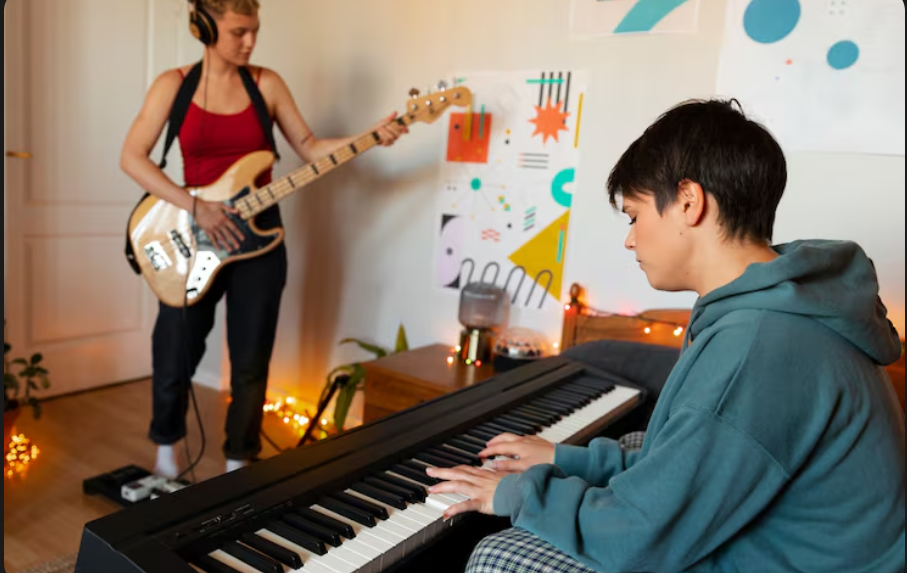
It was a conscious choice to make the course for-credit rather than enrichment. Credit-bearing classes are important because they give the program institutional permanence, connect to treatment services within the facility, and integrate with academic requirements. Additionally, it meant that ACG could assist a student who re-enrolled at a nearby school after leaving Gardner Betts by helping them get into a guitar class there. The continuity was important. The lack of familiarity is one of the more difficult aspects of leaving a facility. Even a common language, like music, is something to cherish.
Since then, ACG has extended this model to three additional juvenile justice facilities in Texas, including programs in Phoenix House, Dallas County, and Williamson County. Songwriting, improvisation, solo repertoire, and ensemble playing are all included in the curriculum. It satisfies state requirements for fine arts. It is a valid course of study in every official sense.
There’s a feeling that what Austin Classical Guitar stumbled into, or perhaps deliberately created, is a minor but significant critique of the way arts education is provided in this nation. Whether a student’s zip code or legal status puts them in a building with resources shouldn’t affect their ability to access creative music as a fundamental graduation requirement. The students at Gardner Betts weren’t less capable of musical expression. They were simply less likely to be offered the chance.
It’s still unclear how many schools or districts will adopt this model in any serious way. Funding remains a persistent obstacle — ACG relies primarily on grants and private donations, not facility budgets. But the proof of concept exists now. The students have played it into existence.
Disclaimer
Nothing published on Creative Learning Guild — including news articles, legal news, lawsuit summaries, settlement guides, legal analysis, financial commentary, expert opinion, educational content, or any other material — constitutes legal advice, financial advice, investment advice, or professional counsel of any kind. All content on this website is provided strictly for informational, educational, and news reporting purposes only. Consult your legal or financial advisor before taking any step.
