

Some ads are so loud they dazzle. Others make a lasting impression by gently settling in. Budweiser’s 2026 Super Bowl commercial is definitely in the second category. It’s not showy. But it’s emotionally rich and extremely good in delivering a story without overselling it.
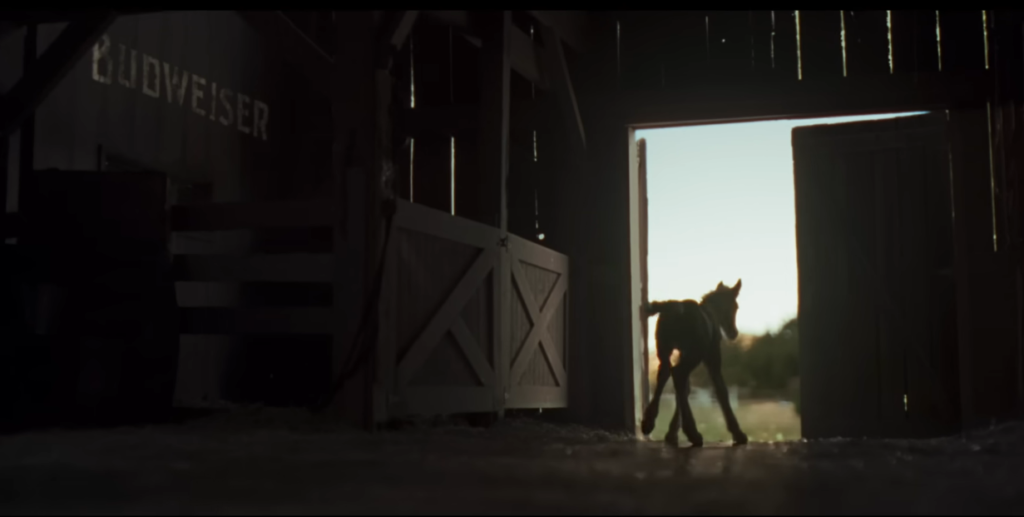
In this year’s campaign—titled American Icons—a Clydesdale colt stumbles upon a fledgling eagle fallen near an overturned tree. At first, the horse walks away. When it starts to rain, it turns around and uses its body to protect the bird. Everything that comes after is put in motion by that simple act of protection.
Over time, the foal matures, and so does the eagle. The two explore their environment, spend peaceful time together, and develop an innate bond. Details, such as the foal’s consistent strength, the eagle’s early, clumsy efforts at flying, and the changing seasons, are more indicative of their development than discourse. Lynyrd Skynyrd’s “Free Bird,” a song that has come to emotionally represent freedom and remembering, highlights these shifts.
By putting the commercial in a pastoral area and focusing on two creatures moving through time together, Budweiser avoids current marketing tactics and crafts something particularly poignant. It’s a pick that feels substantially improved from prior years, leaning less on nostalgia and more on presence.
| Title | Budweiser’s “American Icons” Super Bowl Commercial |
|---|---|
| Brand | Budweiser (Anheuser-Busch) |
| Duration | 60 seconds |
| Theme | Friendship between a Clydesdale foal and a bald eagle |
| Music | “Free Bird” by Lynyrd Skynyrd |
| Occasion | Budweiser’s 150th anniversary & America’s 250th birthday |
| Director | Henry-Alex Rubin |
| Featured Animal | Lincoln the eagle (Philadelphia Eagles’ mascot) |
| Purpose | Celebrate American heritage, unity, and resilience |
| Link | Budweiser Super Bowl Ad 2026 |
At one instance, as the horse jumps over a downed tree, the eagle spreads its wings and perches on the Clydesdale’s back. For a brief period, the silhouette resembles a mythical creature—a pegasus in motion. The illusion dissolves as the eagle flies off, soaring high above the horse that helped it climb.
That moment hits hard. It’s not simply visually beautiful—it’s symbolically rich. A message of support and freedom that goes beyond product marketing is conveyed by the horse’s grounded power and the eagle’s autonomous flight.
The bald eagle in the advertisement, Lincoln, is accustomed to big audiences. He often performs flyovers during Philadelphia Eagles games. But it wasn’t an easy path for him. Lincoln was released into the wild twice but was unable to adjust. One time, he was spotted scavenging through trash for fried chicken. Another time, he was being hand-fed bacon by a well-meaning woman in Michigan. His survival instinct was absent. But all that was left was trust.
The American Eagle Foundation, situated in Tennessee, took him in and trained him not for the wild, but for something probably more ambitious: public storytelling. They helped him become an ambassador after identifying his curious, talkative, and involved disposition. Bird-first behavior, which requires perseverance, repetition, and establishing a steady relationship with trainers, is the foundation of their method. It’s a very efficient model that is also very slow.
I found it very striking that Lincoln “talks” to his trainers in the manner of a toddler learning to speak. It is surprisingly moving to see the picture of an eagle chirping in time with a human companion. It reminds us that communication, even between species, begins with presence.
Budweiser didn’t utilize CGI for this commercial. There’s no artificial intelligence filling in backgrounds or smoothing transitions. What we see instead is authentic: animal trainers working together, meticulously arranging situations, and allowing for impromptu moments. The production involves deliberate choreography between Lincoln’s handlers and the team that works with the Clydesdales, resulting in a natural cadence that seems tremendously adaptable and quietly strong.
Not only did the animals stand out, but the constraint did as well. No general narration. Avoid ostentatious edits. Just a camera documenting a friendship in progress. The last slogan, “Made of America,” felt earned rather than forced because of its simplicity.
The decision to showcase Lincoln wasn’t accidental. He carries decades of conservation labor on his wings. The bald eagle population has recovered greatly after being on the verge of extinction. Lincoln himself couldn’t live in the wild, but under the care of the foundation, he found a purpose that transcends beyond survival.
It was a calculated move for Budweiser, whose brand has always relied on Americana. The ad commemorates both the company’s 150th year and the nation’s forthcoming 250th birthday. Yet the story doesn’t yell patriotism—it indicates it. And that’s what makes it especially apparent in its meaning.
At the end of the ad, two farmers—sitting with beers in hand—watch the eagle take flight. One asks, “You crying?” The other replies, “Sun’s in my eyes.” It’s a statement written to dodge feeling, and yet it accentuates it. That exchange’s delicate mix of vulnerability and pride perfectly conveys how many viewers probably felt.
Hours later, I began to ponder about that line. It was sincere, not because it was cunning.
The way the commercial presents growth also has a subtle compelling quality. The eagle does not acquire flight skills on its own. It has a buddy. Someone or anything that is prepared to stand by it till the appropriate moment. In a world that typically praises self-made strength, this novel highlights the quiet power of shared resilience.
Budweiser, normally linked with barroom laughing and tailgate cheer, went a different route this year. It was successful. The commercial doesn’t just remind us of tradition—it elevates it. It shows how heritage may change without losing its roots.
Many firms have pursued flash-in-the-pan virality and digital gimmicks in recent years. Budweiser instead chose to trust authentic narrative. Through that decision, they’ve not only respected their legacy but created a creative roadmap for emotionally based marketing.
The American Icons ad will be remembered for more than simply its imagery. We will remember it because it provided us with a brief glimpse of what we knew growing into something more.
It’s difficult to fake a lift like that. And Budweiser didn’t try to.
Disclaimer
Nothing published on Creative Learning Guild — including news articles, legal news, lawsuit summaries, settlement guides, legal analysis, financial commentary, expert opinion, educational content, or any other material — constitutes legal advice, financial advice, investment advice, or professional counsel of any kind. All content on this website is provided strictly for informational, educational, and news reporting purposes only. Consult your legal or financial advisor before taking any step.
