

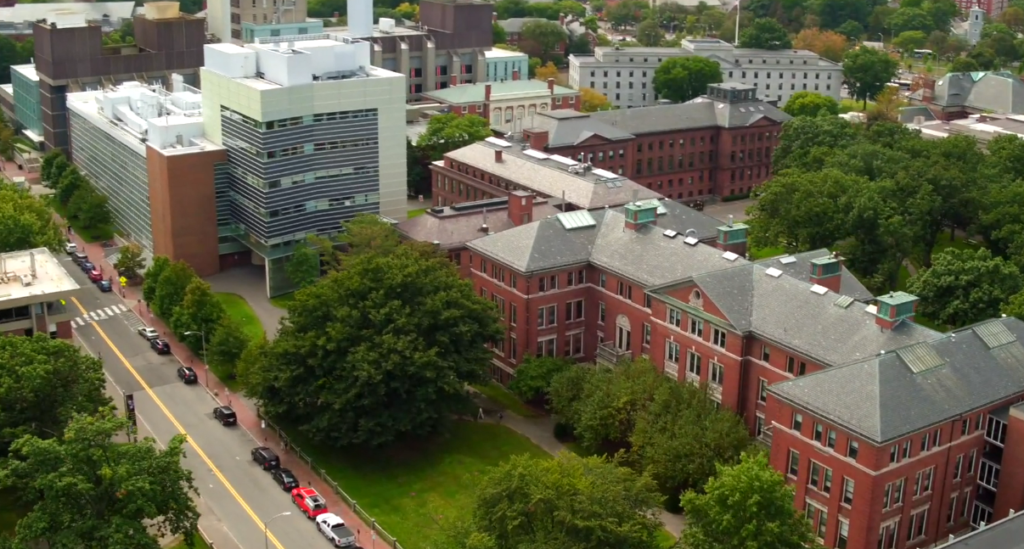
The most fascinating discussions are rarely taking place in a classroom when you stroll through the Harvard Graduate School of Design on any given afternoon. They take place in the spacious hallway that runs alongside the Gund Hall trays, where students studying architecture, landscape architecture, and urban planning end up at the same coffee station and start fighting over a topic that none of them were given to consider that day. John Andrews designed the structure, which was finished in 1972 and has been causing those collisions for more than 50 years. As it happens, that was never an accident.
For many years, the question of how physical space influences creative thought has been growing in both research and practice, but Harvard’s involvement with it has taken on a new degree of seriousness. The Harvard Joint Center for Housing Studies held a half-day event at the GSD in April 2026 to examine how design, from a single shared kitchen to an entire neighborhood, can reorganize how individuals of various ages, backgrounds, and disciplines interact with one another. The topic of discussion at the event, which was organized by Jennifer Molinsky, Jenny French, and Tim Love, ranged from the legalization of mid-rise single-stair construction in Massachusetts to multigenerational housing models. Beneath all of this, however, was a single, unifying argument: most of our existing spaces make decisions that we haven’t consciously considered, and how we design shared space is a cultural decision rather than merely a technical one.
French, an assistant professor in practice of architecture whose firm French 2D designed Bay State Cohousing in Malden, Massachusetts, frequently brought up the term “setting up preconditions” because it touches on a point that most architectural thinking ignores. Interaction is not forced in a good collaborative space. It increases the likelihood of low-friction interaction. With its cozy wood cabinets and a layout that makes it genuinely hard to avoid the neighbors, the shared kitchen at Bay State Cohousing is anything but decorative generosity. It is a thoughtful debate about what occurs when individuals of different ages are given an excuse to be in the same space at the same time.
| Institution | Harvard Graduate School of Design (GSD) / Harvard Joint Center for Housing Studies (JCHS) |
|---|---|
| Address | Cambridge, MA 02138 |
| Key Event | “Living Together by Design: Housing to Connect Generations” — April 16, 2026 |
| Event Organizers | Jennifer Molinsky (JCHS); Jenny French, Assistant Professor in Practice of Architecture; Tim Love, Assistant Director, Master in Real Estate Program |
| Executive Education Programme | “Designing the Creative & Collaborative Workplace: Space, Technology, and Culture” |
| Programme Instructors | Jacob Reidel, Assistant Professor in Practice of Architecture, GSD; Carly Tortorelli, Director of Workplace Technology, Intuitive |
| Key Research | Harvard Business School study on open office architecture: “The Impact of the ‘Open’ Workspace on Human Collaboration” — Ethan Bernstein (cited 548 times) |
| Harvard Business Review Finding | Dynamic, shared workspaces lead to spontaneous interactions and cross-pollination of ideas |
| Key Architecture Project | Bay State Cohousing, Malden, Massachusetts — by French 2D |
| Key Architecture Project 2 | Treehouse, Mattapan, Massachusetts — by MASS (Jonathan Evans, MArch ’10) |
| Key Exhibition | The House Transformed — curated by Mónica Ponce de León (MAUD ’91), Van Alen Institute, Brooklyn |
| Key Researcher Referenced | Natasha Pilkauskas, Associate Professor of Public Policy, Gerald R. Ford School of Public Policy, University of Michigan |
| Core Design Principle | “Adaptation over time” — flexible spaces that shift function as human needs change |
| Cultural Argument | Shared spaces require cultural shift; stigma around co-living actively limits creative and community potential |
Ethan Bernstein’s seminal study on open office architecture from Harvard Business School, which has been referenced almost 550 times, discovered something that defies the logic of most office redesigns. Face-to-face interaction actually decreased, sometimes by as much as 70%, when businesses removed walls and made their spaces completely open. People put on their headphones. They withdrew behind screens. The architecture that was meant to foster unplanned cooperation instead created a learned avoidance and social defensive posture. Since then, research published in the Harvard Business Review has made the counterargument that dynamic shared space—rooms, hallways, and common areas that serve multiple purposes and invite people in without requiring them to collaborate on cue—is what actually fosters spontaneous creative interaction rather than openness per se.
How much of what emerged from the GSD event maps onto that finding is difficult to ignore. James Stockard, who has spent more than 50 years living in Common Place, a twelve-unit cooperative housing community, explained how the kids there were raised to view shared living as normal, not radical or ideological, just something people do. He claims that one of the most important results of the architectural decision his group made fifty years ago was that normalization. The culture was shaped by the space. The expectations of the following generation were shaped by the culture. A few of those kids now reside in comparable situations. Some people are open to it, but they don’t. The design process is still ongoing.
The same issue is addressed from the perspective of organizations rather than housing in the GSD’s executive education program on creating innovative and cooperative workplaces, which is taught by Jacob Reidel and Carly Tortorelli. The physical environment has always played a major cultural role in the creative industries, which is why they have struggled more than most with the shift to hybrid work. The table covered in real models, the shared wall of drawings, and the studio are more than just tools. They are the circumstances that make it possible to think in certain ways and initiate conversations that would not otherwise take place.
Observing Harvard’s architects, housing researchers, and workplace designers come to the same conclusion from various angles gives the impression that the field is coming together around something it has always understood but has seldom intentionally created. Despite their surroundings, good people do not create spontaneous creative collaboration by cultural accident. One shared kitchen, one hallway, one pentagonal void at a time—spaces can either make it easy or difficult.
Disclaimer
Nothing published on Creative Learning Guild — including news articles, legal news, lawsuit summaries, settlement guides, legal analysis, financial commentary, expert opinion, educational content, or any other material — constitutes legal advice, financial advice, investment advice, or professional counsel of any kind. All content on this website is provided strictly for informational, educational, and news reporting purposes only. Consult your legal or financial advisor before taking any step.
