

A seven-year-old types four words into a screen and sees a fully rendered dragon appear in front of her somewhere in an elementary school classroom, the kind with construction paper tacked to the walls and a jar of dried-out markers on the windowsill. The picture is vivid, intricate, and truly amazing. It wasn’t drawn by her. She didn’t start with a rough sketch. She got the scales wrong three times before getting them right, but she didn’t smear paint on her hands. She punched. She got it. She went on.
A growing number of child development researchers are spending a lot of time worrying about that transaction, which is quick, seamless, and becoming more frequent. It’s not because the image is poor; rather, it’s because of all the things that didn’t go as planned.
Twenty empirical studies on the impact of AI-based painting tools on children’s creative thinking were reviewed in a 2025 systematic review published in Frontiers in Psychology, which was headed by Anna Wang at Jiangxi Science and Technology Normal University in China. Both enthusiasts and skeptics should find the results unsettling because they are genuinely conflicting. On the one hand, AI tools seem to improve engagement and creative expression, especially in kids who find traditional art-making intimidating. However, the same standardized interfaces that make these tools accessible also carry a real risk of what the paper refers to as cognitive homogenization: a gradual flattening of the diversity of creative output as children start producing work that looks, feels, and thinks alike. This is the section that researchers keep coming back to.
| Topic | AI Art Tools and Children’s Creative Development |
|---|---|
| Key Research Study | “The Impact of AI-Based Painting Technology on Children’s Creative Thinking” (2025) |
| Lead Researcher | Anna Wang, Faculty of Education, Jiangxi Science and Technology Normal University, Nanchang, China |
| Co-Researchers | Yuxin Zhang, Anman Wang, Wei Zheng |
| Published In | Frontiers in Psychology (2025) |
| Methodology | Systematic review using PRISMA guidelines; 20 empirical articles analyzed |
| NC State Study | “Understanding the Needs and Preferences of Children and Parents in AI-Generated Images for Stories” |
| NC State Researcher | Qiao Jin, Assistant Professor of Computer Science, NC State University |
| Co-Researcher | Irene Ye Yuan, McMaster University |
| Published In | International Journal of Child–Computer Interaction (November 2025) |
| Age Group Studied | Children aged 4–8 |
| Key Platform Referenced | LittleLit AI (child-safe generative AI for creative learning) |
| Central Concern | Cognitive homogenization, loss of process-based learning, erosion of original creative voice |
| Recommended Approach | “AI Second” — traditional art first, AI as iteration tool only |
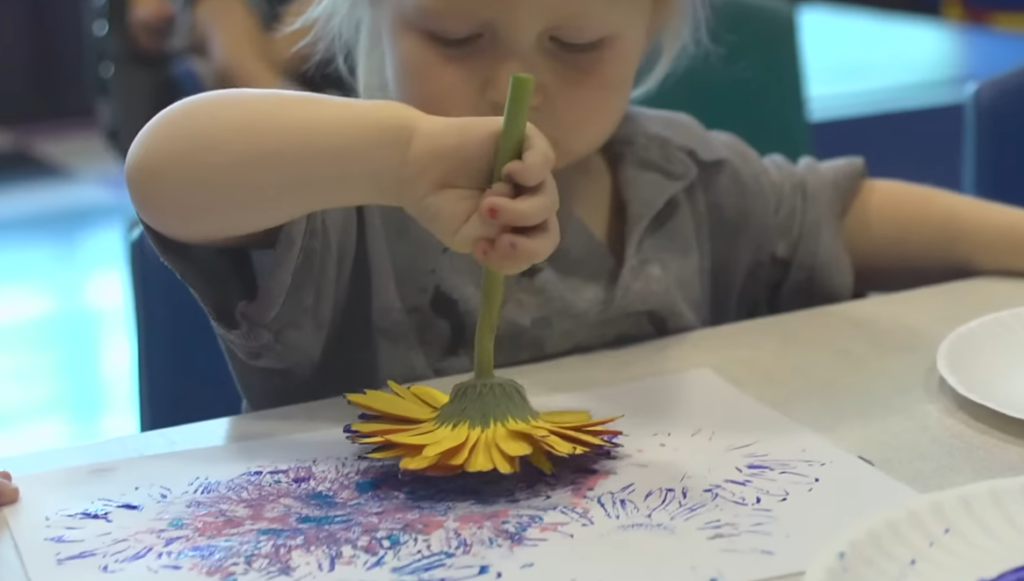
That might seem abstract until you think about its practical implications. When a child draws with pencil and paper, thousands of tiny decisions are made, such as where to begin the line, how hard to press, what to leave out, and how to correct the mistake that turns into the best part. The series of decisions—including the mistakes—is not incidental to the process of creative growth. For the most part, it’s creative development. Most of it is ignored by AI. The outcome is already finished, resolved, and devoid of the awkwardness that imparts invaluable knowledge about creating things to a young mind.
Assistant professor Qiao Jin of North Carolina State University oversaw a different study that looked at how parents and kids aged four to eight reacted to AI-generated pictures in children’s books. The results showed that children were more sensitive than their parents to the emotional content of the pictures, which seems both obvious in hindsight and genuinely surprising in its details. Children noticed when an illustration’s emotions didn’t match the text’s emotions, and it turns out that AI still has a lot of trouble deciphering emotional cues. In ways that their parents frequently overlooked completely, they noticed and were disturbed. The youngest readers were the most sensitive to the emotional void left by AI, which is something to think about.
Researchers’ discussions have started to lean toward what some are referring to as the “AI Second” approach, which is a framework that requires kids to work with tangible materials first, using paint, clay, pencils, and mess to develop fundamental skills and personal meaning before introducing AI as a tool for iteration rather than origination. It’s a sensible notion. Additionally, it calls for a degree of deliberate, structured guidance that most homes don’t naturally provide and most classrooms aren’t currently equipped to provide.
By creating child-safe AI art environments with age-appropriate filters and a stated goal of assisting children in creating with AI rather than being replaced by it, platforms like LittleLit are attempting to find a middle ground. The distinction is genuine and deserving of preservation. However, it still depends on someone—a parent, a teacher, or someone who is paying attention—making sure the tool continues to support the child’s imagination rather than subtly replacing it. That is a more difficult problem than any algorithm has been able to solve so far.
Watching all of this take place in classrooms, living rooms, and tablet screens, researchers seem to agree most of the time that technology shouldn’t be used to solve the inefficiency of learning to imagine, which is the slow, frustrating, and fundamentally human task of conjuring something from nothing. It is the actual object.
Disclaimer
Nothing published on Creative Learning Guild — including news articles, legal news, lawsuit summaries, settlement guides, legal analysis, financial commentary, expert opinion, educational content, or any other material — constitutes legal advice, financial advice, investment advice, or professional counsel of any kind. All content on this website is provided strictly for informational, educational, and news reporting purposes only. Consult your legal or financial advisor before taking any step.
