

Midair turbulence and engine fire are not always involved in aviation incidents. Some take place in silence at 35,000 feet, with increasing pain and a crew that must improvise using instruments that were never intended for the job.
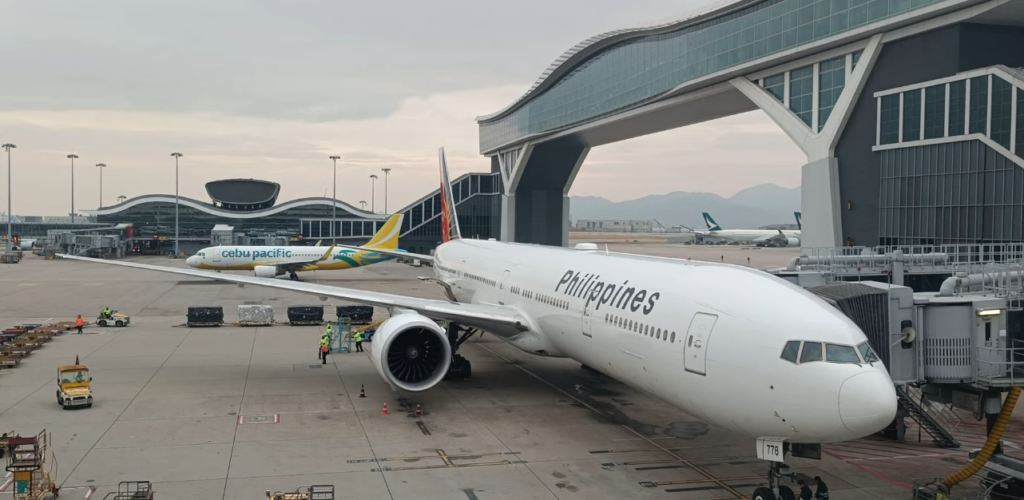
In January, Philippine Airlines Flight PR113—a long-haul Boeing 777—departed Los Angeles heading for Manila. It’s a flight that spans over fifteen hours. Roughly halfway across the Pacific, the crew suffered a breakdown that, while not mechanical in the traditional sense, was extremely disruptive: all eleven restrooms apparently stopped flushing.
It probably felt doable at first. The pressure increased, however, as passengers kept using the facilities. The inconvenience quickly gave way to an unhygienic problem.
Guam was six hours away by the time the crew debated their alternatives. Philippine Airlines later reported that Guam had been designated as a potential diversion site. However, after consulting operational control and considering the aircraft’s condition, the decision was taken to continue to Manila.
On paper, the choice appeared logistically sound. Prior to the plane’s safe landing, the airline reported that several restrooms were operational again. But behind that smooth ending, a series of difficult decisions were made—ones that have sparked reflection across the aviation sector.
| Event | Philippine Airlines PR113 lavatory malfunction |
|---|---|
| Aircraft | Boeing 777-300ER |
| Route | Los Angeles (LAX) to Manila (MNL) |
| Date | January 2026 |
| Issue | Complete failure of lavatory flushing system mid-flight |
| Diversion Option | Guam prepared but flight continued |
| Airline Response | Internal review underway |
One crew film, leaked anonymously, purported to show staff manually clearing garbage from bathrooms using gloves and scoops. Though brief, the clip stirred public alarm and caused aviation experts to worry whether occupational boundaries had been pushed too far.
Sanitation, after all, is not a footnote. It’s essential for passenger dignity and onboard health, particularly on lengthy flights.
These circumstances walk a tightrope, especially for cabin workers. In an emergency, they are taught to be extremely adaptable. But biohazard cleanup is a unique category—one normally reserved for ground staff with dedicated tools, suits, and disposal processes.
However, from a technical standpoint, bathroom malfunctions are not completely uncommon. These vacuum systems, though generally durable, are also highly sensitive to misuse. A single improperly flushed item—tissues, wipes, even wrappers—can induce a clog that cascades through many units. Airlines have made improvements to the system design over time, but the fundamental vulnerability still exists.
What stood out here was the time. In the huge Pacific, Manila is seven hours away and Guam is six. There are fewer possibilities after Hawaii. In that expanse of sky, pilots must make choices with no perfect outcomes.
Remarkably, the flight continued without panic. Passengers were reportedly calm, while cabin personnel maintained composure amid increasing conditions. From an operational standpoint, that’s a success.
But it poses more profound queries.
Should there be a clear protocol when all lavatories fail?
Should human excrement be cleaned at altitude by crews?
And how can airplanes better predict or contain such errors in the future?
In-flight mechanical problems have decreased dramatically over the last ten years because to predictive maintenance technologies. These systems predict issues before they arise by using sensor data and AI analytics. Engines, hydraulics, and cabin pressurization systems have all benefited greatly from this tactic.
Lavatories, by contrast, generally escape such examination. Although uncommon, a complete system failure can have serious sanitary and human repercussions. Therefore, adding flush system monitoring to pre-flight diagnostics might be a sensible next move.
The crew underwent immense pressure to adapt for flight PR113. Despite being unusual, their actions prevented a potentially more disruptive or public sanitation emergency. However, the emotional burden on staff should not be disregarded. It’s never simple to carry out jobs outside of their purview, especially in front of others.
The launch of a review by Philippine Airlines is noteworthy. That’s an optimistic move. Future flights might be better equipped to handle similar anomalies if the decision-making process is documented, staff boundaries are made clear, and perhaps onboard equipment is improved for emergencies.
Discomfort is typically the source of flying lessons.
During the epidemic, we observed how airlines evolved rapidly—installing HEPA filters, rethinking meal service, and instituting sanitary measures within weeks. Now, waste system problems may be handled with more dignity and foresight because to this flexibility.
One traveler, speaking anonymously, commented, “I didn’t know anything was wrong until we landed.” That is evidence of the crew’s poise. However, it also serves as a reminder that passengers seldom get a chance to see the intense calculations taking place right behind the curtain.
Long-haul aircraft will probably have more digitally linked systems in the upcoming years, which will enable improved crew dashboards, modular lavatory shutdowns, and real-time system alarms. These enhancements could considerably lower the likelihood of total failure while providing useful assistance in the event that something goes wrong.
Even while this flight was uncomfortable, it illustrated a delicate reality: sirens and flashing lights are not always present in emergencies. Some come in stealthily, so everyone on board needs to be composed, cooperative, and quick-witted.
Aviation depends not only on engineering but on empathy.
Occasionally, the greatest triumphs are those that passengers are unable to witness.
Disclaimer
Nothing published on Creative Learning Guild — including news articles, legal news, lawsuit summaries, settlement guides, legal analysis, financial commentary, expert opinion, educational content, or any other material — constitutes legal advice, financial advice, investment advice, or professional counsel of any kind. All content on this website is provided strictly for informational, educational, and news reporting purposes only. Consult your legal or financial advisor before taking any step.
