

Twenty years ago, what yeast cells are doing inside a fermentation tank in a technology park in the Brazilian state of São Paulo’s Ribeirão Preto would have seemed like science fiction. They have been given a copy of the genetic code that instructs a cow’s body on how to produce whey and casein, two types of milk protein, and they are doing so. The same proteins exactly. When added to cheese, yogurt, or a protein shake, they have the same molecular structure, functional characteristics, and taste behavior. There’s no cow involved. Pasture is not necessary. Just tanks, sugar, yeast, and the collective creativity of a field that is advancing more quickly than most people think.
Future Cow is the startup that is responsible for this specific operation. Leonardo Vieira, the company’s CEO and co-founder, sums up the goal in a straightforward way that usually dispels doubters: “Our mission is to make milk without a cow.” He clarifies that the procedure is not as strange as it seems. It follows the same principle as brewing beer: you feed microorganisms, allow them to ferment, and then extract the products. Precision makes a difference. You’re engineering the microbe to produce a particular protein and nothing else, rather than removing carbonation and alcohol from the process. The remainder is purification.
| Topic | Precision Fermentation — Cow-Free Dairy Proteins and Climate Impact |
|---|---|
| Technology Definition | Using genetically programmed microorganisms (yeast, fungi, bacteria) in bioreactors to produce dairy proteins molecularly identical to those in cow’s milk |
| Key Proteins Produced | Casein (used in cheese, yogurt) and Whey (protein supplements); also Lactoferrin (infant nutrition, immune health) |
| Environmental Impact | Up to 97% lower greenhouse gas emissions; ~90% less land use; 96–99% less water vs. conventional dairy |
| Lactoferrin Comparison | Takes 10,000 liters of cow’s milk to produce 1 kg of lactoferrin — precision fermentation changes that equation dramatically |
| Key Companies | Perfect Day (USA) — animal-free whey, partners with Nestlé, Unilever; New Culture (USA) — casein for mozzarella; Formo (Germany) — animal-free cheese proteins; TurtleTree (Singapore) — sustainable lactoferrin; Remilk (Israel) — milk proteins for dairy products |
| Notable Startup | Future Cow (Brazil, founded 2023) — CEO Leonardo Vieira; operating from Supera Technology Park, Ribeirão Preto, São Paulo |
| Cost in 2025 | ~€2–€13/kg for traditional protein; ~10x more expensive for precision fermentation equivalents — expected to decrease with scale |
| Regulatory Status | Approved in US and Singapore; classified as “Novel Food” in EU requiring safety approval before sale |
| Market Disruption Timeline | RethinkX projects significant disruption to industrial animal farming by 2030 |
| Total Dairy Market Size | ~$1 trillion globally |
| Key Research | Adeyeye et al., Journal of Basic Microbiology, February 2026 (Wiley) |
| Reference Links | FoodUnfolded – Precision Fermentation: The Technology That Could Transform Our Food System · Phys.org – Biotech Uses Fermentation to Produce Milk Proteins Without Cows |
The idea of precision fermentation is not new. Since the 1980s, E. coli bacteria have been used to produce insulin for diabetics who are unable to produce enough of it on their own. This was the first significant application, and it had nothing to do with food. The same general method was used to create the microbial rennet found in the majority of commercial cheeses today. The use of bulk dairy proteins, the declining cost of synthetic biology, and the rate at which businesses are moving from laboratory quantities to production levels that could genuinely rival industrial dairy farming are all new.
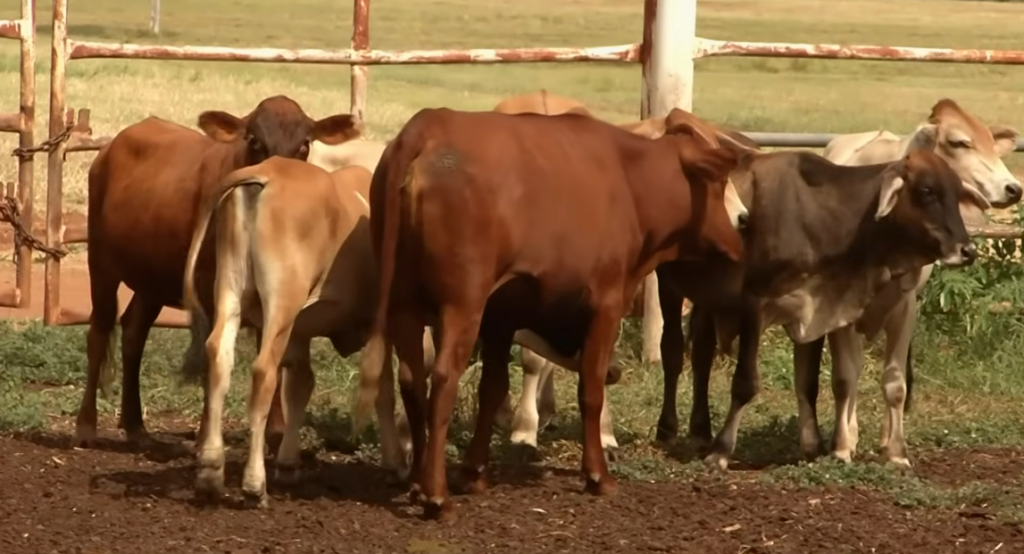
It is hard to dispute the environmental case for doing this. One of agriculture’s biggest sources of greenhouse gas emissions is conventional cattle farming, which produces carbon from land clearing, nitrous oxide from fertilized feed crops, and methane from livestock. Precision-fermented dairy has been shown to reduce emissions by up to 97%, land use by about 90%, and water consumption by 96–99% when compared to conventional production. If those figures hold true on a commercial scale using renewable energy inputs, they represent a truly different footprint for a group of ingredients that are consumed by people all over the world in massive quantities.
The businesses in this sector have been quietly expanding for many years. American company Perfect Day invented animal-free whey protein and has already partnered with Nestlé and Unilever to use its ingredients in popular products. The protein that gives mozzarella its distinctive stretch, casein, is the focus of New Culture’s efforts. Cheese proteins are the main focus of Formo in Germany. TurtleTree in Singapore specializes in lactoferrin, a milk component that requires 10,000 liters of cow’s milk to produce one kilogram, making it nearly impossible to produce at scale using traditional methods. The variety of these strategies indicates that the industry is still figuring out its best paths, which is encouraging and serves as a reminder that there isn’t yet a single strategy that is unquestionably better.
Scale is the issue that almost everyone in this field brings up. Vieira puts it simply: “Ninety-five percent of biotechs fail when they leave a bench environment and go to a pilot plant.” In order to go from a laboratory flask of engineered yeast producing a few grams of protein to a 300,000-liter industrial tank producing tons of it, engineering challenges with no fully established solutions must be solved. Costs are still high; in 2025, they will be about ten times more expensive per kilogram than traditional dairy protein. Similar to how solar panel costs decreased during the 2010s, it is anticipated that these costs will drop significantly as technology advances and investment increases. However, the trajectory depends on successful scale-up, which has not yet been widely proven.
As this field advances, it seems that the general discourse regarding alternative proteins still lags behind the state of the technology. Plant-based burgers and oat milk, which, to varied degrees, mimic animal products using plant ingredients, have been the main narrative. Using a different manufacturing process, precision fermentation produces the same molecular structures that are present in animal foods. The proteins are not replicas. They are identical both nutritionally and functionally. For goods like cheese, where functionality—the way the protein melts, stretches, and browns—is inextricably linked to identity, this distinction is crucial.
At the consumer level, it’s still unclear when or if these products will achieve price parity with traditional dairy. Additionally, it’s still unclear how soon regulatory frameworks will allow fermentation-derived dairy proteins to enter the market, especially in the European Union where novel food approvals proceed slowly. The fact that the technology functions, the investment is genuine, and the businesses developing it are not relying solely on conjecture appears to be less uncertain. They are brewing the milk. How soon the world will be able to drink it is the question.
