

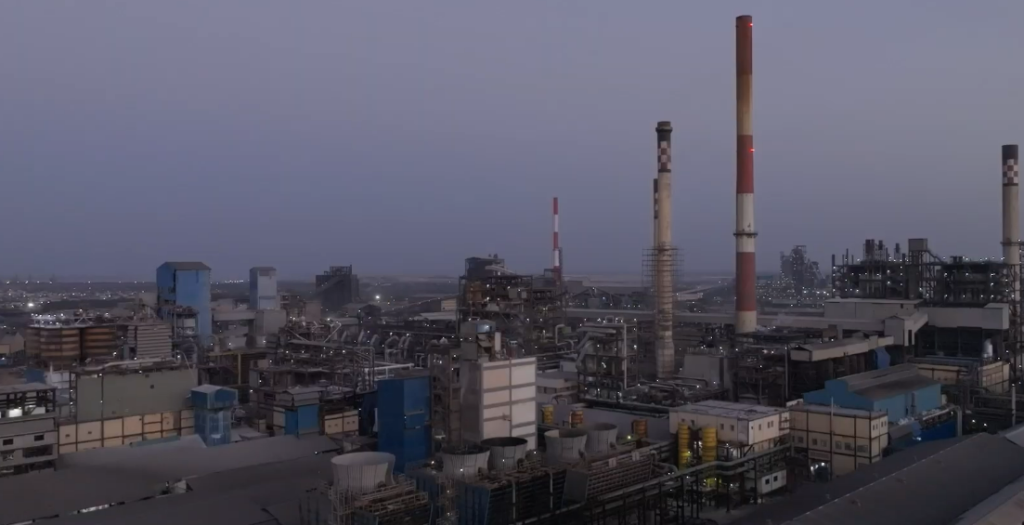
When you stroll through the Tata Chemicals plant in Mithapur, Gujarat, on a clear morning, you will notice the kind of industrial permanence that doesn’t apologize for itself: tall evaporation pans that reach the horizon, the subtle scent of brine and salt in the air, and equipment that has been operating for decades. Since 1939, the company has produced basic chemicals, salt, and soda ash. It eventually spread to North America, Europe, and Africa after aiding in the development of industries throughout India. By all historical standards, it’s a serious business. However, on March 30, 2026, the share price of Tata Chemicals hit ₹580.30, its 52-week low, as the market rendered a decision regarding the company’s current position in a cycle that has clearly turned against it.
The figures from the previous year present an unsettling picture. A net loss of ₹69 crore was recorded in the third quarter of FY2026. Year over year, revenue decreased by 1.11 percent. For comparison, the company’s quarterly net profit during the FY2023 soda ash boom ranged from ₹425 to ₹692 crore. It seems like a long time ago. Operating profit margins are currently at 10% after reaching 25% in the middle of 2023. Over a three-year period, the compound profit growth is negative 40%, and over a five-year period, it is negative 48%. These aren’t rounding mistakes. They show a real decline in the company’s core earnings potential, caused by a global soda ash downcycle that has reduced realizations while keeping costs high.
| Field | Details |
|---|---|
| Company Name | Tata Chemicals Limited |
| Stock Symbol | NSE: TATACHEM / BSE: 500770 |
| Founded | January 23, 1939 |
| Headquarters | Mumbai, India |
| CEO | Ramakrishnan Mukundan (since 2012) |
| Parent Organization | Tata Group |
| Employees | ~4,789 (2025; other estimates ~14,760) |
| Current Share Price | ₹709.35 (April 22, 2026) |
| 52-Week High | ₹1,026.65 (September 17, 2025) |
| 52-Week Low | ₹580.30 (March 30, 2026) |
| Market Capitalization | ~₹18,079–18,082 Crore |
| P/E Ratio (TTM) | 66.5–99.65 |
| Book Value | ₹877 per share |
| Price-to-Book | ~0.81x (trading below book value) |
| Dividend Yield | ~1.54–1.55% |
| Dividend Payout | 119% (FY2025) |
| ROCE | 3.96% |
| ROE | 1.20% (last year); 4.87% (3-year avg) |
| Q3 FY2026 Net Profit | -₹69 crore (loss) |
| Q3 FY2026 Revenue | ₹3,550 crore (-1.11% YoY) |
| 6-Month Return | -32.25% |
| 1-Year Return | -17.06% |
| YTD Return | -7.66% |
| Next Earnings Date | May 4, 2026 (Q4 FY2026 and FY26 annual results) |
| Morgan Stanley Target | ₹566 (downgraded from ₹1,082; Underweight) |
| Key Products | Soda ash, sodium bicarbonate, salt (Tata Salt), crop protection (via Rallis India) |
| Global Position | 3rd largest soda ash producer globally; 6th in sodium bicarbonate |
| Key Operations | India, North America, Europe (UK restructured), Africa |
| Promoter Holding | 37.98% (unchanged for three years) |
| FII Holding | 11.90% (declining from 14.47% in June 2023) |
| DII Holding | 22.83% (rising from 19.91% in June 2023) |
Late in March, Morgan Stanley issued a downgrade that garnered media attention due to its severity. In a single action, the brokerage reduced Tata Chemicals’ price target from ₹1,082 to ₹566 and moved it from overweight to underweight, a reduction of almost 48%. When analysts are trimming estimates at the edges, that type of target revision does not occur. It occurs when someone determines that the prior framework for valuing the business was essentially flawed. At the time, the stock was already trading at about ₹700. A target of ₹566 indicates more significant declines, and the stock’s subsequent modest recovery to ₹709 indicates that the market is also not entirely persuaded by the bear case.
One aspect of the shareholding pattern merits consideration. Over the course of fifteen quarters, foreign institutional investors have been steadily selling Tata Chemicals; by March 2026, their holding had decreased from 14.47 percent in June 2023 to 11.90 percent. In contrast, domestic institutional investors have been increasing, going from 19.91 percent to 22.83 percent during the same time frame. There are various ways to interpret that divergence. FIIs have repriced the soda ash cycle and moved on due to their shorter time horizons and tighter tolerance for earnings misses. It’s possible that DIIs, who usually invest with longer mandates, are viewing the current prices as a discount entry into a Tata Group company that is trading below its ₹877 book value. Even when the near-term earnings outlook is uncertain, value-oriented buyers have historically been drawn to the stock at ₹709, which is 0.81 times book.
It’s difficult to ignore the fact that Tata Chemicals paid out more dividends than it made in net profit in FY2025, with the dividend payout ratio reaching 119 percent of earnings. Although a payout of ₹11 per share on earnings of about ₹9 per share shows management’s dedication to sustaining shareholder income even during a challenging cycle, it also raises concerns about sustainability if losses persist into FY2026. On May 4, the Q4 results will be very important. The quarterly revenue estimate for Q4 is ₹34.62 billion, while the EPS estimate is ₹0.51. The story may change if the business can demonstrate that losses have stabilized and margins are improving. The ₹566 target ceases to feel far away if it is unable to.
Observing Tata Chemicals from this angle gives the impression that the business is truly at a turning point—not a comfortable one, but a genuine one. Long-term, soda ash’s structural case is still strong because it is used in the manufacturing of glass, detergents, lithium-ion batteries, and a dozen other enduring industrial uses. The current oversupply and price pressure are the result of the last two years’ global capacity additions. Cycles shift. The question is whether Tata Chemicals’ balance sheet, which has ₹22,103 crore in reserves and ₹7,495 crore in borrowings, is robust enough to wait for that turn without necessitating a restructuring that dilutes shareholders in the process. The next data point is May 4. It will be closely examined by long-term investors.
Disclaimer
Nothing published on Creative Learning Guild — including news articles, legal news, lawsuit summaries, settlement guides, legal analysis, financial commentary, expert opinion, educational content, or any other material — constitutes legal advice, financial advice, investment advice, or professional counsel of any kind. All content on this website is provided strictly for informational, educational, and news reporting purposes only. Consult your legal or financial advisor before taking any step.
