

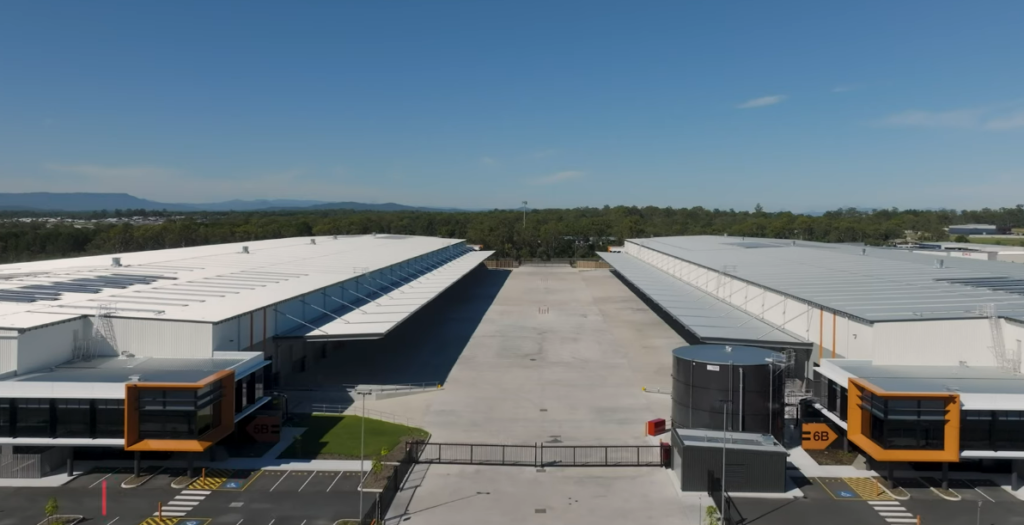
You might pass a Mapletree property without realizing it if you drive through any of the main logistics corridors in South Korea, Japan, Singapore, or the industrial areas outside of Ho Chi Minh City. They don’t make a loud announcement about themselves. Seldom do large warehouses and distribution centers. They act as the unglamorous backbone of supply chains that transport consumer goods from factories to doorsteps, store goods, and handle shipments. With S$13.0 billion in assets and 174 properties spread across nine Asia-Pacific markets, Mapletree Logistics Trust was the first logistics REIT with an Asia-Pacific focus to list on the SGX in Singapore in July 2005. On April 22, the share price was SGD 1.26. less than SGD 1.38, its book value. decreased by about 35% over a five-year period. Over a year, it increased by a meager 6 to 8%. providing a dividend yield that is close to 6%. Growth investors tend to ignore this REIT, while income investors keep a close eye on it. As of right now, the two groups are coming to quite different conclusions from the same set of facts.
The headline from the January release of the Q3 FY2026 numbers unnerved some investors. Distribution per unit dropped to SGD 0.01816, a 9.3% annual decrease. Both the number and the decline are real. However, a closer look reveals something different from what the headline suggests. SGD 7.5 million in one-time, non-recurring divestment gains were included in the previous period’s DPU. Translated income was impacted by currency weakness in four markets: the Korean won, Japanese yen, Vietnamese dong, and Hong Kong dollar. Twelve properties that were sold during the year were no longer generating income. When all of that is taken out, the operating DPU decreased by about 2.1 percent annually. That number is far more doable. The price has stabilized and slightly increased since the announcement, though it’s unclear if the market has fully absorbed that distinction.
By the metrics that are important for a logistics REIT, the operational foundations are holding up fairly well. In Q3, portfolio occupancy increased from 96.1 percent to 96.4 percent. Throughout the entire portfolio, rental reversions remained positive at 1.1%. The China rental reversion, which had been operating at extremely negative levels during the real estate downturn—minus 10.2 percent a year ago—has been the most closely watched figure in recent quarters. It had subsided to minus 2.2 percent by Q3. That is still unfavorable. However, the direction of travel is important, and anyone who has followed the logistics market in China over the last 18 months would see that movement as significant. China may continue to steadily stabilize. Additionally, the trend might be reversed by a more widespread slowdown in the local economy.
IMPORTANT INFORMATION — MAPLETREE LOGISTICS TRUST (SGX: M44U)
| Field | Details |
|---|---|
| Trust Name | Mapletree Logistics Trust (MLT) |
| Stock Symbol | SGX: M44U / MAPL |
| Type | Real Estate Investment Trust (REIT) |
| Founded / Incorporated | 2004 |
| Listed On | SGX-ST Main Board (July 28, 2005) |
| Headquarters | Singapore |
| CEO | Sok Kam Kam |
| Manager | Mapletree Logistics Trust Management Ltd. (wholly owned subsidiary of Mapletree Investments) |
| Employees | 285 (2024) |
| Current Share Price | SGD 1.26 (April 22, 2026) |
| 52-Week Range | SGD 1.07 – SGD 1.37 |
| Market Capitalization | ~SGD 6.39–6.49 Billion |
| P/E Ratio (TTM) | ~37.43–38.25 |
| Book Value Per Share | SGD 1.38 |
| Price-to-Book | ~0.91x (below book value) |
| Dividend Yield | ~5.57–5.92% |
| Quarterly Dividend | SGD 0.02 per unit |
| Annual Payout (est.) | SGD 0.07 per unit |
| EPS (TTM) | SGD 0.0334 |
| Revenue (TTM) | SGD 711.31 Million |
| Net Income (FY) | SGD 183.54–192.54 Million |
| EBITDA | SGD 514.09 Million |
| Gross Profit Margin | 73.4% |
| Q3 FY2026 Revenue | SGD 176.83 Million (-3.06% YoY) |
| Q3 FY2026 DPU | SGD 0.01816 (-9.3% YoY) |
| Portfolio Occupancy (Q3) | 96.4% (up from 96.1%) |
| Rental Reversion (Q3) | +1.1% |
| China Rental Reversion | -2.2% (improved from -10.2% a year earlier) |
| Assets Under Management | S$13.0 Billion (as of Dec 31, 2025) |
| Number of Properties | 174 across 9 Asia-Pacific markets |
| Geographies | Singapore, Australia, China, Hong Kong SAR, India, Japan, Malaysia, South Korea, Vietnam |
| 1-Year Return | +6.84–8.62% |
| 5-Year Return | -35.30 to -36.47% |
| YTD Return | -4.55% |
| Next Earnings Date | April 30, 2026 |
| Analyst Avg. Target | SGD 1.433 (+14.64% upside) |
| JPMorgan Target | SGD 1.50 (Buy, upgraded Oct 2025) |
| Citi Target | SGD 1.33 (Buy) |
It is worthwhile to focus on the portfolio recycling program. So far this year, MLT has sold six properties at an average premium of 20% over book value. Additionally, management has identified approximately S$1 billion in older-specification assets that will eventually be sold, with about half coming from China and Hong Kong. What distinguishes well-managed REITs from passive income vehicles is this type of active management, which includes selling older properties at premiums and redeploying into assets with higher specifications. The April 30 earnings release should help determine whether the proceeds are redeployed effectively enough to support DPU recovery over the next two to three years.
It’s difficult to ignore the fact that Mapletree Logistics Trust is currently trading at 0.91 times book value, which is below NAV and usually indicates that the market is pricing in some level of asset impairment or continuous income pressure. With an average target of SGD 1.433, nine out of fourteen covering analysts advise purchasing the stock, suggesting an increase of about 15% from current levels. In October 2025, JPMorgan upgraded from Hold to Buy. As of right now, no analyst gives it a sell rating. There is a perception that the market has overcorrected from the pandemic-era REIT premium, and that what appears to be a struggling REIT on the surface is actually a well-occupied, actively managed portfolio experiencing a dip driven by cycles and currencies. The trust’s future course will depend on whether the April 30 results validate that reading.
Disclaimer
Nothing published on Creative Learning Guild — including news articles, legal news, lawsuit summaries, settlement guides, legal analysis, financial commentary, expert opinion, educational content, or any other material — constitutes legal advice, financial advice, investment advice, or professional counsel of any kind. All content on this website is provided strictly for informational, educational, and news reporting purposes only. Consult your legal or financial advisor before taking any step.
