

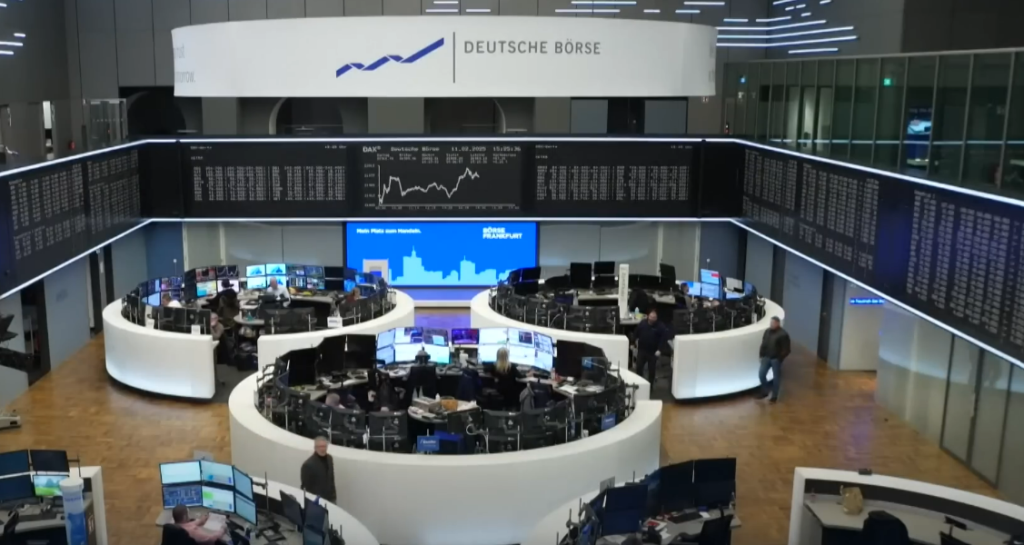
On a Wednesday afternoon, if you stand at the windows on the upper trading floors of the Frankfurt Stock Exchange on Börsenplatz and gaze out at the city, you may notice that the atmosphere is different than it was a year ago. These days, the screens are almost always green (the DAX has increased by almost 10% over the last 12 months and 58% over the last five years), but there’s a certain level of awareness in the room that wasn’t present before. Every headline about a ceasefire, a report of ships being fired upon in the Strait of Hormuz, or a statement from Washington regarding the extension or termination of the Iran truce is processed and repriced in a matter of minutes. On April 22, the DAX closed at about 24,194, down 0.31 percent. Technically sound. However, it is only 1.3 percent above the 200-day moving average, which is regarded by professional traders as the boundary between a bullish trend and an unstable market.
On April 20, two days prior, the session was more educational. The higher-than-expected producer price data indicates that the inflationary pressure in the German industrial supply chain has not completely subsided. This has an impact on the rate path of the European Central Bank, which in turn affects borrowing costs for all German banks with loan books to manage and all German industrial companies with capital expenditure plans. That day, the DAX dropped 1.1%, with nine constituents rising and 31 declining. 3.67 percent was lost by MTU Aero Engines. SAP experienced a 3.37 percent decline. Mercedes-Benz and Volkswagen both saw declines of roughly 2.6%. Inflationary surprises are not taken lightly by this market, especially when they coincide with unresolved geopolitical tension.
IMPORTANT INFORMATION — DAX (GDAXI)
| Field | Details |
|---|---|
| Index Name | DAX (Deutscher Aktienindex) |
| Trading Symbol | GDAXI / ^GDAXI |
| Exchange | Frankfurt Stock Exchange (Xetra) |
| Index Type | Total Return (includes dividends) |
| Number of Constituents | 40 (currently 39 active) |
| Current Level | ~24,126–24,194 (April 22–23, 2026) |
| Daily Change | -84.23 (-0.35%) |
| 52-Week High | 25,507.79 |
| 52-Week Low | 21,731.79 |
| YTD Return | Approximately flat to slightly negative |
| 1-Year Return | +9.91–10.17% |
| 1-Month Return | +6.55% |
| 5-Year Return | +57.97% |
| Day’s Range | 24,032.00 – 24,140.50 |
| 200-Day Moving Average | ~24,115 (key support level) |
| German 10-Year Yield | ~3.0% |
| Key Gainers (April 22) | Infineon (+3.47%), Continental (+0.69%), BASF (+0.39%) |
| Key Losers (April 22) | SAP (-2.28%), Commerzbank (-1.46%), Deutsche Bank (-1.31%), Heidelberg Materials (-1.13%) |
| Most Active | Deutsche Telekom, Infineon, Deutsche Bank |
| Xetra Volume (April 20) | ~€2.2 Billion |
| Key Macro Pressures | Iran/Middle East; German PPI above expectations; ECB rate uncertainty |
| Notable Prior Session | April 20: -1.1% to 24,440; MTU Aero Engines -3.67%, SAP -3.37% |
The DAX’s internal makeup on April 22 speaks for itself. Due to strong chip demand and some encouraging analyst comments, Infineon Technologies, a German semiconductor company with extensive exposure to automotive and industrial electronics, gained more than 5 percent, making it the session’s top performer. SAP fell 2.28 percent, Deutsche Bank fell 1.31 percent, and Commerzbank fell 1.46 percent on the same day. A market managing two distinct economic cycles concurrently is one in which banks perform poorly and semiconductor equipment performs well on the same day. The dynamics of the yield curve and the state of the domestic economy have an impact on Germany’s finances. Global AI capital expenditures and export demand have an impact on its technology and industrial businesses. The index is being pulled in different directions by both occurring simultaneously.
Sentiment is influenced by the larger European picture in ways that seem unique to 2026. Due to jet fuel shortages brought on by the Hormuz blockade, Lufthansa, which is not a DAX constituent but whose problems permeate the ecosystem, had to cancel 20,000 short-haul flights. This is a tangible, tangible result of the geopolitical situation that affects not only airline stocks but everything that depends on European aviation and logistics. To offset fuel expenses, Air France-KLM announced long-haul fare increases. An effort to maximize the distribution of jet fuel among member states was started by the European Commission. These macro variables are not abstract. These are real-world financial limitations that appear in business choices on a daily basis.
Observing the DAX trade in this narrow range between 24,000 and 24,500 gives the impression that the market is in a holding pattern, awaiting clarification on the Middle East situation, clearer signals from the ECB, and a stabilization or decline in Germany’s domestic demand picture in ways that the available data does not yet conclusively demonstrate. Several analysts have identified the 200-day moving average at about 24,115 as the pivot point. An alternative signal would be sent by a prolonged break below it. A return to 25,000 would indicate that the recent volatility was transient. As of right now, neither a breakdown nor a convincing recovery are occurring in the DAX. It is holding positions, processing information, and waiting for a resolution to the uncertainty, which is what German markets frequently do.
Disclaimer
Nothing published on Creative Learning Guild — including news articles, legal news, lawsuit summaries, settlement guides, legal analysis, financial commentary, expert opinion, educational content, or any other material — constitutes legal advice, financial advice, investment advice, or professional counsel of any kind. All content on this website is provided strictly for informational, educational, and news reporting purposes only. Consult your legal or financial advisor before taking any step.
