

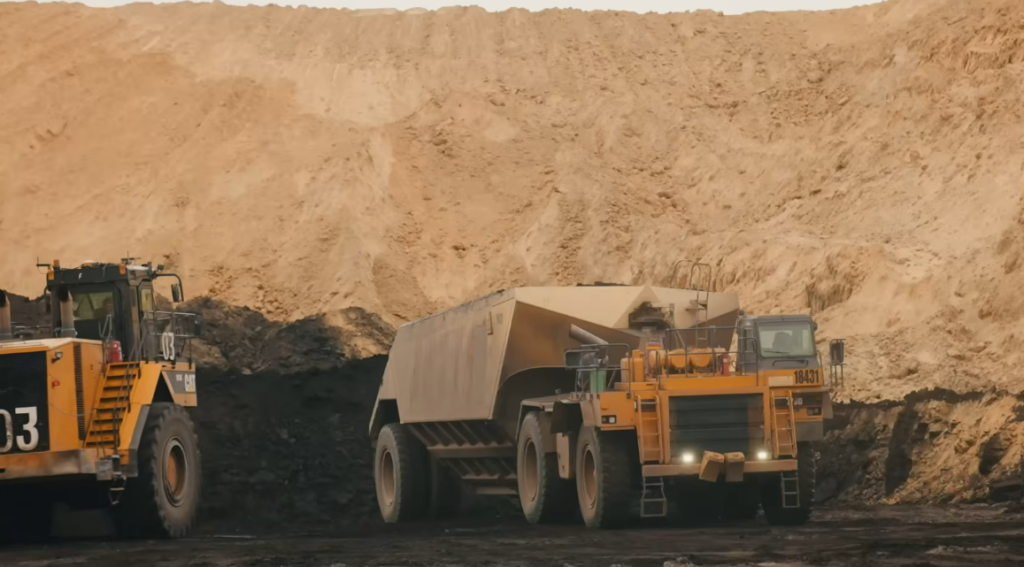
When you drive through the mining districts of Odisha or the coalfields of Jharkhand, you come across a landscape that doesn’t apologize for what it is: kilometers of open-cast pits, massive machines that move earth with the methodical patience of something that has been doing this for fifty years. Since the Indian government nationalized the coal industry and established the biggest coal-producing company in the world in November 1975, Coal India has been doing precisely that. The company still employs over 220,000 people, contributes about 82% of India’s total coal output, is listed in the Nifty 50, and has a market capitalization of more than ₹2.73 trillion after 50 years. According to most green energy narratives, it wasn’t expected to remain so commercially significant in 2026.
The energy transition discourse mostly ignores the story that the share price conveys. Over the past year, Coal India’s stock has increased by 19%. increased by 136% in just three years. 438 percent more than five. The Sensex’s 1.36 percent one-year return and 31.62 percent three-year return seem almost insignificant in comparison to those figures. It has been hard to argue against the returns for investors who held Coal India through the renewable energy wave despite the ESG noise. For a company with 38.9 percent ROE, 48 percent ROCE, and a dividend yield close to 6 percent, the stock currently trades at a P/E of about 9, which is genuinely low. Either a commodity business is being discounted more than it merits, or the market is pricing in a significant long-term decline.
| Field | Details |
|---|---|
| Company Name | Coal India Limited |
| Stock Symbol | NSE: COALINDIA / BSE: 533278 |
| Founded | November 1975 (as Coal Mines Authority Ltd) |
| Headquarters | Kolkata, West Bengal, India |
| Classification | Maharatna Central Public Sector Enterprise |
| Owner | Ministry of Coal, Government of India |
| Employees | 220,272 (2025) |
| Current Share Price | ₹444.35 (April 22, 2026) |
| 52-Week Range | ₹368.65 – ₹476.00 |
| Market Capitalization | ~₹2.73 Trillion |
| P/E Ratio (TTM) | 9.14–9.21 |
| EPS (TTM) | ₹48.44 |
| Dividend Yield | ~5.93–5.96% |
| Forward Annual Dividend | ₹22.00 per share |
| Book Value | ₹171 per share |
| Price-to-Book | ~2.59x |
| ROCE | 48.0% |
| ROE | 38.9% (3-year avg: 48.7%) |
| Profit Margin | ~23% |
| Annual Revenue (FY2025) | ₹1.434 Trillion (~US$17 billion) |
| Q3 FY2026 Net Profit | ₹7,166 crore (-15.85% YoY) |
| Q3 FY2026 Revenue | ₹34,924 crore (-5.25% YoY) |
| TTM Net Profit | ₹29,755 crore |
| Total Cash (Sep 2025) | ₹365.2 Billion |
| YTD Return | +12.79% |
| 1-Year Return | +19.26% |
| 3-Year Return | +136% |
| 5-Year Return | +438% |
| India Coal Production Share | ~82% of total national output |
| Earnings Date | April 27, 2026 |
| Analyst Avg. Target | ₹431.38 (Hold consensus) |
| Key Subsidiaries | Bharat Coking Coal, Mahanadi Coalfields, CMPDI |
A more conflicting picture was presented in the latest quarterly results. Net profit dropped 15.85 percent to ₹7,166 crore in Q3 of FY2026, while revenue decreased 5.25 percent year over year to ₹34,924 crore. Compared to the 33 to 35 percent range the company was operating at a year prior, the operating margin shrank to 27 percent. A portion of this can be attributed to the e-auction coal prices’ softness, which was once high but has since subsided. Ammonium nitrate prices have increased by 44% and diesel prices have increased by 54% as of April 1, 2026, according to a separate note from the company in April. In a mining-intensive operation where each tonne of coal necessitates the transportation of overburden over kilometers, that type of input cost inflation does not quickly reverse.
The next big data point is the results announcement on April 27, which is more important than usual. In addition to Q4 results, the board will take into account a final dividend recommendation for FY2026. Income-oriented investors and domestic institutions, who together own between 22 and 23 percent of the company in addition to the government’s 63 percent stake, are drawn to Coal India because of its dividend history. At the current price, the forward annual dividend of ₹22 per share yields close to 5%. That yield is not insignificant in a setting where fixed deposit rates are dropping.
Coal India’s strategic positioning is currently experiencing an intriguing tension. On the one hand, the company has pledged to spend about $3 billion to build 4.5 gigawatts of clean energy capacity, including wind and solar projects that coexist awkwardly with the company’s primary coal mining operations. However, a recent MCA notice suggested using Section 248(2) of the Companies Act to strike off CIL Solar PV Ltd., a wholly owned subsidiary. The goal of clean energy and the administrative cleanup of a solar car don’t exactly go hand in hand. It’s possible that the subsidiary dissolution is just a corporate housekeeping issue and the clean energy push is sincere. Additionally, Coal India’s renewable diversification may proceed more slowly in reality than it does in public statements. Between those two readings is most likely where the truth lies.
When observing Coal India from a distance, it seems as though the stock is torn between two narratives that haven’t been resolved into a single cohesive view: the long-term displacement story, which makes analysts hesitant to assign a strong buy, and the income and value story, which makes the current price appear appealing. The average analyst believes the stock has already exceeded their twelve-month estimate because the consensus target of ₹431.38 is actually lower than the current share price of ₹444. Nevertheless, the business continues to make money, distribute dividends, dig, and supply about 70% of India’s thermal electricity. The short-term business is still going strong, regardless of the long-term trajectory.
Disclaimer
Nothing published on Creative Learning Guild — including news articles, legal news, lawsuit summaries, settlement guides, legal analysis, financial commentary, expert opinion, educational content, or any other material — constitutes legal advice, financial advice, investment advice, or professional counsel of any kind. All content on this website is provided strictly for informational, educational, and news reporting purposes only. Consult your legal or financial advisor before taking any step.
