

It arrived on Saturday in the manner that British storms frequently do: with enough notice to cause people to feel uneasy, but when it finally touched down, it did so with a lot more force than the fear had fully prepared them for. Over the course of the Easter weekend, Storm Dave swept across the United Kingdom, causing wind gusts of up to 93 mph in North Wales, power outages in thousands of homes from Armagh to Swansea, the collapse of a gable wall in Blackpool, and the need for a mountain rescue team in the Lake District to rescue four teenagers who had made the youthful decision to camp in a cave on a crag during an amber weather warning. Additionally, the storm reached Denmark, where it battered the northwest coast of Jutland on Sunday, indicating that it still had some energy after traveling all the way across Britain.
| Storm Name | Storm Dave |
|---|---|
| Date of Impact | Saturday, April 5 — Sunday, April 6, 2026 (Easter Weekend) |
| Peak Wind Gust | 93mph (150km/h) — Capel Curig, North Wales |
| Other Significant Gusts | 83mph Aberdaron, Gwynedd; 75mph Emley Moor, West Yorkshire; 75mph St Bees Head, Cumbria |
| Warning Levels Issued | Amber (danger to life) — N. England, NW Wales, S. Scotland; Yellow — Scotland, NW Wales, N. England |
| Warnings Lifted | Amber lifted overnight; Yellow lifted ~7:30am Sunday (ahead of scheduled midday expiry) |
| Power Outages | Thousands of homes across Wales, Scotland, Northern Ireland |
| Key Disruption Areas | A66, Humber Bridge, Queensferry Crossing, Forth Road Bridge, ScotRail, Network Rail Manchester |
| Notable Incidents | Blackpool house partial collapse; Lake District teenage rescue; trees onto homes in Staffordshire |
| Snow | Isle of Skye, Western Isles, Glasgow, Inverclyde, west Highlands |
| Forecast Aftermath | Temperatures rising to 20°C by Tuesday; dry and calm by Monday evening |
| Reference Links | BBC News — Storm Dave Coverage / Met Office — UK Weather Warnings |
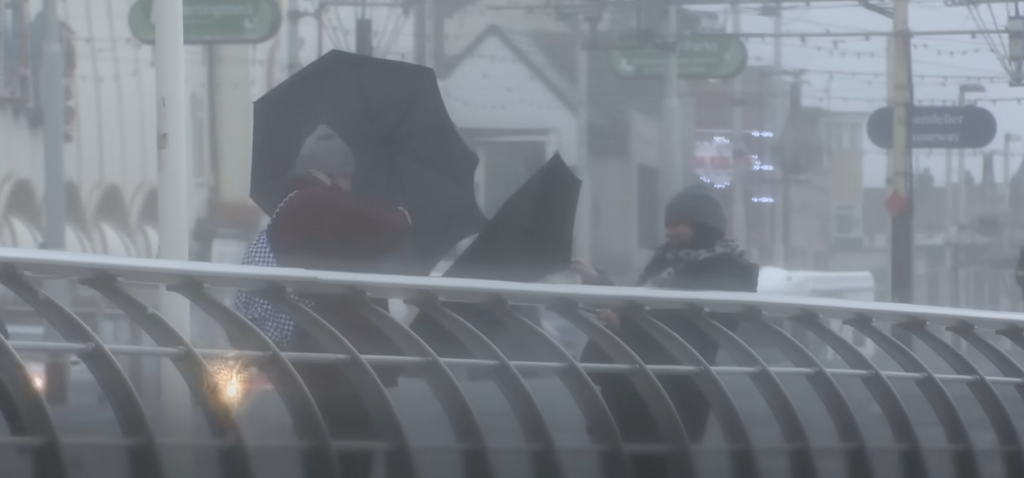
At the Capel Curig weather station in Snowdonia, the strongest gust ever measured was 93 mph. That’s the kind of wind speed that launches wheelie bins into the air and removes slates from roofs, so it’s not a minor springtime annoyance. Gwynedd’s Aberdaron recorded 83 mph. In West Yorkshire, Emley Moor reached a speed of 75 mph. The Met Office explicitly stated that there was “danger to life from flying debris” in the amber warning that covered portions of northern England, north-west Wales, and southern Scotland. This indicates that the situation called for more caution than usual.
The disruption’s geographic location provides its own narrative. As gusts raked the North Pennines on Saturday evening, the A66 trans-Pennine route was closed in both directions, initially to high-sided vehicles and then to all traffic. On Stainmore, wind speeds of 98 mph were noted. The Humber Bridge, which links north Lincolnshire and East Yorkshire, closed for the night. Cars were restricted to 30 mph on the Forth Road Bridge and the Tay Road Bridge, as well as the Queensferry Crossing in Scotland, which typically transports M90 traffic over the Firth of Forth. In certain areas of its network, ScotRail implemented emergency speed limits. Replacement bus services between Manchester Piccadilly and Chester have been announced by Network Rail Manchester. Many people had already decided to spend Easter visiting family or traveling to the coast and countryside, so the combination of a major storm and a holiday weekend caused the kind of travel disruption that affects hundreds of thousands of people at once.
Donna Hanna, a resident of Blackpool, reported feeling “sick” following the partial collapse of the gable end of her former Westbourne Avenue home into the adjacent alleyway. She had just moved out with her daughter. It was the kind of narrow escape that only makes headlines as a detail, but it illustrates a particular aspect of how extreme wind affects the stock of older homes in British seaside towns—structures that were never intended to withstand gusts of up to 80 mph. A big tree fell onto the roofs of two families in Staffordshire, forcing them to relocate. A woman who was staying with relatives in Newark, Nottinghamshire, reported a two-hour power outage and winds that threw objects against windows and cars outside. “Frightening” was how she described it.
Prior to the storm, the Energy Networks Association had issued a warning about the increased risk to power infrastructure, advising network operators to prepare for the worst by staffing up and moving spare equipment. On Saturday, thousands of homes in Northern Ireland, North Wales, and South and West Wales lost electricity. The most severely affected areas in Northern Ireland were Seaforde in County Down and Newtownhamilton in County Armagh. While locating and repairing downed lines in rural and coastal areas usually takes longer than the storm itself, the majority of power was restored before Sunday morning.
The fact that Storm Dave eased more quickly than the Met Office had predicted was one of its more beneficial characteristics. The yellow warnings for Scotland, northern England, and Wales were supposed to last until noon on Easter Sunday, but by 7:30 a.m., they had been lifted because the storm was moving northeast faster than anticipated. According to Marco Petagna, a spokesman for the Met Office, winds “eased down a bit more quickly than forecast” and the yellow warnings were “no longer warranted.” After a rough morning in some parts of the north and west, Easter Sunday actually became passable for the majority of the country. This is a fairly uncommon result, as storms typically stick closer to their predicted timelines.
After a storm like this one, there’s a sense that the UK has become somewhat accustomed to the rhythm of named storms—the warnings, the travel advice, the social media trending hashtag, the train disruption notices, and then, usually within a day, the return to something approaching normal. Although the infrastructure repercussions are real and occasionally severe, they are usually absorbed. The particular cruelty of a major storm arriving exactly on a bank holiday weekend, when people have made plans, when trains are already full, and when the window for alternate arrangements is practically nonexistent, is less frequently recognized. In the worst sense of the word, Storm Dave had perfect timing.
Disclaimer
Nothing published on Creative Learning Guild — including news articles, legal news, lawsuit summaries, settlement guides, legal analysis, financial commentary, expert opinion, educational content, or any other material — constitutes legal advice, financial advice, investment advice, or professional counsel of any kind. All content on this website is provided strictly for informational, educational, and news reporting purposes only. Consult your legal or financial advisor before taking any step.
