

Scientists once referred to a region north of Greenland as the “Last Ice Area.” The idea that this frozen redoubt would endure even as the rest of the Arctic softened and retreated was conveyed by the name. A ship could be completely engulfed by ridges formed by centuries of pressure on thick, unyielding ancient ice. It was meant to live. It’s not surviving anymore.
Over the past few years, the concerning loss of Arctic sea ice has changed from a warning to a record. The Arctic’s winter maximum extent, which is the annual peak of ice cover prior to the start of spring melting, reached its lowest point in the 47-year satellite record in 2025. That record was then essentially tied once more in March 2026. The worst-case scenario is beginning to resemble the norm.
The specific silence surrounding this in popular discourse is difficult to ignore. The numbers continue to come in; this past winter, they were about 1.31 million square kilometers below the 1981–2010 average. There is a brief wave of worry, a few alarming headlines, and then things move on. However, the ice doesn’t go away. Since the 1980s, more than 95% of the thickest, oldest sea ice—the type that takes more than four years to form—has simply disappeared. Young, thin ice that melts before summer even fully arrives is what’s left.
| Topic | The Alarming Disappearance of Arctic Sea Ice |
|---|---|
| Region | Arctic Ocean, North Pole, Greenland, Canadian Arctic Archipelago |
| Key Metric | Sea ice declining at over 12% per decade since the late 1970s |
| 2025 Record | Lowest winter maximum extent in 47 years of satellite records |
| Primary Drivers | Ice-albedo feedback, Atlantic warming (“Atlantification”), atmospheric heat transport |
| Projected Ice-Free Summer | As early as 2027–2033 (first occurrence); consistently by the 2030s–2050s |
| Oldest Ice Lost | Over 95% of ice older than 4 years has vanished since the 1980s |
| Global Consequences | Disrupted jet stream, Greenland melt acceleration, coastal erosion, AMOC risk |
| Key Research Bodies | Alfred Wegener Institute, University of Gothenburg, NOAA, IPCC |
| Reference Links | NOAA Arctic Report Card 2025 · Nature Climate Change – AWI Study on Pressure Ridges |
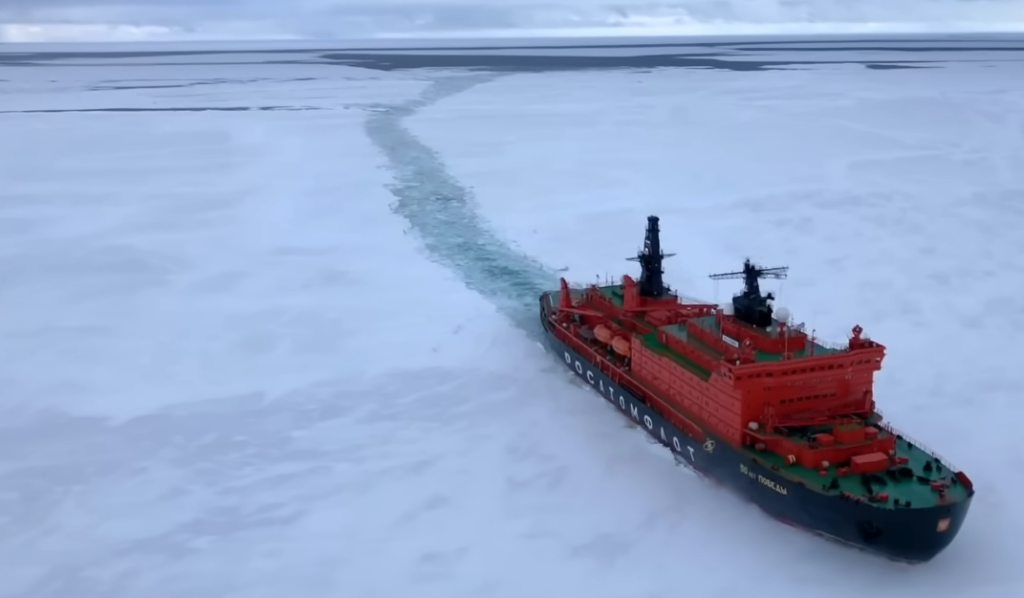
It’s worthwhile to consider the physics underlying this. Like a mirror, white ice reflects sunlight back into space. Darker ocean water absorbs heat rather than reflecting it when it melts, warming the ocean and causing more ice to melt. This is essentially a planetary thermometer that has switched to the incorrect setting and is now feeding itself; scientists refer to it as the ice-albedo feedback loop. This is made worse by a phenomenon that scientists have begun to refer to as “Atlantification”—warmer, saltier Atlantic water pushing northward into the Arctic, upsetting the ocean’s natural layering and making it more difficult for ice to form from below. In other words, the Arctic isn’t simply losing ice. It is undergoing restructuring.
Even the physical architecture of Arctic ice is disappearing, according to research recently published by the Alfred Wegener Institute. North of Greenland, pressure ridges—those striking formations where ice floes collide and stack into 30-meter-deep underwater walls—are disappearing at a rate of more than 12% every ten years. Most people are unaware of how important these ridges are. They serve as a shelter and a place for polar bears to give birth. They are home to entire communities of organisms. From a distance, their loss is silent and nearly undetectable, but it symbolizes a slow-motion ecological destruction.
Climate scientists are concerned about more than just the Arctic. The cascade is what it is. The temperature differential between the Arctic and the tropics affects the jet stream, which controls weather patterns throughout the Northern Hemisphere. The jet stream stalls, loops, and wobbles as that gap gets smaller, and it’s getting smaller quickly. There is a compelling scientific argument that the Arctic’s transformation is directly linked to the harsh heatwaves that have become grimly commonplace throughout Europe and North America, the wildfires, and the flooding events that appear out of nowhere.
The ocean comes next. The Beaufort Gyre, a significant current in the Arctic Ocean, may be nearing a tipping point, according to a study released in early 2025 by the University of Gothenburg. At the moment, it holds massive volumes of freshwater. The Atlantic Meridional Overturning Circulation, the planetary conveyor belt that includes the Gulf Stream, may suffer if it weakens and releases that water into the North Atlantic. That system is largely responsible for the comparatively mild climate of Northern Europe. Although it is still genuinely unclear whether this will actually happen over decades or within a century, the fact that researchers are now modeling it as a plausible possibility says something.
Speaking with those who study this closely gives you the impression that you’ve crossed some unseen threshold, which is more of a point of commitment than a tipping point. The first truly ice-free summer day in the Arctic is now expected to occur sometime between 2027 and 2033, if not sooner. Regardless of emission trajectories, the majority of scientific projections now consider an ice-free summer to be practically inevitable within this century. That does not justify fatalism. The frequency and duration of those ice-free summers, as well as what happens in all the years that follow, are still determined by emissions reductions. However, the first one is most likely on the horizon.
When you take a step back from the data, you’ll notice how consistently the models have underestimated this. The Arctic is warming about four times more quickly than the rest of the world. Only when researchers employ the most pessimistic scenarios have the majority of climate projections—including, frequently, the cautious ones generated under the IPCC framework—aligned with actual observations. It’s uncomfortable to admit that, and there’s a chance that the upcoming forecasts will once more be overly conservative. The ice does not move with the same caution as science.
The unanswered question no longer really concerns the Arctic. The question is whether the systems that rely on it, such as weather patterns, ocean circulation, and coastal communities in Alaska, Canada, and Siberia, which are already witnessing the erosion of their shorelines due to increased wave action and less ice to buffer it, have enough time to adjust. Whether they do is still up for debate.
Disclaimer
Nothing published on Creative Learning Guild — including news articles, legal news, lawsuit summaries, settlement guides, legal analysis, financial commentary, expert opinion, educational content, or any other material — constitutes legal advice, financial advice, investment advice, or professional counsel of any kind. All content on this website is provided strictly for informational, educational, and news reporting purposes only. Consult your legal or financial advisor before taking any step.
