

A journalist was awake at one in the morning on a January night in the Yarra Valley, east of Melbourne, listening to the wind rip through the eucalyptus canopy over his home. The text from a friend whose family owned a sizable property in the expanding fire zone had settled something, even though smoke was already in the air—distant fires, he told himself, nothing immediate. “Definitely leave.” The family was in the car by the next morning, when catastrophic fire danger warnings were in effect throughout Victoria and temperatures were predicted to reach 46 degrees Celsius.
That January 2026 story is no longer out of the ordinary. It is becoming more and more similar to how Australian summers, autumns, springs, and even winters feel in the north. The nation that historians have long referred to as “the fire continent” has reached a stage where the idea of a fire season, with its suggested start and finish, has begun to seem like a holdover from a previous climate.
It is difficult to casually comprehend the numbers underlying this change. Three of the four worst forest fire years in 90 years of Australian records have happened since 2002. Depending on how you measure it and whether you include the disastrous 2019–20 Black Summer, which alone saw 24 million hectares—roughly the size of the United Kingdom—consumed by fire, the annual average area burned has increased by between 350% and 800% compared to the period from 1988 to 2001. Since 1910, the average temperature in Australia has increased by 1.4 degrees Celsius. The number of fires during the cooler months of March through August has increased by 14% yearly. These are not small adjustments. They represent a reorganization of the continent’s connection to fire.
Because the word “unprecedented” is used so frequently in climate reporting that it begins to lose its meaning, it is worthwhile to take a moment to consider what the Black Summer actually was. This fire burned concurrently in Queensland, New South Wales, Victoria, South Australia, and Western Australia for several months, from August 2019 to March 2020. Over 700 million tonnes of CO2 were released in just three months, which is equivalent to the yearly emissions of a mid-sized industrialized country. The number of animals killed or displaced ranged from one to three billion. For weeks, Sydney was engulfed in concentrations of smoke that turned the harbor orange and drove locals to hardware stores to purchase face masks. Naval ships evacuated coastal towns. In a red-orange haze that many described as truly apocalyptic, people flocked to beaches.
After that, it was over. Less than six years later, in January 2026, parts of Victoria experienced catastrophic fire conditions once more, with heatwave temperatures exceeding 45 degrees and residents packing their cars at midnight on the advice of emergency services.
| Topic | Australia’s Year-Round Wildfire Crisis |
|---|---|
| Country | Australia |
| Temperature Increase Since 1910 | 1.4°C (approximately 1.6°C above pre-industrial levels) |
| Black Summer Dates | September 2019 – March 2020 |
| Area Burned (Black Summer) | 24 million hectares (approx. 90,000 sq miles) |
| Human Deaths (Black Summer) | 34 direct; approximately 400+ smoke-related |
| Animals Killed or Displaced | 1–3 billion (estimated) |
| CO₂ Released (Black Summer, 3 months) | Over 700 million tonnes |
| Annual Increase in Cool-Month Fires (March–Aug) | 14% per year |
| Increase in Annual Burned Area vs 1988–2001 | 350%–800% (including 2019/20) |
| 2025–2026 Season Impact | Severe heatwaves in Victoria and Western Australia; multiple towns evacuated |
| Climate Change Wildfire Risk Multiplier | Up to 20x in some regions (State of Wildfires report) |
| Key Fire Authority | Bureau of Meteorology (BoM); CSIRO; Country Fire Authority (CFA) |
Reference Links: Australia’s Fire Weather Seasons — Bureau of Meteorology Climate Change and Australia’s Wildfires — University of Melbourne Pursuit
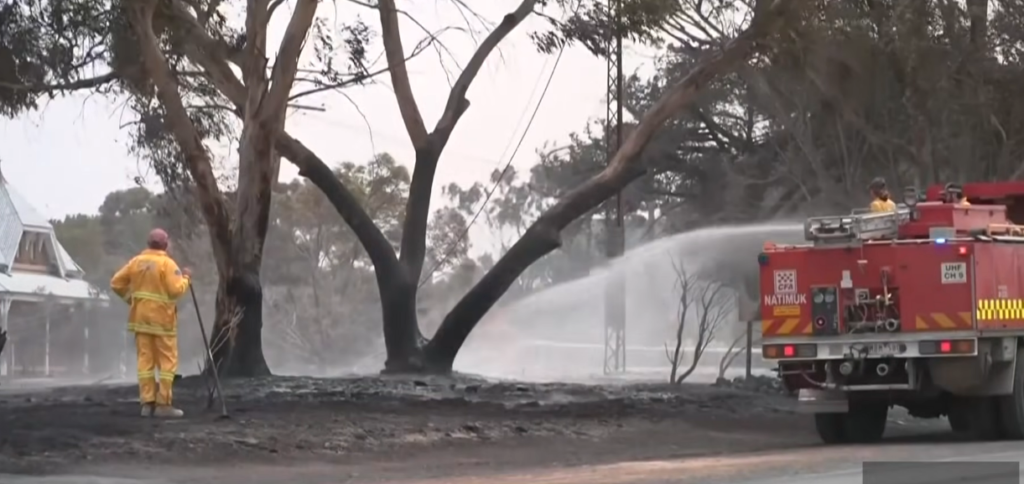
Here, a longer historical context is worth clinging to. Fire has always existed in Australia. Black Thursday in 1851, Red Tuesday in 1898, Black Friday in 1939, Ash Wednesday in 1983, and Black Saturday in 2009 are just a few examples of the named days of disaster that date back to the early days of European colonization. The “fire flume,” the corridor where hot northerly winds carry scorching air from the central deserts into the forested ranges of Victoria and Tasmania, creating conditions for firestorms every few decades, has been the subject of extensive research by Australian historian Tom Griffiths. Ecologically speaking, these occurrences are very old. High-intensity crown fires are actually necessary for the mountain ash forests that characterize the southeastern ranges to crack open their seeds and regenerate in large numbers. In this environment, fire is not an accident. It’s a biological necessity.
Everything surrounding the fire has changed. The gaps between hazardous situations are getting smaller. As the seasons get hotter and drier earlier, there is less opportunity for prescribed burning, the hazard reduction work that fire services rely on to lower fuel loads before summer. Large tracts of dead, blackened tree skeletons have been left behind by recent, intense fires throughout the Southeast, creating future fuel loads while also destroying habitat that might not recover in the shorter time between fires. Furthermore, rather than improving, the urban interface issue—where Australian cities have spread into bushland in ways that resemble the circumstances that have resulted in catastrophic losses in California—is becoming worse.
Observing all of this build up gives the impression that Australian policy is still catching up to a reality that the environment has already determined. A clear emphasis on early evacuation has taken the place of the “stay and defend or leave early” policy that led to 173 deaths on Black Saturday in 2009, when two-thirds of victims died in their homes. It’s highly likely that this change has saved lives. The mayor of the Yarra Valley towns that were under threat in early 2026 praised the locals for following evacuation orders, and the towns mostly avoided direct casualties. Unquestionably, progress.
However, the more complex issues remain, such as prescribed burning windows that continue to shrink, fossil fuel approvals that continue to be signed, and housing developments that continue to push farther into bushland that is prone to fire. In January 2026, the prime minister of Australia paid a visit to the devastated towns of Mount Alexander Shire to offer support. Since 2022, his government has approved 32 major fossil fuel projects that are projected to produce over 6.5 billion tonnes of greenhouse gases over the course of their lifetimes. There is no subtlety to the contradiction.
The cultural burning customs that many First Nations communities have preserved and are attempting to revive—setting low-intensity fires at the appropriate ecological moments to reduce fuel loads and restore country—are an important aspect of the expanding discussion about Indigenous fire practices. North Queensland-born Tagalaka descendant Victor Steffensen has written about these approaches with a mix of optimism and frustration, pointing out that the practical difficulty is as much bureaucratic as ecological. Conventional ecological burning is not directly scalable across all Australian ecosystems, and it differs from prescribed burning carried out by fire services. However, the partnership has real potential, and there is a growing understanding that the European fire suppression model, which viewed uncontrolled fire as an enemy, was never fully appropriate for a continent whose ecology had been shaped by fire for millennia.
According to an international research team’s 2024 State of Wildfires report, climate change has made extreme fire weather up to 20 times more likely in some regions of the world. During the 2023–2024 season, carbon emissions from wildfires worldwide were 16% higher than average, amounting to about 8.6 billion tonnes of CO2. With 84 million hectares burned in the northern savannahs alone, Australia made a substantial contribution to those numbers, placing the season among the top five burned-area years since 2002.
The precise limit of this trend is still unknown. According to models, extreme fire events will increase in frequency over the remainder of the century under mid-to-high emissions scenarios. Concretely, this means that in areas like the Yarra Valley, the Blue Mountains west of Sydney, or the forested ranges above Adelaide, the decision to stay or leave—which was already made earlier and more urgently than it was a generation ago—will need to be made more frequently, with less notice, and with harsher penalties for making the wrong decision.
Disclaimer
Nothing published on Creative Learning Guild — including news articles, legal news, lawsuit summaries, settlement guides, legal analysis, financial commentary, expert opinion, educational content, or any other material — constitutes legal advice, financial advice, investment advice, or professional counsel of any kind. All content on this website is provided strictly for informational, educational, and news reporting purposes only. Consult your legal or financial advisor before taking any step.
