

In long-term research, there is a moment that occasionally occurs when a scientist who has spent years observing something change very slowly realizes the change has reached a point from which it won’t return. For the majority of his career, Dr. Jason Box of the Geological Survey of Denmark and Greenland has measured, flown over, and thought about the Greenland Ice Sheet. Since 2004, he has witnessed the Sermilik glacier at Greenland’s southernmost point lose about 100 meters of thickness—not in a dramatic collapse, but in a grinding, steady recession that has left the remaining ice appearing, in his words, “diminished, almost battered.” He works as a scientist. He is picky about the words he uses. However, when questioned about the significance of the ice sheet’s current state, he stated bluntly: “Already effectively that’s a death sentence for the Greenland ice sheet because also going forward in time we’re expecting temperatures only to climb.” Thus, we are losing Greenland; the only question is how quickly.
Now, the key question is how quickly. For 27 years in a row, the Greenland Ice Sheet has decreased. It has lost an average of 269 gigatons of ice annually since 2002, a figure that is difficult to understand until someone makes a comparison. In an attempt to make it tangible, Twila Moon, deputy lead scientist at the National Snow and Ice Data Center, imagined that every one of the world’s eight billion inhabitants would pour a liter of water into the ocean every fifteen minutes, day and night, for twenty-two years in a row. That’s about how much freshwater Greenland has been adding to the world’s oceans. The salinity is altered. It modifies existing patterns. Additionally, it causes sea levels to rise in ways that, when combined with Antarctic melt and the thermal expansion of warming water, constitute one of the slower-moving but most significant effects of the climate the world has created.
Key Facts: Greenland Ice Sheet & Climate Research
| Location | Greenland — world’s largest island; ice sheet covers most of it |
| Ice Sheet Dimensions | Over 3km thick at center; spans 2,000km north-south, ~1,000km east-west |
| Potential Sea Level Rise | Up to 7 meters if entire sheet melted (over centuries/millennia) |
| Annual Average Ice Loss | ~269 gigatons per year since 2002 |
| Consecutive Shrinking Years | 27 years in a row as of 2024 |
| New Scientific Discovery | Thermal convection inside the ice — swirling plume structures driven by temperature differences |
| Lead Researcher (convection) | Robert Law (glaciologist); Prof. Andreas Born, Bjerknes Center / University of Bergen |
| Key Climate Scientist | Dr. Jason Box, Geological Survey of Denmark and Greenland (GEUS) |
| Sermilik Glacier Change | Surface lowered ~100 meters since 2004; shrinks ~9 meters per summer |
| Sea Level Equivalence | 362 billion tonnes of melt = approximately 1mm of global sea level rise |
| Reference Links | Greenland Ice Sheet Can’t Be Stopped But Can Be Slowed – Bulletin of the Atomic Scientists · Ice on Greenland Acting Strangely – Phys.org |
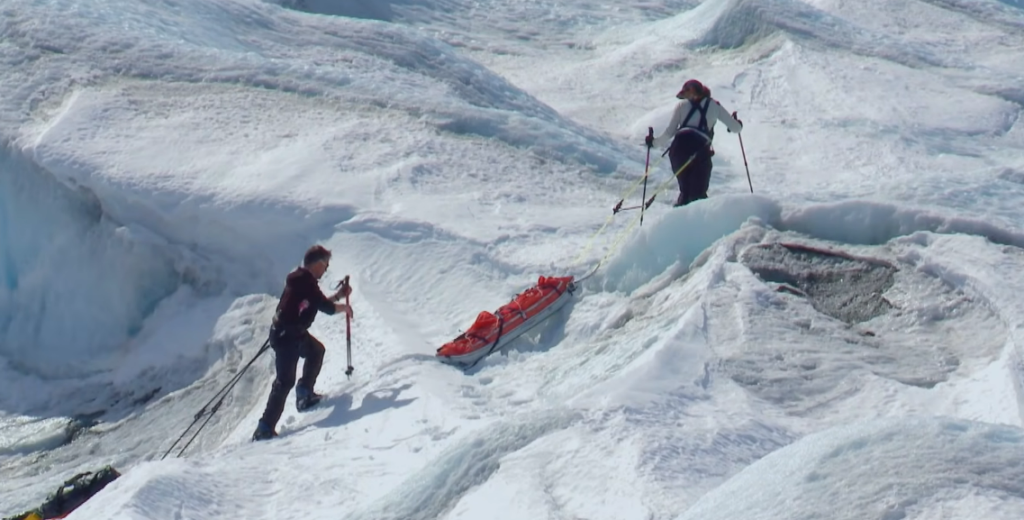
Global sea levels could rise by up to seven meters if the ice sheet melted completely, which scientists estimate would take hundreds to thousands of years even under the most extreme warming scenarios. Bangladesh would not be what it is today. A significant chunk of Florida would be submerged. The landscape of Eastern England would change. These are the simple physics of the amount of water trapped in the ice, not fringe projections. The contribution that is being made now, in decades as opposed to millennia, is the more immediately applicable figure. Research has repeatedly demonstrated that millions of people in low-lying coastal regions worldwide could be at risk from even a slight but persistent increase in the rate of melting over the next few decades. Standing at the edge of a glacier that has lost 100 meters of thickness in the last 20 years, Bangladesh, Florida, the Netherlands, and the Pacific island nations are not far-off abstractions.
The magnitude of the loss and a recent finding about the behavior of the ice’s interior, which scientists are still trying to fully comprehend, are what make the current scientific moment so remarkable. Early in 2026, glaciologist Robert Law and Professor Andreas Born of the University of Bergen’s Bjerknes Center for Climate Research published a paper that discovered thermal convection inside an ice sheet, something no one had anticipated. In enormous swirling plume-like structures that have baffled scientists for more than ten years, it appears that the same slow, churning movement that propels the motion of Earth’s tectonic plates—typically linked to the hot, semi-liquid mantle thousands of kilometers below the surface—is occurring inside the Greenland ice itself. What was thought to be a nearly static solid undergoes a sort of slow boil due to the mechanism, which is driven by vertical temperature differences within the ice. “We typically think of ice as a solid material,” said Born, “so the discovery that parts of the Greenland ice sheet actually undergo thermal convection, resembling a boiling pot of pasta, is as wild as it is fascinating.”
What this means for the ice’s potential speed of movement and eventual melting is the immediate question. According to current models, the deep ice in these convecting zones is about ten times softer. Softer ice flows more readily in the direction of the coast, where it collides with the warmer ocean water that has been subtly eroding the ice sheet from below or breaks off as icebergs. Law took care to point out that the relationship between softer ice and faster melting is more nuanced and needs more research. The finding does, however, indicate that the models that scientists have been using to forecast future sea level rise and ice loss were based on a lack of knowledge about the behavior of the ice. It might be necessary to recalibrate those projections’ margin of uncertainty in ways that could go either way.
In addition, a biological issue is causing the surface melt to accelerate in ways that were only recently fully recognized. In person, the Sermilik glacier’s surface appears much darker than it does in older photos, which show it as a bright expanse of pale blue-white ice. One BBC reporter once said that walking on it is like landing on the moon. Algae, microscopic plants that have been thriving in the warming, melting ice, are largely to blame for the darkening, which has caused the surface to change from highly reflective white to gray or almost black in some areas. Instead of reflecting sunlight back into space, a darker surface absorbs more of it. This speeds up surface warming, which produces more melt and more conditions for the algae to proliferate. It is a self-feeding feedback loop that can be seen both from satellite imagery and from the ground.
Disclaimer
Nothing published on Creative Learning Guild — including news articles, legal news, lawsuit summaries, settlement guides, legal analysis, financial commentary, expert opinion, educational content, or any other material — constitutes legal advice, financial advice, investment advice, or professional counsel of any kind. All content on this website is provided strictly for informational, educational, and news reporting purposes only. Consult your legal or financial advisor before taking any step.
