

Before dawn, the departure boards started to turn red. The word “Cancelled” began to recur at Dubai International Airport, which is typically a ballet of long-haul connections and polished efficiency, in subtly defying the norm. The same scene played out in Doha, Abu Dhabi, Tel Aviv, and Beirut in a matter of hours. Flights to the Middle East were canceled. No delay. Not redirected. canceled.
The trigger was set off quickly: US and Israeli strikes on Iran were followed by drone and missile launches across the Gulf in retaliation. There was a complete or partial closure of airspace over Iran, Iraq, Israel, Qatar, Kuwait, Bahrain, and portions of the United Arab Emirates. Cirium reports that during the initial wave, almost 25% of scheduled flights into the area were canceled. Flightradar24’s flight tracking maps revealed vast, empty skyways where heavy traffic typically moves between Europe and Asia.
Invisible highways are essential to air travel. Everything behind the scenes starts to unravel when you close them.
| Category | Details |
|---|---|
| Major Hub | Dubai International Airport |
| Key Airline | Emirates |
| National Carrier | Qatar Airways |
| UK Carrier Affected | British Airways |
| Aviation Data Source | Cirium |
| Flight Tracking Service | Flightradar24 |
| Reference 1 | BBC News – Flights cancelled after Iran strikes |
| Reference 2 | Reuters – Airlines suspend Middle East operations |
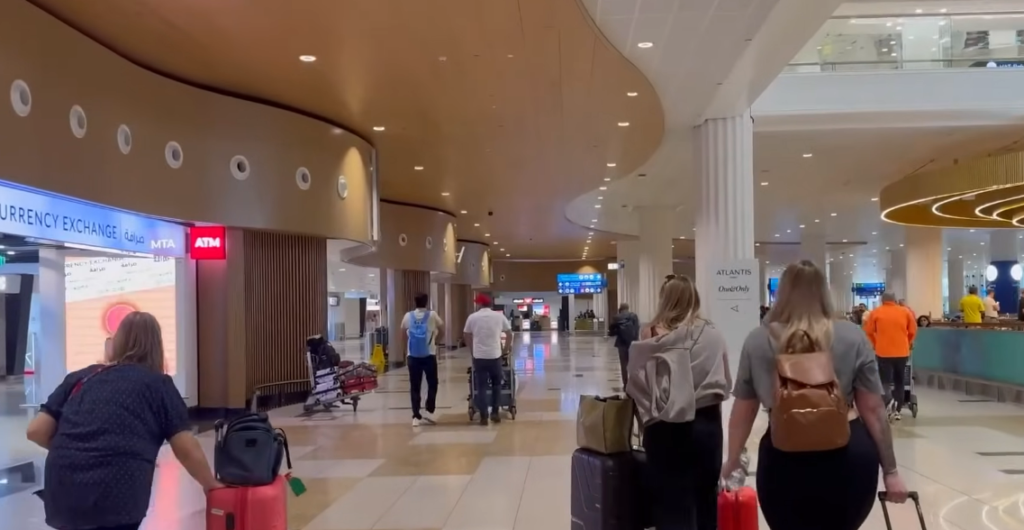
Passengers sat on suitcases in Dubai’s Terminal 3, their phones glowing in their hands as they updated airline apps that appeared to be updated every minute. On their way back to Manchester from the Maldives, a family found that their Emirates flight had completely disappeared from the system. One traveler whispered, half to himself, “No one really knows what’s going on.” People seem to be more uneasy with uncertainty than with delays.
Emirates temporarily halted operations. Departures from Doha were suspended by Qatar Airways. Bahrain and Tel Aviv flights were canceled by British Airways. As the day went on, the list of airlines grew longer, including Lufthansa, Air India, Turkish Airlines, and Delta. The dispersion of aircraft and crews across continents resulted in logistical complexities that could take days to resolve.
Executives in the aviation industry might have practiced for something similar. Airlines redesigned their schedules with contingency planning in mind following the pandemic. A sudden collapse of regional airspace, however, is not the same. Crews need to take a break. The aircraft needs to be moved. It is necessary to rebook passengers, frequently onto flights that are no longer available.
Heathrow experienced the knock-on effect. In one day, it canceled almost half of its flights to destinations in the Middle East. Flights to Gulf hubs, which are crucial transit hubs for North America and Europe, were removed from the departure lists in Delhi and Mumbai. Even routes that didn’t land in the Middle East had to change their course, which increased expenses and fuel consumption by hours.
It’s difficult to ignore how crucial the Gulf has become to international travel. Abu Dhabi, Doha, and Dubai serve as intersections connecting continents. Under normal circumstances, about 90,000 passengers pass through those hubs every day. The entire system gets tighter when those airports slow down because the shock spreads outward.
Like abandoned trolleys in a supermarket parking lot, luggage carts were arranged in rows outside Beirut’s Rafik Hariri International Airport. In groups, travelers stood, some phoning family members, others just gazing at screens. The air was humid, tense, and unclear. As we watch this develop, we get the impression that the seamless connectivity that air travel promises is more brittle than we realize.
Travel warnings were issued by governments. The UK advised residents to stay indoors or refrain from visiting certain areas of the region unless absolutely necessary. According to reports, over 76,000 Britons registered in the impacted areas. Whether widespread evacuations will be necessary is still up in the air. These kinds of operations are politically delicate, costly, and complex.
In the meantime, airlines must balance solvency and safety. It takes a lot more time and fuel to reroute around closed airspace, which is frequently done via Saudi Arabia or the Caucasus. Despite the fact that oil prices are already rising and adding to financial strain, investors appear to think that disruptions will only last temporarily. The margins deteriorate with each extra hour in the air.
Additionally, there is the psychological cost. Aviation gradually picked up speed after COVID grounded fleets all over the world. The confidence of the passengers returned. Orders for aircraft increased. It was assumed that the system was now more robust. Now that so many flights to the Middle East have been canceled, that confidence feels put to the test once more.
An anniversary celebration in Doha was reduced to a hotel room and unanswered emails for a couple. Passengers in Newcastle were instructed to “wait for updates” and return home. The expression may seem straightforward, but waiting in limbo is rarely that way.
Nevertheless, airports continue to function at the periphery. Crews on the ground inspect aircraft that might not take off. Crews in the cabin wait for orders while their uniforms are pressed. Airspace might reopen in a few days, bringing the rhythm back. It’s also possible that the closures could be prolonged by additional escalations.
Precision is the foundation of aviation: timetables, slots, and carefully planned international handoffs. That accuracy quickly evaporates when geopolitics gets involved. Tracking screens show sparse, oddly calm skies over the Middle East, once crowded with intersecting flight paths.
Not stable, but calm.
Travelers are quietly realizing that peace is more important to global connectivity than technology. Aircraft cannot outrun missile alerts or closed borders, even if they are designed to be resilient.
Disclaimer
Nothing published on Creative Learning Guild — including news articles, legal news, lawsuit summaries, settlement guides, legal analysis, financial commentary, expert opinion, educational content, or any other material — constitutes legal advice, financial advice, investment advice, or professional counsel of any kind. All content on this website is provided strictly for informational, educational, and news reporting purposes only. Consult your legal or financial advisor before taking any step.
