

The first indication of discontent did not come from an impassioned speech or a protest march. It appeared on January 13, 2026, as a subtly written notification bearing the serious title of the Regulations for the Promotion of Equity in Higher Education Institutions. On paper, the intention seemed very obvious. On campuses, the response was somewhat different.
Within days, students in northern India were becoming increasingly uneasy as they read the fine print. Campus notice boards were adorned with homemade posters, WhatsApp groups exploded, and casual talks outside libraries swiftly evolved into concerted action. Equity had been promised, but not everyone felt involved. This was a remarkably universal worry.
Scheduled Castes, Scheduled Tribes, and Other Backward Classes must file grievances with Equity Committees and Equal Opportunity Centers, according to the regulations. In light of decades of institutional silence and documented negligence, proponents contend that this perspective is especially helpful. Instead, critics emphasized the rules’ exclusions rather than their inclusions.
| Regulation Name | Promotion of Equity in Higher Education Institutions Regulations, 2026 |
|---|---|
| Issued By | University Grants Commission (UGC), India |
| Date Notified | January 13, 2026 |
| Objective | To combat caste-based discrimination and promote campus inclusivity |
| Key Provisions | Equity Committees, Equal Opportunity Centres, 24/7 helplines |
| Main Points of Controversy | Alleged exclusion of general category students, procedural vagueness |
| Protest Locations | Delhi, Lucknow, Meerut, Saharanpur, Alwar, Patna, Ranchi |
| Political Impact | Resignations from BJP leaders, dissent in Parliament |
| Legal Challenge | PIL filed in Supreme Court on caste-neutral protections |
| Reference | The Hindu – UGC 2026 Protest Coverage |
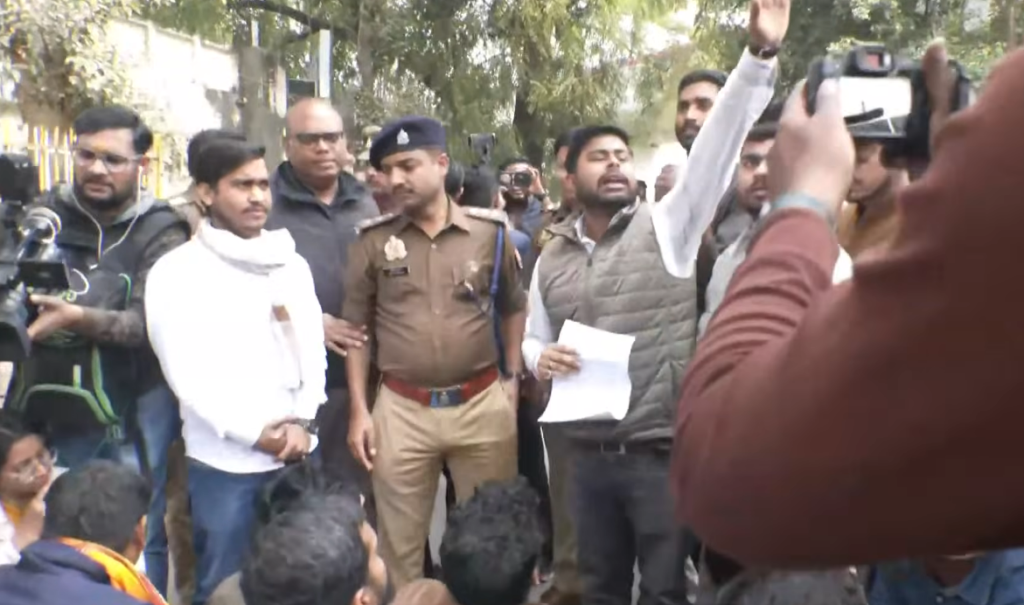
By the middle of the morning, students at Lucknow University had congregated close to the main gate with signs that asked questions rather than slogans. “Who keeps us safe?” one said. Another merely said, “Equality must be reciprocal.” Though not hostile, the atmosphere was tense because of the feeling that something essential had changed.
As the week progressed, protests had extended to Patna, Ranchi, Saharanpur, and Meerut. Daily improvements in participation were significant, indicating coordination as opposed to spontaneity. The meetings resembled civic assemblies rather than ideological confrontations, with students discussing clauses in a manner similar to how policy analysts might analyze a draft bill.
In response, UGC representatives cited data. Currently, SC, ST, and OBC populations account for more than 60% of all students enrolled in higher education in India. These protections were not symbolic to them; they were long needed. That viewpoint made the new regulations appear remedial rather than extreme.
Many pupils in the general category, however, were alarmed by the regulation’s wording. The protection beneficiaries are defined in Section 3(c), which was interpreted as exclusionary. Students expressed concern about a grievance system that acted as a one-way valve, taking complaints without providing corresponding protections.
The legislation itself was put on trial when a group of law students in Meerut held a sham hearing. Combining comedy with legal criticism, it was a particularly creative kind of protest. As debates concerning natural justice and due process developed, onlookers initially scoffed before paying close attention.
It was quickly followed by a legal challenge. Vineet Jindal, a lawyer, launched a Public Interest Litigation, claiming that equality under the constitution cannot be implemented selectively. His filing transformed the protest from an emotional backlash to a legal dispute, giving the campaign a legitimacy that significantly increased after it made it to court.
One line—“I fear the accusation more than the offence”—stayed with me longer than I had anticipated as I stopped beside a protest wall in Delhi decorated with handwritten letters that students had taped.
Immediately, there were political repercussions. Due to the regulation’s poor design and social instability, local BJP leaders in Uttar Pradesh resigned. A student movement became an administrative rift when Bareilly City Magistrate Alankar Agnihotri resigned, precipitating more escalation.
By promising that the regulations would be applied equitably and that abuse would be avoided, the Union Education Minister made an effort to reassure. However, when compared to the written regulation, which is still enforceable and subject to interpretation, the impact of verbal promises was considerably diminished.
Nearly simultaneously, counter-protests began to appear. Students from underrepresented groups demonstrated in support of the regulations at Punjab University. Both of their points were equally strong. They talked about extended stretches of time without institutional support, complaints that were lost in red tape, and quiet that passed for objectivity.
Because it provided structure where none had been there, the new framework felt incredibly dependable to them. Reversing it, they contended, would put campuses back in an unofficial hierarchy where discrimination persisted because there was no system in place to deal with it.
Soon, the controversy spread outside of universities. Legal experts, retired bureaucrats, and business executives all offered their opinions. “Is it appropriate to base a regulation that affects millions of people on a few hundred reported cases?” asked T.V. Mohandas Pai. In response, several argued that the true issue was underreporting rather than absence.
Like a bee swarm, social media was fast-moving, raucous, and hard to ignore. Simplified narratives hardened viewpoints, hashtags clashed, and videos went viral. The debate was much quicker thanks to the digital amplification, but it wasn’t always more obvious.
Teachers found themselves in a difficult position. Many were in favor of equity but were concerned about how it would be implemented. The committees would turn into punitive rather than corrective, they thought, if there were no clear protections against fraudulent allegations.
But cautious optimism also exists. In private, administrators admit that the framework has the potential to be extremely successful with slight modifications. Transparent inquiry procedures, caste-neutral grievance redressal access, and clearer definitions could turn disagreement into agreement.
Fundamentally, the protest at UGC is not a rejection of equity. They are calling for symmetry. Students want protections that are reliable and consistent, not less protection.
The Supreme Court’s action may compel that recalibration in the upcoming months. A system where safeguards unite campuses rather than divide them might be the outcome, if it is implemented with care.
The best educational policies, like education itself, listen before they teach. Currently, Indian campuses are speaking with a level of clarity that is uncommon.
Disclaimer
Nothing published on Creative Learning Guild — including news articles, legal news, lawsuit summaries, settlement guides, legal analysis, financial commentary, expert opinion, educational content, or any other material — constitutes legal advice, financial advice, investment advice, or professional counsel of any kind. All content on this website is provided strictly for informational, educational, and news reporting purposes only. Consult your legal or financial advisor before taking any step.
