

The teacher whispers, “Let’s take three mindful breaths,” as twenty kids sit cross-legged on the classroom floor. The normal chatter is replaced by the hum of the air conditioner. These little moments are changing education. Children’s emotional resilience is now being shaped by what was formerly a yoga studio.
This change has been made possible in large part by educators such as Dr. Alison E. Parker. Her Master Mind Program, a mindfulness-based curriculum for elementary school students, showed how regular awareness exercises and breathing techniques can dramatically improve focus and decrease aggression. Her results were extremely successful, demonstrating observable gains in young learners’ executive functioning and self-control.
Teachers who previously used strict discipline discovered new tools in self-awareness and silence. It’s “a way to give children space to think before they act,” according to a fourth-grade teacher from North Carolina. Even among students who previously had trouble controlling their emotions, the program had a significant positive impact on their attention spans and reduced behavioral disruptions.
A cultural rethinking of what education means is reflected in the increasing emphasis on mindfulness. For many years, the primary focus of education was on intellectual growth. Emotional literacy is now becoming just as important. Children as young as nine years old who practice mindfulness report greater life satisfaction and improved emotion regulation, according to studies published by BMC Psychology and The Mindfulness in Schools Project.
Table: Key Figure Behind the Research
| Full Name | Alison E. Parker |
|---|---|
| Profession | Educational Psychologist & Research Scientist |
| Affiliation | Innovation Research & Training, Durham, North Carolina |
| Field of Study | Child Development, Mindfulness Education, Behavioral Psychology |
| Notable Work | Co-developer of the Master Mind Program for mindfulness in schools |
| Major Research Focus | Mindfulness-based prevention programs for children; emotional self-regulation |
| Contribution to Education | Evaluated the impact of mindfulness on cognitive and behavioral regulation among elementary students |
| Published Research | The Impact of Mindfulness Education on Elementary School Students (NIH, 2014) |
| Authentic Source | National Institutes of Health – PMC4821437 |
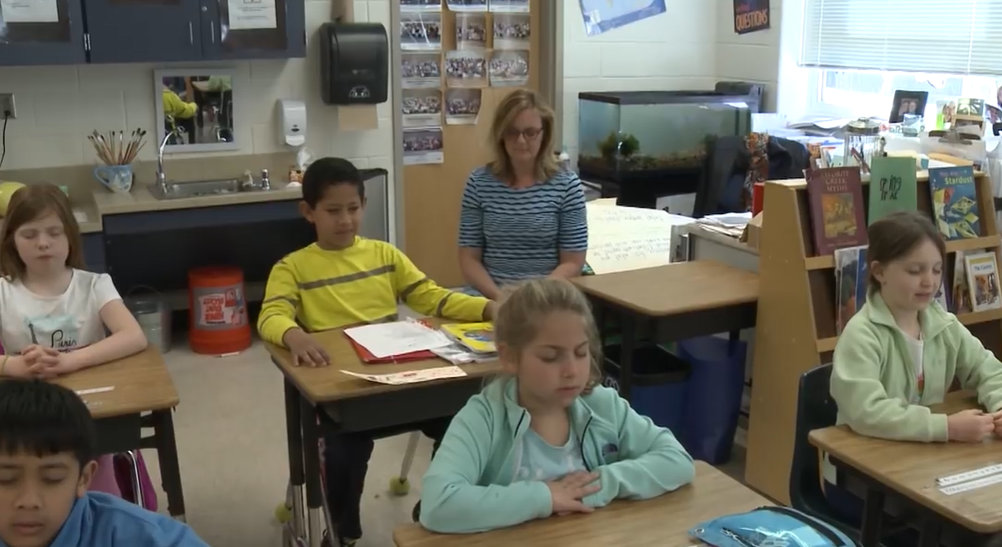
Children who practice mindfulness learn to notice stress rather than to get rid of it. It teaches the mind to view emotions as fleeting clouds rather than dangerous storms. This method works especially well in classrooms where learning is frequently hampered by anxiety and attention issues. Students gain an emotional agility that textbooks cannot teach them by developing awareness.
It’s interesting to note that this increase in mindfulness reflects a larger social shift toward mental health. Prominent individuals such as Emma Watson and Oprah Winfrey have defended mindfulness as a vital component of contemporary self-care. Teachers are incorporating quick mindfulness exercises into morning routines or after recess as a result of their subtly permeating influence into educational systems. Stronger peer relationships, more empathy, and calmer classrooms have been the remarkably consistent outcomes.
The Master Mind Program is cleverly organized. It is based on four pillars: relationships, thoughts, feelings, and body awareness. Every component encourages kids to investigate their social and inner worlds with curiosity rather than condemnation. Lessons frequently incorporate role-playing, mindful eating, and gentle movement to help kids apply these ideas in everyday situations.
Students are not the only ones undergoing this change. Change is also happening to teachers. Teachers who engage in mindfulness practices report much lower levels of stress and burnout, according to research published by SpringerLink. They set an example of composure by learning to think things through before acting, which makes classrooms feel safer and more welcoming. “It’s not just the students breathing—it’s us learning to exhale too,” one educator observed.
There are wider societal ramifications to mindfulness’s success in schools. In today’s fast-paced, technologically advanced world, emotional control has grown in importance. Emotional intelligence, which includes self-awareness, empathy, and adaptability, is a characteristically human advantage as automation and artificial intelligence transform the labor market. In this way, mindfulness is education that is future-proof, not just a teaching tool.
Because they suspect a religious undertone, some critics wonder if mindfulness should be taught in secular schools. However, Parker and other researchers have made the practice very clear: it is not about spirituality but rather emotional and cognitive training. The focus and breathing techniques are not based on mysticism, but rather on neuroscience. According to Frontiers in Psychology’s MRI research, practicing mindfulness on a regular basis can change the way the brain’s attention and emotion control regions look.
Some doubters fear that mindfulness is just a passing fad in education. However, long-term research has strongly supported its impact. Students who took a six-week mindfulness course reported feeling more satisfied with their lives months after the program ended, according to a 2023 Northumbria University study. Students became more thoughtful, less reactive, and noticeably kinder to one another, according to teachers.
Once doubtful, parents are now some of the most ardent supporters. Many parents report that their kids are teaching mindfulness practices at home by suggesting “quiet moments” during dinner or encouraging siblings to vent their frustration. This cultural change implies that mindfulness is a lifestyle tool that is spreading throughout families rather than just being a classroom technique.
Mindfulness has even taken the place of detention in some schools. Children are encouraged to spend a few minutes in reflection rooms, taking deep breaths and thinking through their options, as an alternative to punishment. The outcomes have been especially creative, as numerous schools have reported a notable decrease in recurring behavioral problems. “Kids come out calmer, not resentful,” according to one California principal. They emerge prepared to begin anew.
The movement is growing quickly. In order to emphasize emotional intelligence as a component of academic success, Finland and New Zealand have integrated mindfulness into their national education policies. States like California and Massachusetts are spearheading the movement in the US by educating educators on mindfulness-based classroom management.
Disclaimer
Nothing published on Creative Learning Guild — including news articles, legal news, lawsuit summaries, settlement guides, legal analysis, financial commentary, expert opinion, educational content, or any other material — constitutes legal advice, financial advice, investment advice, or professional counsel of any kind. All content on this website is provided strictly for informational, educational, and news reporting purposes only. Consult your legal or financial advisor before taking any step.
