

The announcement of Samsung Messages’ discontinuation that appeared on the company’s website this past weekend contains a tiny but significant detail. Users are advised to open Samsung Messages and check if they want to know the precise date the app stops functioning. In other words, the app has a funeral notice of its own. Depending on how attached you were to it, that could be either poetic or a little depressing.
| Topic | Samsung Messages App Discontinuation |
|---|---|
| Developer | Samsung Electronics Co., Ltd. |
| Headquarters | Samsung Digital City, Suwon, South Korea |
| App Successor | Google Messages |
| Discontinuation Date | July 2026 (exact date available in-app) |
| Affected Devices | Samsung Galaxy devices running Android 12 (One UI 4) or higher |
| Unaffected Devices | Android 11 or lower; Tizen OS smartwatches (partial impact) |
| Key Features Lost | Samsung Messages UI/design consistency with One UI; full conversation history on older Tizen smartwatches |
| Google Messages Replacement Features | RCS messaging, AI-powered spam/scam detection, Gemini integration, multi-device sync |
| Galaxy S26 Status | Ships with Google Messages as default; Samsung Messages not pre-installed |
| Reference Links | Samsung Official — Switch to Google Messages / Android Authority — Samsung Messages End-of-Life |
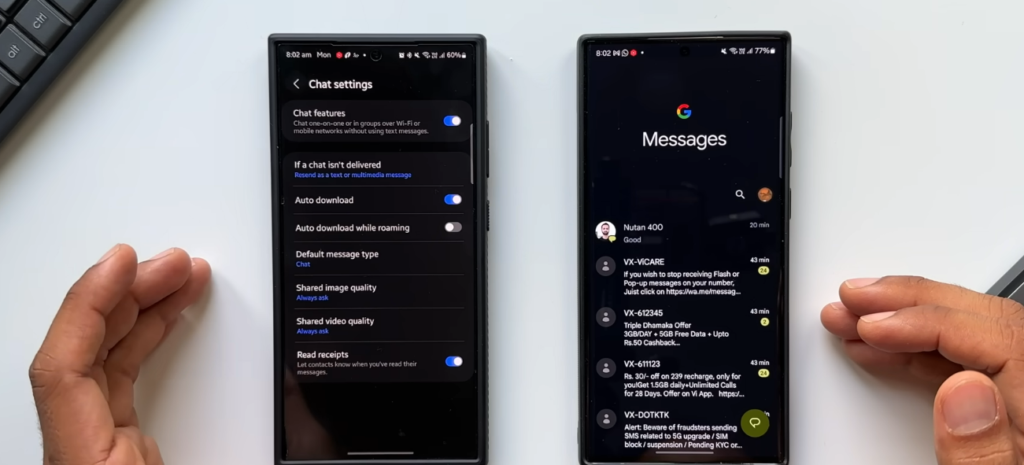
The native Messages app will be discontinued in July 2026, Samsung announced on April 5. The announcement, which is presented as a “End of Service” notice, is intended for Galaxy users with Android 12 or later, which includes the vast majority of Samsung devices that are currently in use in the US. “Upgrade to Google Messages as your default messaging app today to maintain a consistent messaging experience on Android” is a clear and somewhat definitive instruction. That sentence doesn’t contain any hedging. A replacement Samsung product is not promised. Just a twelve-week countdown and a redirect to Google’s offering.
This is likely to be perceived as a minor annoyance at most by those who have been using Samsung phones for years and hardly noticed which messaging app they were opening—a few taps to set a new default, some initial discomfort with a slightly different interface. However, the announcement has a different impact on a significant portion of Samsung’s user base, especially those who appreciated how Samsung Messages sat inside the One UI design system. In the hours following the news, comments on Reddit and other social media platforms consistently expressed frustration: Most people agree that Google Messages functions well, but it feels foreign. The fonts, backgrounds, and visual cadence of the rest of the Samsung experience are not consistent with it. Google Messages feels like a visitor who moved in and started rearranging the furniture, while Samsung Messages fits the design language, according to a post on X.
This decision wasn’t made overnight, which is the deeper context. For a while now, Samsung has been gradually withdrawing from its own messaging app instead of making a dramatic announcement. Samsung Messages is completely absent from the Galaxy S26 series, which was released earlier this year, and Google Messages is the default. As a number of tech reporters pointed out this past weekend, the writing has been there for some time. Samsung finally added a date to the wall next to the writing on Saturday.
The majority of users might not experience this in any useful way. Due to WhatsApp’s overwhelming popularity on Android and in the world, where it has over three billion users, a sizable percentage of Samsung owners use neither app for the majority of their daily messaging. SMS and RCS texting were the true battleground for Samsung Messages, and even there, Google Messages had been steadily gaining ground. Google’s strongest argument for consolidation around Google Messages has always been that RCS, the messaging protocol designed to bring iMessage-like features to Android, only functions properly when all participants in a conversation are using the same app.
However, there is a more significant trend that transcends the messaging app itself. Despite being the biggest Android manufacturer in the world, Samsung has been giving up ground in ways that would have seemed improbable ten years ago, while Google has been expanding its reach deeper into the Android experience for years. Google’s Gemini integration on Samsung devices has gradually eclipsed Bixby, the company’s voice assistant. Although the flagship AI features on Samsung phones increasingly rely on Google’s infrastructure, the Galaxy AI suite does exist and is truly capable. The default messaging app is currently acting in the same manner. As this develops, it’s difficult to avoid seeing it as a gradual but intentional reduction in the definition of “Samsung Android” as opposed to “Google Android.”
For the majority of users, the technical transition will be simple. For Android 12 and 13 devices, Samsung has released a detailed tutorial that explains how to launch or download Google Messages, make it the default SMS app, and verify the modification. While regular SMS and MMS messaging continues during the transition, users of pre-2022 Galaxy phones are cautioned that there may be a brief interruption to ongoing RCS conversations. After July, owners of older Samsung smartwatches running Tizen OS will no longer be able to see complete message conversation histories, though basic sending and receiving will still work. This is a more permanent restriction.
How Samsung’s long-term relationship with its own software suite develops from this point on is still genuinely unclear. There is still the Samsung Internet browser. The Play Store continues to operate alongside the Galaxy Store. Google’s camera app is still different from Samsung’s. However, the messaging concession seems significant because texting is not an optional feature. People do this on every phone, in every situation, and do it dozens of times every day. Giving that to a rival’s application reveals something about the current boundary between Samsung and Google as well as whether Samsung is still actively defending it.
