

A microscope, a thin liquid layer, and a few light streaks were the components of a discovery that has scientists reconsidering what time might truly look like. Researchers at the University of Colorado Boulder, under the direction of Hanqing Zhao and Ivan Smalyukh, persuaded a familiar substance to perform an unknown action. The digital displays’ liquid crystals started dancing on their own.
The crystals performed rather than merely reacting under specific light and geometrical circumstances. They looped, swirled, and twisted in remarkably rhythmic and ordered ways. There was more to this than merely chemical action. What the scientists observed looked like a time crystal, which is a condition of matter that is thought to repeat endlessly without consuming energy.
This discovery was especially noteworthy because it was easily accessible. This time crystal could be viewed under a microscope using materials that anyone could recognize, in contrast to previous ones that were restricted to strictly regulated quantum settings. The patterns occasionally even grew large enough to be seen with the unaided eye. These whirling structures maintained their shape by cycling through change in a predictable and steady manner rather than by opposing it.
These ripples weren’t arbitrary. They were referred to by the researchers as “topological solitons,” which are molecular disruptions that maintain their stability while in motion. A sort of temporal choreography arose as one soliton circled another. The motion persisted for hours without deteriorating or ceasing. And without any outside energy to keep it alive, it accomplished this with astonishing efficiency.
| Aspect | Details |
|---|---|
| Discovery Date | September 2025 |
| Lead Scientists | Hanqing Zhao, Ivan Smalyukh |
| Institution | University of Colorado Boulder |
| Material Used | Liquid crystals (same as in LCD displays) |
| Visibility | Patterns visible under microscope; sometimes to the naked eye |
| Notable Feature | Stable motion over hours without energy input |
| Journal Published In | Nature Materials (DOI: 10.1038/s41563-025-02344-1) |
| Potential Applications | Data storage, anti-counterfeiting, advanced materials research |
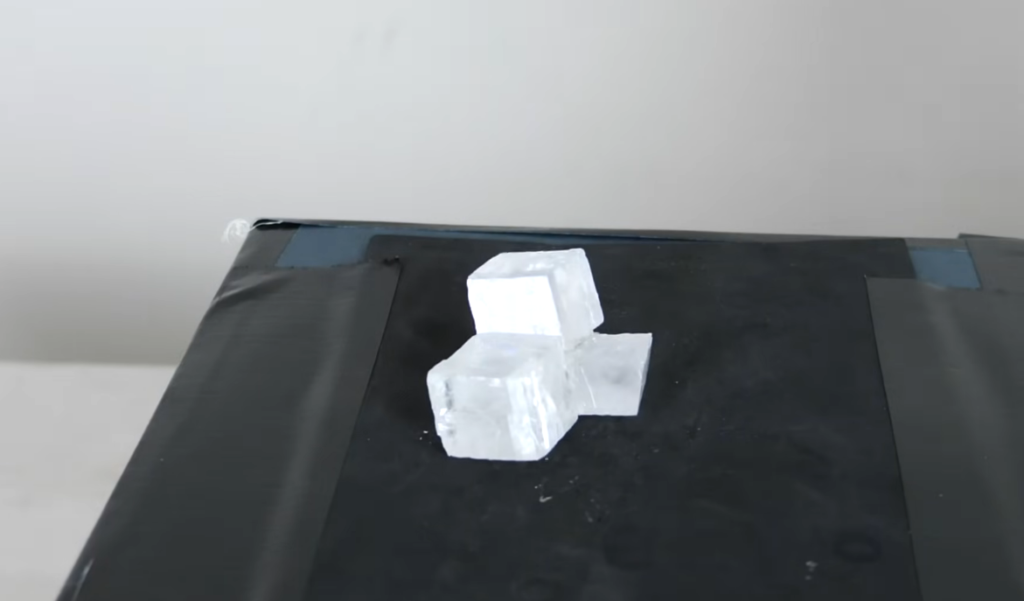
The way that this motion pattern exposes a new type of order is quite inventive. Time crystals are controlled by recurring activities, whereas traditional crystals are characterized by repeating spatial patterns. They could be compared to an endless loop of music or a metronome that never stops.
The ramifications extend beyond aesthetics. Presently, Smalyukh’s group is working with applications that seem both useful and futuristic. Embedding time crystal patterns into anti-counterfeiting materials is one concept. A signature dance would be triggered by the correct type of light, making it nearly impossible to replicate this authentication mechanism.
Additionally, they are creating “time barcodes” that store data in dynamic sequences rather than static patterns. Higher density and more resistance might be provided by such encoding, which would significantly improve data security. This type of shifting data signature is especially useful in settings where traditional patterns deteriorate or become unintelligible.
Zhao’s statement that “everything is born out of nothing” best summed up the phenomenon’s emergence during his reflections on the project. That sentiment is significant. Suddenly, without any apparent reason, a silent patch of liquid comes to life.
Additionally, these liquid time crystals were remarkably resilient. The pattern was unaffected by changes in temperature. The structure remained intact despite a slight prod. They continued to move. In experimental materials, where even little disturbances frequently cause collapse, this stability is extraordinary.
These liquid crystal patterns feel accessible, in contrast to time crystals created within cold atom traps or quantum computers. They are not concealed by thick shields or abstract simulations. They can be seen, felt, and replicated. The obstacles for other labs to expand on this work are greatly diminished by that change alone.
The discovery goes beyond merely hinting at new technology. It appeals to a deeper sense—that time may be more malleable and participatory than we previously thought. It’s like witnessing time act in ways we weren’t told it could when we watch these crystals loop, spin, and recombine.
This isn’t magic, though. It’s light-responsive molecules. Its structure emerges from the emptiness. The researchers demonstrated how basic components might disclose extraordinarily complex dynamics through purposeful testing.
The technology will probably find use in advanced materials research in the future. These sustained, low-energy movements could be useful in fields such as soft robotics, energy transfer, and even secure communication. The most significant change, though, may be philosophical: time is now seen as a characteristic that can fold, twist, and repeat—all without fading—rather than merely a measurement.
Just that concept is a very powerful catalyst for further invention. It’s like seeing a secret be slowly revealed by time as these liquid crystals move, long enough for us to start asking more insightful inquiries.
