

I spotted it while passing, like a smart ring or fitness tracker on a shelf. “Enhance Your Focus with Brain-Tech” was printed on the plain white, minimalist packaging. It was no longer a gimmick or prototype. It existed. The average consumer could now purchase brain-computer interfaces, which were previously exclusively associated with medical facilities and neuroscience labs.
The initial generation of consumer BCIs does not attempt to read your innermost thoughts. They are non-invasive, based on electroencephalography, and enhanced by artificial intelligence. They are made to identify brainwaves through the scalp. These stylish headbands and earphones subtly track patterns of concentration and exhaustion, converting brain activity into signals that may be used for productivity tools, games, or even apps that facilitate guided meditation.
They are exceptionally well-designed and set a new standard. It’s not that the technology is perfect, but rather that it functions well enough to be practical and integrates with your everyday life. That in and of itself is a change. Similar to how early cellphones were limited in their capabilities but nevertheless revolutionized the world, these gadgets hint at what’s to come.
The field of BCI research has made steady progress during the last ten years. Medical versions were the first. Researchers assisted patients who had lost the ability to speak or move by using their thoughts to operate robotic arms or cursors. The results, which showed how the human brain could interact with robots in very intimate ways when equipped with the appropriate sensors and software, were frequently astounding.
| Key Aspect | Description |
|---|---|
| What’s New | Brain‑computer interfaces (BCIs) becoming available to regular users |
| Types of BCIs | Non‑invasive wearables now on shelves; implantable devices still clinical |
| Leaders in Field | Neuralink, Synchron, Blackrock Neurotech advancing clinical implants |
| Consumer Uses | Wellness, gaming, AR/VR control, focus tracking |
| Medical Roots | BCIs first developed for paralysis, ALS, spinal injuries |
| Technical Challenges | Signal clarity, calibration, affordability |
| Social Implications | Communication, accessibility, ethical questions |
| Regulatory Landscape | FDA “Breakthrough Device” status accelerates some pathways |
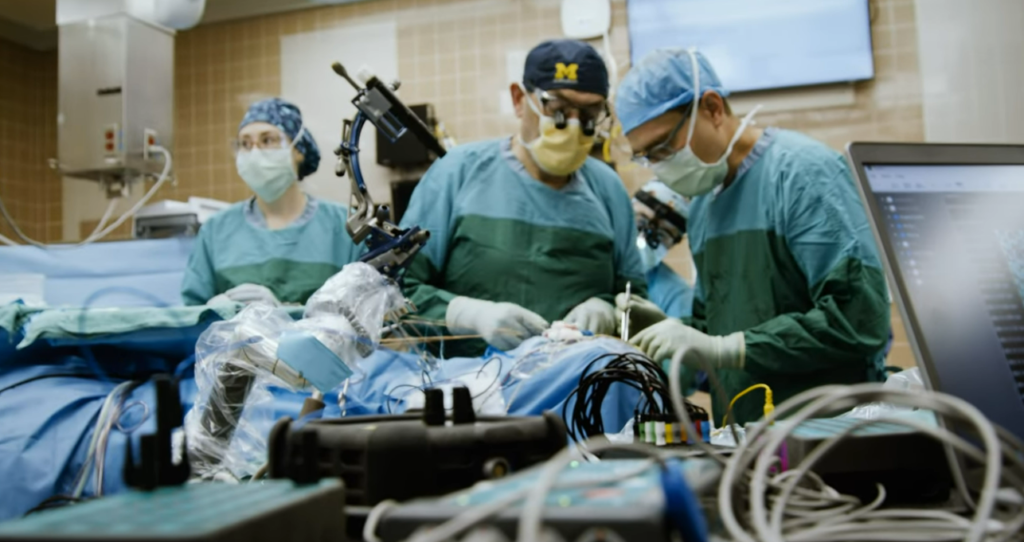
Those systems, however, needed clinical teams and were surgically established. Consumers are now more inclined toward simplicity and comfort. a gentle ring around your skull. Your ears are equipped with lightweight sensors. A smartphone software that directs your “neurofeedback session” with soothing white and blue tones In a world where health tracking is commonplace, the experience feels shockingly familiar—just another wearable.
The way these gadgets interpret neural impulses has been significantly enhanced by developers by utilizing machine learning. Even though the raw data is jumbled—blurred by head tilts, jaw strain, or blinking—the algorithms get more intelligent with each use. Over time, certain systems pick up on your unique habits and improve accuracy in a way that seems uncannily intimate.
Giants in the tech industry like Snap and Meta have indicated a sustained interest in this field through smart acquisitions. Their focus is experiential rather than just medical. Consider virtual reality games that adapt to the degree of brain activity. Applications for augmented reality that gradually fade when your thoughts begin to wander. Or tools for productivity that change according on whether you’re fading off or mentally locked in.
These are hardly unrealistic forecasts. They are currently being demoed. In one headset I tested, the playlist changed according to my level of concentrate, gradually switching from upbeat tunes to background noise when I became less focused. Although it wasn’t magic, it was remarkably responsive and strangely reassuring.
BCIs fit in well with voice assistants, facial recognition, and haptic feedback in the larger context of technological advancement. But something is different in this situation. The notion that a gadget, even in a passive manner, is listening to your brain opens the door to a closer connection with technology. It is modest yet profound—it crosses a boundary.
Needless to say, there are more and more ethical questions. Your brain data is owned by whom? What is the outcome of uploading it to cloud servers? Could focus-tracking headsets be used by businesses to track employee productivity? Perhaps in the future, advertisers will target depending on how the brain reacts to branding? These are situations we are deliberately moving toward, not dystopian anxieties.
A remarkably human tale is also being told, though. Daily structure and feedback can be provided by these tools to those with attention difficulties. They provide players new ways to control the game. They provide more effective ways for students or knowledge workers to complete challenging jobs. Consumer BCIs are promised to change the way we think about thinking because they are incredibly flexible and getting cheaper.
By combining cutting-edge materials and small computers, engineers have greatly decreased the bulk of previous designs. Some have the appearance of fashionable headphones. Some disguise themselves as sleep masks or caps. There is a sense of peaceful familiarity rather than sci-fi spectacle in the design language. This increases the likelihood that adoption will scale naturally.
As of late, regulatory bodies have adopted a cautiously hopeful approach. Review processes have accelerated since the FDA designated some BCI implants as Breakthrough Devices. Although consumer-grade headbands usually evade this kind of inspection, there is still some gray area about the crossover between wellness and medical functioning.
The problem for early-stage developers is more complex than simply deciphering signals. That’s what gives those signals purpose and joy. Instead of causing anxiety, a twitch in your prefrontal brain should pique your interest. Like a coach whispering rather than yelling, the best gadgets in this field transform brain feedback into soft prods.
I’m especially interested in the more subdued, non-heroic tale here because I once witnessed a friend relearn how to type with a BCI following a spinal injury. regular users, without a prescription or implant, can subtly enhance mood or focus. Bringing neural technology into everyday life and out of the clinic seems like the true revolution.
The line separating the human mind from the machine will continue to dissolve in the upcoming years as these systems grow more affordable and intuitive. Not very dramatic. Not overtly. Day by day, more and more of us are wearing headbands for study sessions or nightly meditations.
It’s both thrilling and sobering to think that you can now purchase a device that watches your thoughts, not your speech. In the future, technology will not only react to our actions but also predict our emotions, including human intention into the interface.
Currently, these early devices are still flawed and frequently need to be adjusted and patiently used. However, their being on shelves indicates a change in circumstances. No longer is the experiment restricted to hospitals or labs. In classrooms, offices, and bedrooms, it’s taking place each time someone chooses to investigate what it means to think a command rather than click one.
Disclaimer
Nothing published on Creative Learning Guild — including news articles, legal news, lawsuit summaries, settlement guides, legal analysis, financial commentary, expert opinion, educational content, or any other material — constitutes legal advice, financial advice, investment advice, or professional counsel of any kind. All content on this website is provided strictly for informational, educational, and news reporting purposes only. Consult your legal or financial advisor before taking any step.
