

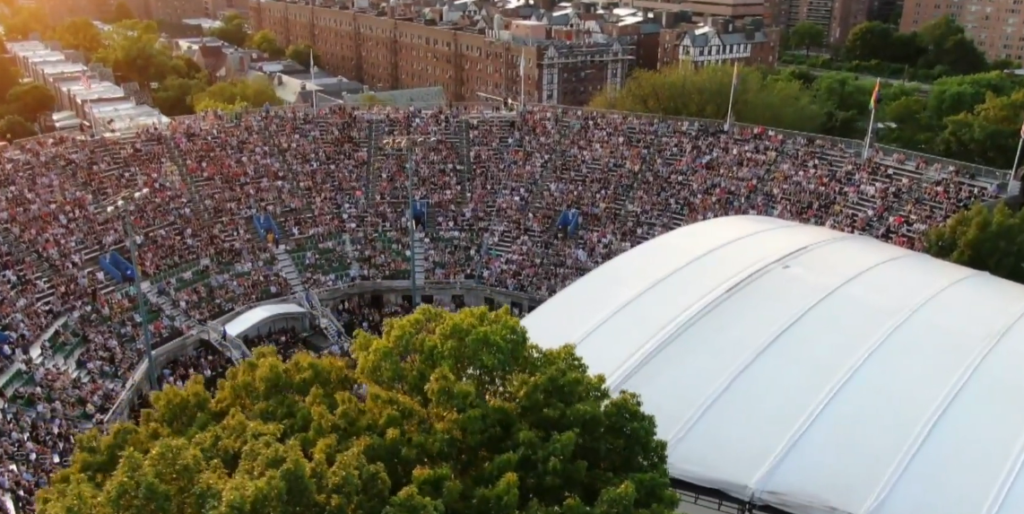
The disconnect strikes you almost instantly if you’re standing on any residential street in Forest Hills Gardens on a summer Saturday night. On one side is a peaceful, verdant community of Tudor-style houses that appear to have been transported by air from an English village to the heart of Queens. On the other hand, thousands of concertgoers are passing by, traveling through private streets in the direction of a stadium that has played host to artists such as Bob Dylan and the Beatles, as well as more recent acts that attract younger, boisterous, and less historically aware audiences. A $150,000 settlement from the City of New York to the Forest Hills Gardens Corporation was reached in March 2026 as a result of the collision, which had been going on for years. The NYPD also promised to speak with the neighborhood before the next show.
At least one chapter of what turned out to be one of the more peculiar property rights disputes in recent New York City history has been closed with the Forest Hills stadium lawsuit settlement, which was reached on March 16th and quietly signed without fanfare. The private streets surrounding the stadium are owned by the Forest Hills Gardens Corporation, or FHGC. Not on the pavements. Not the blocks around it. The streets themselves—an arrangement that dates back to Forest Hills Gardens’ early planned development, which the city allegedly chose to disregard for years whenever a major concert came around.
The then-current FHGC board filed the initial lawsuit in October 2025, claiming that the NYPD had effectively seized private property on over thirty concert days during the previous summer. Without FHGC’s permission, officers blocked off the corporation’s streets, put up barricades on privately owned property, and directed thousands of concertgoers through the area. Strong language, but not without legal reasoning, was used in the lawsuit to describe it as an unconstitutional taking. FHGC’s attorney, Katherine Rosenfeld, contended that the city had been doing this for years, even after admitting that the streets were privately owned, essentially putting the interests of a commercial concert operation ahead of a property owner’s constitutional rights.
Key Information Table
| Detail | Information |
|---|---|
| Venue | Forest Hills Stadium, Forest Hills, Queens, New York City |
| Plaintiff | Forest Hills Gardens Corporation (FHGC) |
| Defendant | City of New York / NYPD (112th Precinct) |
| Lawsuit Filed | October 2025 (by previous FHGC board) |
| Settlement Reached | March 16, 2026 |
| Settlement Amount | $150,000 (paid by the City of New York) |
| Settlement Payment Timeline | Within 90 days, by mailed check |
| Legal Basis of Lawsuit | Alleged unconstitutional taking of private property; NYPD closure of private streets on 30+ concert days |
| FHGC’s Attorney | Katherine Rosenfeld, Emery Celli Brinckerhoff Abady Ward & Maazel LLP |
| New FHGC Board Elected | End of 2025; took office January 2026 |
| Key Board Member | Jeff Mitchell (trial lawyer) |
| NYPD Obligations Under Settlement | 112th Precinct captain must consult FHGC board on security arrangements, street closures, resident access, rideshare logistics |
| Settlement Disclaimer | Does not constitute admission of unlawful conduct by the city or its employees |
| Previous Legal Costs | Prior FHGC board spent over $1 million across three-year legal battle |
| 2026 Concert Season Start | Expected June 6, 2026 |
| Supporting Councilmember | Lynn Schulman |
In retrospect, the issue was organizational. The board that filed the lawsuit was a combative one, and it wasn’t the only one fighting; during the previous board’s three years in office, there had reportedly been more than a million dollars spent on legal battles, numerous lawsuits filed over the years, and noise complaints dating back further. That’s a substantial amount for a community corporation to burn through, and it seems like at some point locals started to question whether the organization’s goal had shifted from defending the neighborhood to just fighting the stadium.
Elections have repercussions. A new group of FHGC board members were elected at the end of 2025, and this change was swift and intentional. Deescalation, not surrender, was the platform of the incoming board’s campaign. In December, trial attorney Jeff Mitchell, a board member who was likely familiar with the cost-benefit analysis of protracted litigation, told reporters that the objective was straightforward: lower tensions, find points of agreement, and engage in negotiations. A settlement was in writing by March.
It’s interesting to consider the $150,000 settlement amount. The agreement makes it clear that the city does not acknowledge any wrongdoing, and it neither closes the stadium nor significantly reduces the number of concerts it hosts. It is still anticipated that summer 2026 will begin on June 6. The settlement does purchase a formal mechanism for the community to have a seat at the table prior to concert nights, something the previous board was never able to achieve. In accordance with the agreement, the 112th Precinct captain must now confer with the president of the FHGC board regarding planned security measures, such as the scheduling of street closures, resident access to their own streets, and the locations of rideshare pickups and drop-offs.
We should take a moment to consider that final point. The feeling of being locked out of their own neighborhood while cars idled and people milled around was one of the most enduring annoyances for Forest Hills Gardens residents over the years, in addition to the noise. On a Friday night, people attempting to return home discover that their street has been blocked without prior notice and that there is no obvious way to get through. Although the settlement does not completely rule out that possibility, it does mandate that the NYPD make an effort to address it beforehand. The agreement makes it clear that the precinct has the final say on all safety decisions, but the requirement for consultation is a significant improvement over the current situation.
Whether $150,000 is sufficient compensation for what the lawsuit claimed were years of repeated property incursions is still up for debate. Opponents of the settlement within the community may legitimately contend that it doesn’t—that the city got off relatively cheaply and that nothing structurally stops the same pattern from happening again in the absence of an admission of liability. The worry is not irrational. The strength of consultation requirements depends on both parties’ willingness to uphold them in good faith.
Observing this from the outside, the way it ended is both commonplace and subtly instructive. After years of costly, noisy, and legitimate constitutional complaints, a neighborhood gained momentum when a new board chose to start talking instead of fighting. There will be concerts. They do it every time. However, before the barricades are erected this summer, the captain of the 112th Precinct will, at least in theory, speak with someone from the FHGC. This could be more valuable to Forest Hills Gardens than the check.
Disclaimer
Nothing published on Creative Learning Guild — including news articles, legal news, lawsuit summaries, settlement guides, legal analysis, financial commentary, expert opinion, educational content, or any other material — constitutes legal advice, financial advice, investment advice, or professional counsel of any kind. All content on this website is provided strictly for informational, educational, and news reporting purposes only. Consult your legal or financial advisor before taking any step.
