

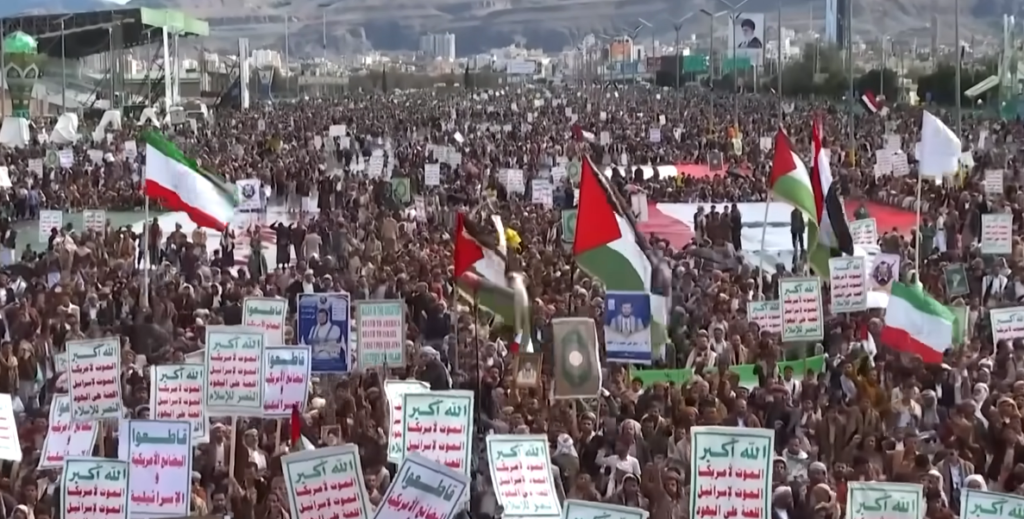
Sana’a’s announcement on Saturday was not shocking, but it carried a lot of weight. The Houthi movement in Yemen, which controls a large portion of the country’s north and northwest from the capital they took in 2014, acknowledged that they had fired a barrage of ballistic missiles at what they claimed to be strategic Israeli military locations. A second wave arrived a few hours later. Both were intercepted, according to the Israeli military. No casualties. However, the message was unambiguous and purposeful: the group that had been observing from the sidelines for a month had made the decision to intervene.
For weeks, the Houthis had been hinting at this. They were “on the trigger for direct military intervention” if any nation joined the U.S.-Israeli campaign against Iran or if the Red Sea was used for operations against Tehran, according to a formal warning issued by their military spokesman. Israel’s growing operations in southern Lebanon against Hezbollah, another member of what the Houthis refer to as the axis of resistance, provided the group with its own justification when neither requirement was formally met. Citing “resistance fronts in Palestine, Lebanon, Iraq, and Iran,” the statement promising more attacks provides insight into how Sana’a is framing and experiencing this conflict.
| Category | Details |
|---|---|
| Group Name | Houthi Movement (Ansar Allah) |
| Based In | Sanaa, Yemen (controls northern/northwestern Yemen) |
| Ideology | Zaydi Shia Islamism; part of Iran’s “Axis of Resistance” |
| Backed By | Islamic Republic of Iran |
| Date of Entry Into Iran War | March 29, 2026 (Day 29 of U.S.-Israel war on Iran) |
| Attack Type | Ballistic missiles and drones fired at Israel |
| Number of Attacks (Mar 29) | Two separate waves within 24 hours |
| Israeli Response | Both missile salvos intercepted; no casualties reported |
| Houthi Statement | Attacks will continue until “aggression against all resistance fronts ceases” |
| Key Waterway Controlled | Bab al-Mandab Strait (access to Red Sea from Indian Ocean) |
| Red Sea History | ~200 attacks on ships Nov 2023 – early 2025; forced shipping rerouting |
| Global Trade at Risk | ~15% of global seaborne trade passes through Red Sea |
| Current Context | Iran has already blocked Strait of Hormuz (~20% of global oil) |
| Conflict Death Toll (1 month) | Iran: ~1,937; Lebanon: ~1,189; Iraq: ~99; Israel: ~23 civilians + 4 soldiers |
| Reference Links | BBC Houthis Enter War | Al Jazeera — Houthis Open New Front |
It’s important to comprehend the strategic question, which currently lies at the nexus of geography and economics. About 20% of the world’s oil typically passes through the Strait of Hormuz, which is a narrow passage between the Persian Gulf and the Gulf of Oman that Iran has already effectively closed. Brent crude has already surpassed $115 per barrel as a result of that closure, and governments all over the world have released emergency stockpiles. In response, Saudi Arabia rerouted oil through its East-West pipeline to the port of Yanbu in the Red Sea, sending crude south past the coast of Yemen and toward international markets. The Bab al-Mandab Strait, a 20-mile-wide chokepoint between Yemen and the Horn of Africa that the Houthis are uniquely positioned to disrupt, is directly traversed by that route. The Sana’a correspondent for Al Jazeera put it simply: Bab al-Mandab is the group’s “ace.” Oil traders, shipping firms, and energy ministers throughout Asia and Europe are genuinely concerned about whether they will decide to play it to the fullest.
Despite its flaws, this history is instructive. In support of Hamas, the Houthis launched nearly 200 attacks on commercial ships in the Red Sea between November 2023 and early 2025, damaging over 30 vessels and forcing major shipping companies to completely abandon the route and reroute around Africa’s southern tip. This increased fuel prices, lengthened travel times by weeks, and disrupted international trade flows worth about $1 trillion a year. In response, the United States and the United Kingdom launched airstrikes against Houthi targets in Yemen. The attacks continued unabated. Eventually, it slowed them down, but the episode’s lesson is that the Houthis endure punishment with a patience that defies traditional military reasoning.
Observing the current course of events, it seems as though the geography of the conflict has been preparing for this point for weeks. The Red Sea has become the only practical route for delivering Gulf energy to international markets, with the Hormuz closure focusing attention on oil and Saudi diversion routes passing south of Yemen. The Houthis are aware of this. Two of the most important maritime chokepoints in the world could be closed simultaneously by coordinated or semi-coordinated actors due to their ability to threaten that corridor and Iran’s closure of Hormuz. This scenario has few historical precedents. The current disruptions to international trade are the worst in eight decades, according to Ngozi Okonjo-Iweala of the WTO. On top of Hormuz, a persistent Bab al-Mandab closure would completely change that assessment.
It’s still unclear if the Houthi entry is mainly symbolic, such as a political statement, a few intercepted missile launches, or a declaration of solidarity, or if it’s the start of something more serious and long-lasting. The group should exercise caution. Twelve years of terrible civil war and dire humanitarian conditions have already befallen their own people in Yemen. There is significant risk involved in escalating a conflict with the United States, which has previously attacked Houthi targets and sent more Marines and paratroopers to the area. Sana’a is currently performing a calculation, and it’s unclear which way it will go. However, the first missiles have been fired. Within hours, the second wave arrived. Additionally, a group that has previously demonstrated that it will accept consequences rather than back down has now formally entered the most significant regional conflict in a generation.
