

At first glance, driving through the Sierra Nevada on a clear morning appears to be how mountain forests should appear. The air has a certain sharpness of pine resin and elevation, tall conifers press against the hillsides, and the scale of everything—the trees, the ridgelines, the silence—has a permanence that seems almost geological. It appears to be healthy. enduring. Just the way it ought to be.
Examining vegetation data dating back to the 1930s, researchers have discovered that much of what you see isn’t exactly what it seems. The trees are living things. However, the climate beneath about 20% of the conifers in the Sierra Nevada, such as sugar pine, Douglas fir, and ponderosa pine, has changed to the point where they are unable to reproduce, which is a basic requirement for forests. The seedlings don’t make it. The saplings fail to establish themselves. The mature trees are still standing, photosynthesizing, and providing shade, but they are not producing any offspring. The idea is known as ecological inertia, according to ecologist Avery Hill, who worked on the Stanford study that gave this phenomenon its name. The trees continue to exist because the conditions that once supported them haven’t completely unwound. These regions were dubbed “zombie forests” by Hill and his associates. the lifeless.
Zombie Forests: Key Facts & Reference
| Field | Details |
|---|---|
| Term | “Zombie Forests” — coined by researchers studying vegetation-climate mismatch |
| Lead Researcher | Avery Hill, graduate student at Stanford University (now postdoctoral researcher, California Academy of Sciences) |
| Research Institution | Stanford Woods Institute for the Environment |
| Primary Location Studied | Sierra Nevada mountain range, California |
| Key Species Affected | Ponderosa pine, Douglas fir, sugar pine, giant sequoia |
| Definition | Trees technically alive but no longer climatically compatible with their environment; unable to reproduce |
| Current Scale (Sierra Nevada) | ~20% of all Sierra Nevada conifers are mismatched with their climate |
| Projected Scale (77-Year Forecast) | Could double — even in optimistic climate scenarios |
| Upslope Movement of Conifers (Since 1930s) | ~112 feet uphill |
| Upslope Movement of Suitable Climate | ~600 feet higher — a gap conifers cannot close |
| Temperature Rise (Sierra Nevada Since 1930s) | Just over 1°C |
| Key Concept | “Ecological Inertia” — trees persist due to the momentum of past conditions |
| Replacement Vegetation | Chaparral shrubland, scrub — not new forest |
| Wildfire Connection | Stressed zombie forests create high-intensity fire fuel; megafires prevent seedling regrowth |
| Compounding Factor | A century of fire suppression has packed forest floors with combustible material |
| Data Baseline | Stanford team analyzed vegetation data dating back to the 1930s |
| Management Tools | Prescribed burns, climate-niche modeling, community science platforms like iNaturalist |
| Key Reference — Ideastream/NPR | Climate is changing too quickly for the Sierra Nevada’s zombie forests |
| Key Reference — Stanford Woods Institute | Zombie Forests — Stanford Woods Institute for the Environment |
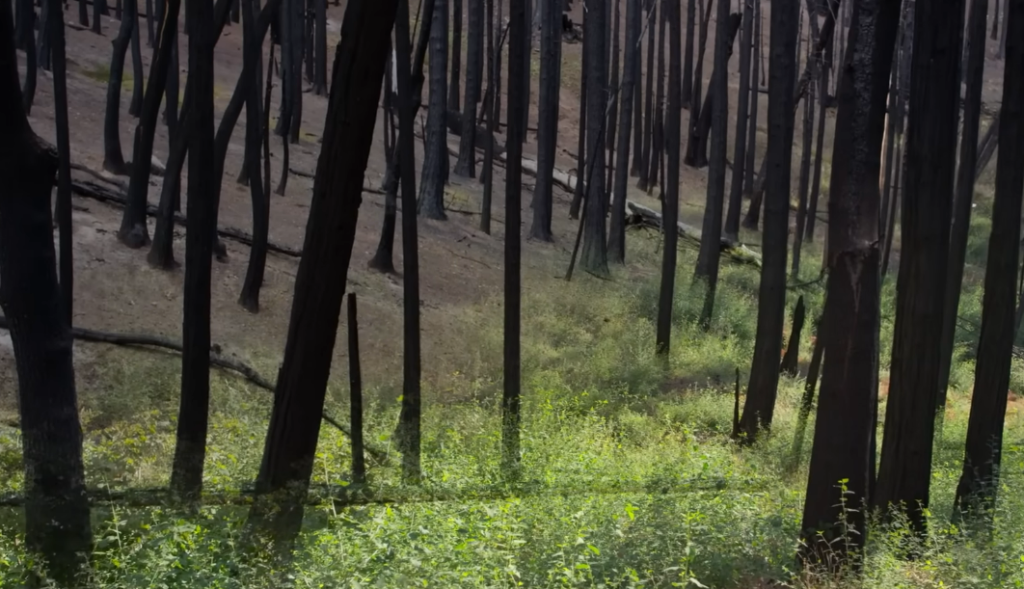
This situation can be explained by a straightforward and depressing gap. The average elevation of Sierra Nevada conifers has increased by roughly 112 feet since the 1930s, as trees at lower, warmer elevations have perished while those higher up, where the air remains cooler, have survived. It sounds like a significant uphill migration. However, during the same time period, conifer-friendly climate conditions have shifted about 600 feet higher. The trees are shifting. The climate is changing more quickly. Technically speaking, zombie forests exist in that gap—nearly 500 feet of ecological mismatch—because they are unable to persist over time.
Mature conifers are incredibly resilient organisms, which makes this difficult to see from a car window or a hiking trail. A large ponderosa pine can withstand years of stress, drought, and slight temperature increases that would kill a younger tree. In its coverage of this study, the Sierra Club pointed out that a large conifer cannot be killed by climate stress alone. A disturbance is what you need. A wildfire. a prolonged drought that exceeds what even an old tree can withstand. This is where the narrative takes a darker turn: zombie forests are stressed forests by nature. Stressed trees are more vulnerable to disease, bark beetle infestations, and the kind of devastating wildfire that scorches the soil to the point where replanting is impossible.
Parts of this have already occurred in California. The burned trees in places like Eldorado National Forest, which experienced a drought and a wildfire in quick succession, have not been replaced by new conifers. Chaparral, or shrubland better suited to the hotter, drier climate that now characterizes these elevations, is reappearing. Some of what we’ve been referring to as wildfire recovery may actually be transition rather than recovery. The centuries-old forest is not returning. It’s being replaced by something else.
Once you realize what zombie forests are, you get a certain feeling. When you reflect on all the hikes you’ve done, the drives you’ve taken through mountain passes, and the times you’ve seen a conifer forest, it seems like proof that some things have not changed. It’s a slight change in the way you interpret a landscape. These trees may be more ancient than any human being, having survived decades of drought, fire, and snowpack, and they may continue to stand for decades to come. However, the ecosystem of which they were a part, which both supported and would have supplanted them, is already operating in a different way. There is a forest. The forest’s future is not.
Building on Hill’s initial mapping work, the Stanford research team led by Chris Field is attempting to make this understanding useful. The areas that are most at odds with their current climate and most likely to undergo a transition within the next generation can be identified with a fair degree of specificity using the maps they have created. In order to lessen the catastrophic fire risk that these stressed forests carry, land managers can use this information to determine where to concentrate prescribed burning and where to take into account what researchers refer to as assisted migration, which involves actively moving tree species upslope to areas where conditions are now more suitable for them. It’s a seemingly pointless intervention, but in some of these situations, it might be the only practical choice.
The amount of conifer forest in the Sierra Nevada that can be preserved in any meaningful ecological sense is still unknown, as is whether the lower elevations’ trajectory toward shrubland is just the way things are going regardless of what managers do. On that point, the research does not provide false solace. The 20% figure represents the current situation as determined by data. Climate models, which have historically tended to be conservative rather than alarmist, are the source of the doubling prediction within 77 years. In all honesty, zombie forests are not a sign of impending danger. They are records of something that is already happening, visible on a Californian hillside, tall, green, and silently past the point of no return.
